
AI-Assisted Model Card & Claim Consistency Validator
A specialized tool that verifies the internal consistency of computational claims in academic manuscripts by cross-referencing stated model architectures, hyperparameters, and reported metrics against standardized, public model card databases.
Can AI catch mismatched model specs and metrics in an ML paper before submission?
Yes: automated tools can cross-check a manuscript's stated model architecture, hyperparameters, and reported metrics against structured, public model card databases like the HuggingFace Hub. A validation agent extracts parameters from the methodology text (e.g., '12 layers, 768 dim'), queries the reference database to confirm the architecture is valid, and checks whether reported metrics align with known benchmarks for that configuration. It outputs a Metadata Consistency Report flagging contradictions for manual reconciliation, intended for ML researchers preparing journal or preprint submissions.
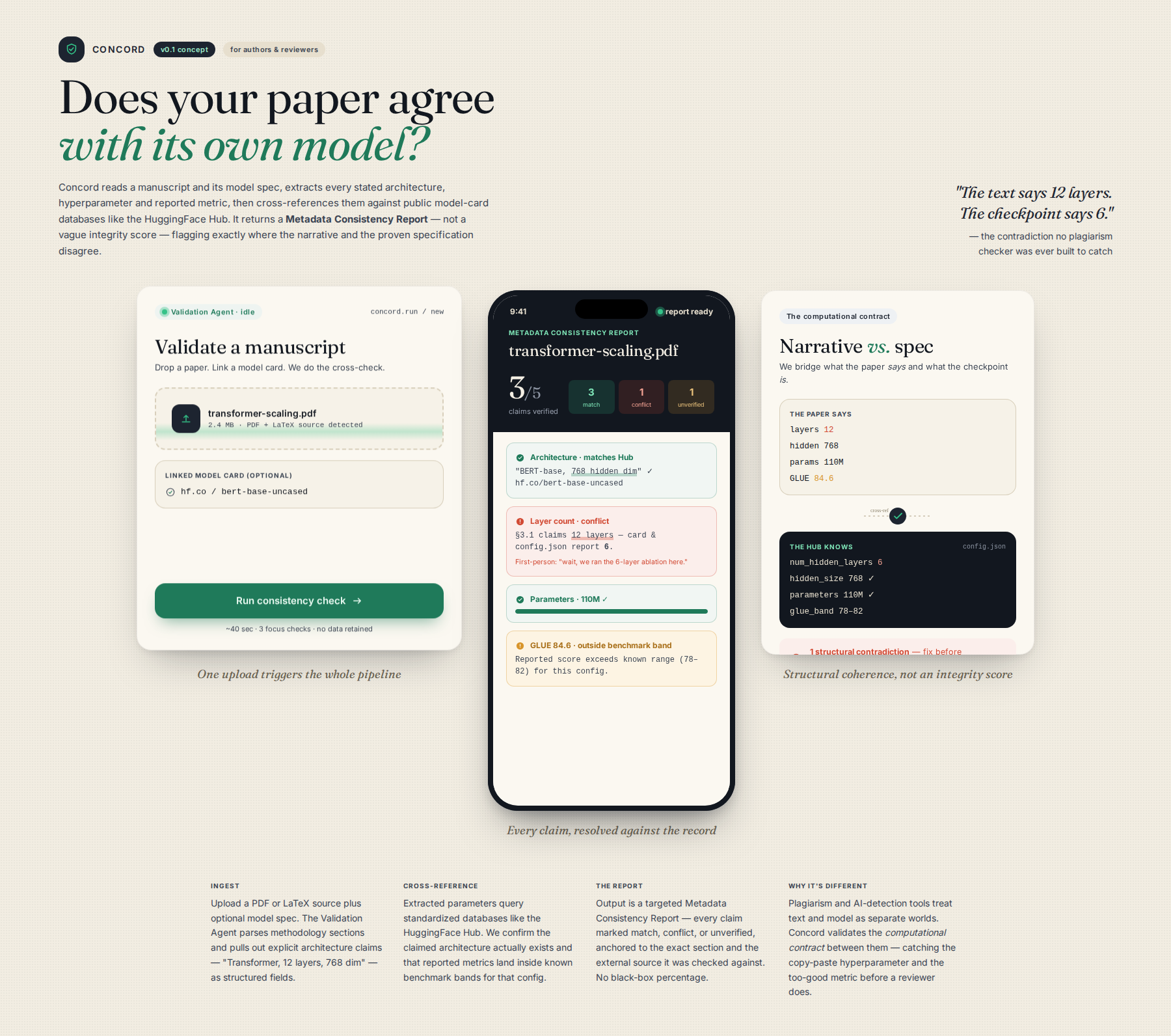
Process flow
Who it's for
Computational researchers and machine learning practitioners submitting technical papers to journals/preprints.
Why they need it
The primary risk in modern ML research is the ability to cherry-pick or misrepresent model specifications (e.g., claiming a specific layer count or dimension) to achieve desired results. This is a specific, measurable point of failure that AI can mask or introduce inconsistencies into, leading to flawed science.
What it is
An automated agent service that ingests a manuscript and its associated model specification text. It performs targeted validation checks by comparing textual claims against external, structured knowledge bases, generating a 'Metadata Consistency Report' rather than a general 'Integrity Score'.
How it works
- User uploads manuscript (PDF/LaTeX) and optionally provides a linked model card reference (e.g., HuggingFace ID).
- The system uses a specialized 'Validation Agent' framework.
- Focus Check 1 (Parameter Validation): It scans methodology sections for explicit model parameters (e.g., 'Transformer with 12 layers, 768 dim').
- Focus Check 2 (Cross-Reference): It queries standardized databases (like HuggingFace's structure) using the extracted parameters to confirm if the claimed architecture is valid and if the reported metrics align with known benchmarks for that architecture.
- The system outputs a targeted 'Consistency Report', flagging sections where the text claims parameters or results that contradict established metadata or known standards.
Differentiation
Unlike general plagiarism or AI detection tools, this service focuses purely on structural scientific coherence. It bridges the gap between the narrative (the paper) and the proven model specification. Existing tools treat these components separately; we integrate them for cross-validation. Gap: A single platform for validating the computational contract of a scientific paper by cross-referencing text claims against structured, public model metadata (e.g., HuggingFace Hub structure).
Implementation sketch
- Develop the core NLP pipeline to reliably extract structured parameters (e.g., {layers: 12, dim: 768}) from unstructured text sections.
- Build the 'Validation Agent' to interface with a limited, public API (e.g., HuggingFace Model Hub API) to check parameter existence and basic structural validity.
- Prototype the reporting UI to display mismatches clearly, suggesting 'Metadata Reconciliation Required' rather than just 'Suspicious'.
First step: Identify the top 3 most commonly cited, open-source ML model architectures (e.g., BERT, ViT, specific GAN variants) and map their key, extractable metadata fields (e.g., input size, number of heads, specific layer counts) into a simple JSON schema for initial testing.
Remaining risks
- The 'Metadata Consistency' check is limited to publicly available model card data. If a researcher uses a novel, proprietary, or highly customized architecture that has not been indexed or standardized in public hubs (like HuggingFace), the tool will generate a false negative (i.e., fail to flag a real inconsistency because it can't find a match). — The tool must be explicitly marketed and designed to flag 'Unverifiable/Non-Standard Architecture' as a warning rather than a failure, guiding the user to manually document the missing metadata or to provide a supplementary, structured specification file.
- The NLP extraction of structured parameters (e.g., extracting '12 layers, 768 dim' from varied prose) is brittle. Minor variations in sentence structure, use of abbreviations, or surrounding text can cause the extraction agent to fail or misinterpret the intended numerical values, leading to systemic false negatives. — Implement a confidence scoring layer on the NLP extraction. If the confidence score for extracting a critical parameter falls below a threshold (e.g., 85%), the system should halt the validation process for that parameter and prompt the user to manually confirm the extracted value, rather than proceeding with a potentially incorrect check.
- The core value proposition remains academic credibility, which is inherently subjective. While the tool validates metadata, it cannot validate the scientific insight or the correctness of the experimental setup if the underlying assumptions are flawed. Researchers may perceive this as a superficial check, leading to low adoption. — Position the tool not as a 'Truth Verifier,' but as a 'Structural Compliance Checker' or 'Metadata Audit Layer.' The marketing must emphasize that it enforces adherence to stated standards, not scientific truth itself. Collaborate with journal/conference formatting guides to make compliance mandatory.
Watch for: If leading ML research groups or major academic journals begin integrating this functionality directly into their submission portals without requiring a separate, paid tool, it signals that the market has internalized the need, but also that the concept's value is being commoditized or absorbed by incumbents. Kill criterion: If the primary APIs or structured knowledge bases required for cross-validation (e.g., HuggingFace Hub structure, common ML benchmark schemas) undergo a fundamental, unannounced change that breaks the extraction or querying logic, requiring a complete, non-trivial re-engineering effort that cannot be solved by minor patches.