
Architectural Deep Dive AI Study Group
A structured, multi-agent platform for architects to conduct deep, critical analyses of residential design, moving beyond simple visual inspiration.
How do I move beyond shallow architectural inspiration online?
An AI-powered community platform generates deep, multi-perspective critique reports for architectural images using specialized agents covering historical, structural, and sustainability aspects. Rather than unstructured debate, users perform structured curation by selecting the most impactful agent finding and justifying their choice. This bridges visual inspiration and critical analysis, using AI scaffolding to elevate casual engagement into structured learning.
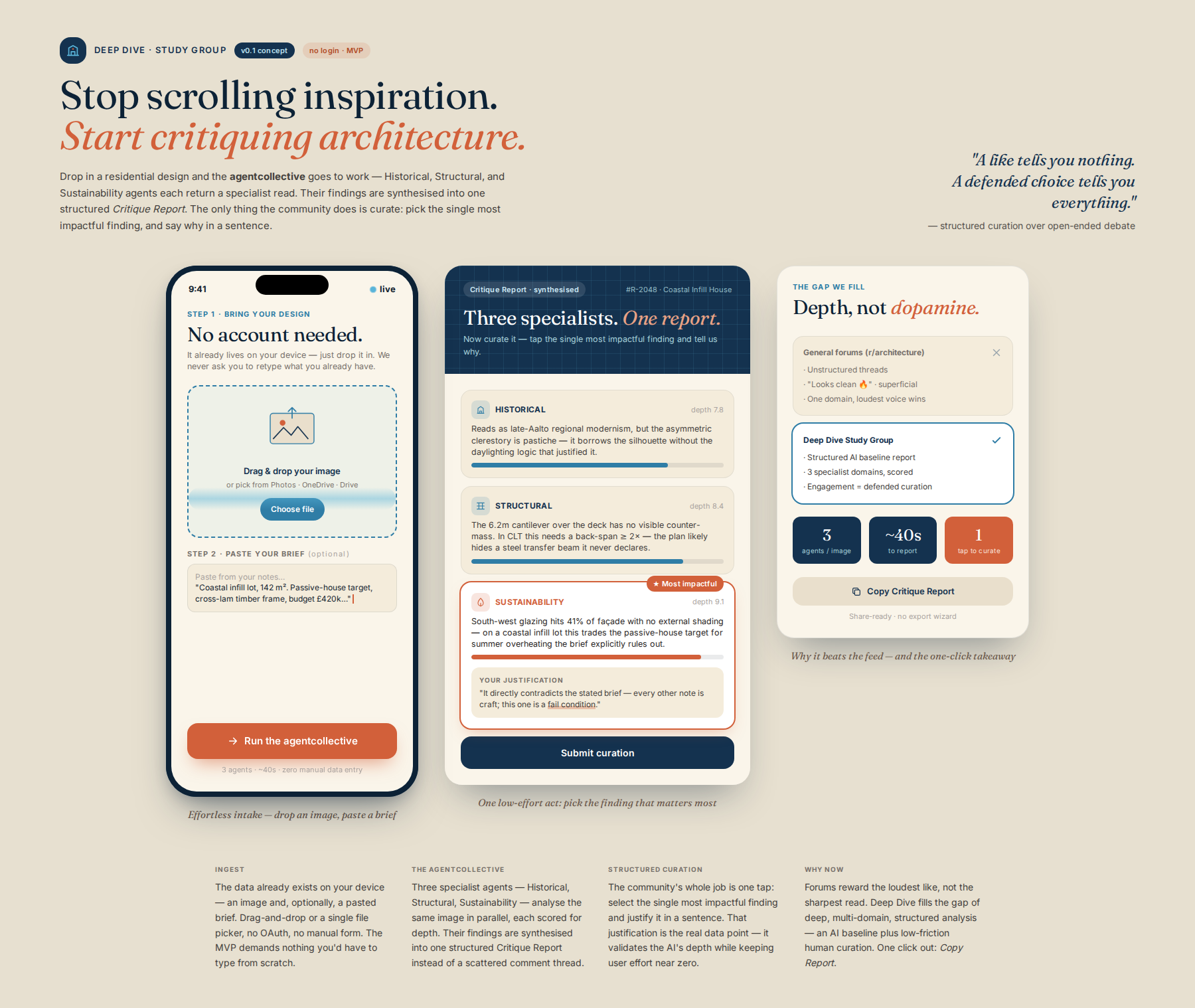
Process flow
Who it's for
Architects, Design Enthusiasts, and Students seeking structured learning.
Why they need it
Users are frustrated because existing content platforms offer insufficient or superficial discussion surrounding beautiful residential architecture, leading to low engagement depth. (Cited: p1)
What it is
A specialized, AI-powered community platform that facilitates structured critical analysis of architectural images, going beyond simple likes/comments.
How it works
Users upload a residential design image. The system triggers the 'agentcollective' to run specialized agents (Historical, Structural, Sustainability). The results are synthesized into a structured 'Critique Report.' The community's primary, low-friction interaction is to curate the AI's findings by selecting the single most impactful agent output and providing a brief justification for that selection. This validates the AI's depth while keeping user effort minimal.
Differentiation
Unlike general forums like Reddit, which are unstructured and suffer from superficial engagement, this platform fills the GAP of 'Deep, Multi-Domain, Structured Analysis' by using the AI to generate a structured baseline report, and then channeling community engagement into a low-effort act of structured curation (selecting the single most impactful finding) rather than open-ended debate.
Implementation sketch
- Develop a front-end interface allowing image upload and basic metadata tagging (e.g., 'Style: Modernist', 'Location: Pacific Northwest').
- Integrate a specialized pipeline using 'agentcollective' to run 3-5 specific, pre-defined analysis agents (e.g., Style Analysis, Materiality Check, Contextual Fit).
- Build a 'Critique Report' view. The core interaction must be a 'Curation Widget' requiring the user to click one of the agent findings and write a 1-2 sentence justification for why it was the most valuable insight.
First step: Wireframe the 'Curation Widget' flow: Design the UI where the user sees the 3 agent outputs side-by-side, with a single, prominent 'Select Most Impactful Finding' button that triggers a mandatory, focused text input for justification.
Remaining risks
- The AI's analysis, while deep, might be perceived as overly academic or dry, failing to capture the emotional resonance and aesthetic appreciation that drives casual engagement with beautiful architecture. — Incorporate a secondary, low-effort 'Aesthetic Resonance' scoring mechanism alongside the technical critique, allowing users to rate the image's beauty/impact on a separate scale (e.g., 'Emotional Impact Score: 8/10') without disrupting the core technical critique flow.
- The 'Curation Widget' might become a repetitive, low-stakes game of 'picking the best-sounding answer,' leading to content that is technically structured but emotionally hollow or performative. — Introduce a 'Challenge/Counter-Curator' role where a subsequent user can challenge the selection itself (e.g., 'I disagree that Sustainability is the most impactful; the structural choice fundamentally limits the potential use'). This adds a necessary layer of low-stakes conflict to validate the curation.
- The platform's success relies entirely on the quality and diversity of the initial image uploads. If the initial pool of images is niche, uninteresting, or poorly tagged, the entire system stalls due to lack of input data. — Develop an initial 'Curated Showcase' mode populated by high-quality, pre-vetted, public domain architectural images (e.g., famous museum pieces) to bootstrap initial user engagement and demonstrate the platform's capability before relying on user-generated content.
Watch for: A high volume of users ignoring the 'Curation Widget' and instead posting general, unstructured comments about the image's beauty, indicating the core structural mechanism is a barrier rather than an aid. Kill criterion: If the first 100 users fail to engage with the Curation Widget, or if the average justification length drops below 5 words, indicating that the structure is perceived as mandatory homework rather than helpful scaffolding.
Sources the council used
Real-world evidence that grounded this idea — judge it for yourself.