
Interoperable Ontology Layer for Simulation-Constrained Hypothesis Generation
A platform that standardizes the translation layer between high-level, cross-disciplinary scientific concepts and the concrete, machine-readable input parameters required by established, proprietary simulation toolkits.
How do I convert a general research idea into the exact parameter files GROMACS or Rosetta need to run it?
A standardized ontology layer can translate high-level concepts like 'membrane dynamics' or 'electrostatic interaction' into the specific machine-readable parameters each simulator requires. It works by mapping user-input concepts through a curated knowledge graph to generate a 'Simulation Blueprint'—a validated JSON/YAML package specifying force fields, boundary conditions, and time steps for tools like GROMACS, LAMMPS, or Rosetta simultaneously. This targets computational chemists and biophysicists who lose time manually translating theory into proprietary simulator inputs rather than testing hypotheses.
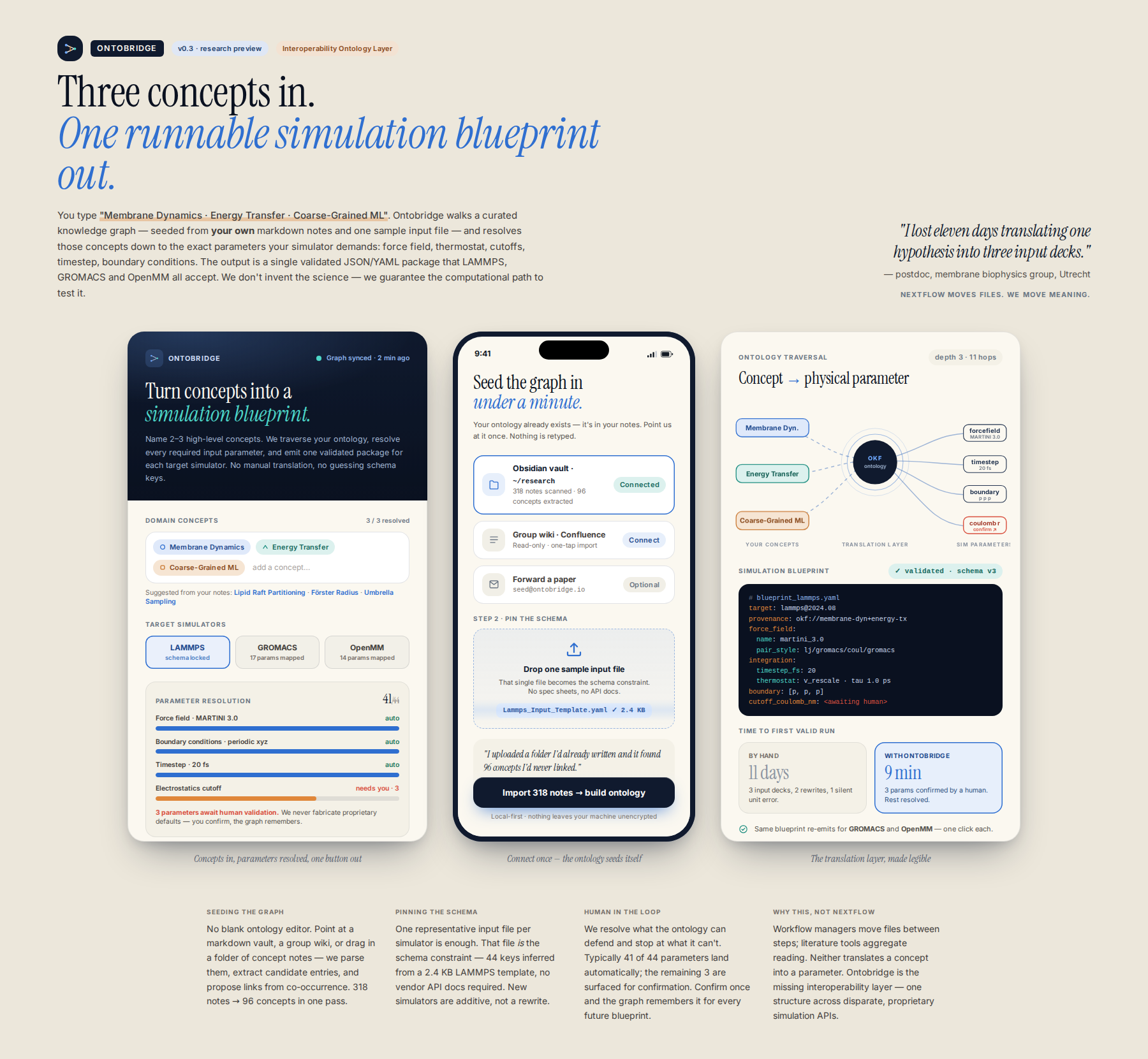
Process flow
Who it's for
Computational chemists, biophysicists, and research groups needing to bridge theoretical concepts to executable simulation pipelines.
Why they need it
The critical bottleneck in modern science is not generating novel ideas, but integrating those ideas into the disparate, proprietary data standards and APIs of existing simulation software (e.g., GROMACS, Rosetta). We solve the 'last mile' problem of scientific computation: data interoperability.
What it is
A standardized ontology layer that accepts high-level concepts and outputs a structured, machine-readable package containing the precise, required input parameters (e.g., force field definitions, boundary conditions, simulation time steps) for multiple target simulators.
How it works
- User inputs 2-3 high-level domain concepts (e.g., 'Membrane Dynamics', 'Machine Learning', 'Energy Transfer').
- The system queries a curated knowledge graph/ontology layer, which maps conceptual relationships to known physical parameters.
- Instead of running agents to debate a hypothesis, the system generates a structured test case by traversing the ontology to find the required input parameters for target simulators.
- The output is a 'Simulation Blueprint'—a single, validated JSON/YAML package that can be directly consumed by multiple specified simulation toolkits, eliminating manual parameter translation.
Differentiation
Existing tools (e.g., literature search, basic workflow managers like Nextflow) manage workflow or data aggregation. Our differentiation is the Standardized Interoperability Ontology Layer. We do not generate the science; we guarantee the computational path to test the science by providing a unified, standardized input structure across disparate, proprietary simulation APIs. The gap is the lack of a universal translation layer for simulation parameters.
Implementation sketch
- Identify the top 3 most common, yet disparate, simulation toolkits in the target niche (e.g., GROMACS, LAMMPS, Rosetta).
- Manually map the input requirements for one core concept (e.g., 'Electrostatic Interaction') across these 3 toolkits to build the initial structure of the Ontology Layer.
- Develop a proof-of-concept parser that ingests a simple conceptual input and attempts to output the structured parameter dictionary for the 3 selected tools, failing gracefully if a required parameter is missing.
First step: Spend 4 hours researching the documentation for GROMACS and LAMMPS, specifically documenting the required input files (.mdp, .mdp, etc.) for a basic protein-water interaction simulation. The goal is to create a comparative cheat sheet of required parameters for the first target simulator.
Remaining risks
- Ontology Coverage and Maintenance Burden: The core value relies on mapping concepts to parameters across multiple proprietary toolkits. The initial manual mapping is a massive, ongoing maintenance burden. If the target niche evolves or a key simulator updates its API, the entire 'Standardized Interoperability Ontology Layer' breaks and requires expensive, manual re-engineering. — Focus initial efforts on building a highly modular, version-controlled ontology layer that treats each simulator's input structure as a distinct, replaceable 'Adapter Module.' Prioritize building a robust versioning and dependency tracking system around the ontology, rather than trying to make the ontology itself infinitely flexible.
- Conceptual Mapping Ambiguity: The ontology layer assumes a clean, one-to-one mapping between a high-level concept (e.g., 'Electrostatic Interaction') and a fixed set of parameters. In reality, scientific concepts are often context-dependent, requiring human judgment (e.g., what type of electrostatic interaction? Coulomb's law vs. PME?). The system risks generating technically correct but scientifically meaningless blueprints due to insufficient context. — __
- Adoption Barrier: Computational scientists are deeply invested in their existing, highly specialized toolchains. They may view an external, standardized layer as an unnecessary abstraction or an academic academic exercise, leading to low adoption even if the technical output is perfect. — __
Watch for: Any indication that the scientific community prefers to solve data interoperability via domain-specific data standards (e.g., FAIR principles applied at the data level) rather than through a generalized, centralized parameter ontology layer. Kill criterion: If the initial research into the top 3 simulators reveals that their input requirements are fundamentally incompatible (e.g., one requires a full force field definition, another requires only a simple distance cutoff, and a third requires a custom C++ module), indicating that a single, unifying parameter structure is mathematically or computationally impossible.