
Contract-First Agent for Multi-Service Data Plumbing
A specialized platform that ingests two or more external service APIs and autonomously generates a validated, executable data contract (OpenAPI/JSON Schema) defining the precise, stateful transformation required for reliable cross-service integration.
Can AI validate the data mapping between two APIs before I write integration code?
Yes, an agent-based system can generate and validate a data contract between two APIs before any integration code is written. It ingests the source and target schemas (for example a Stripe webhook payload and Notion's API structure) along with a plain-language transformation intent, then produces an executable OpenAPI or JSON Schema contract. A validation sandbox tests this contract against mock payloads, flagging type mismatches or missing required fields upfront. It targets indie developers and SaaS builders who otherwise debug this data plumbing manually.
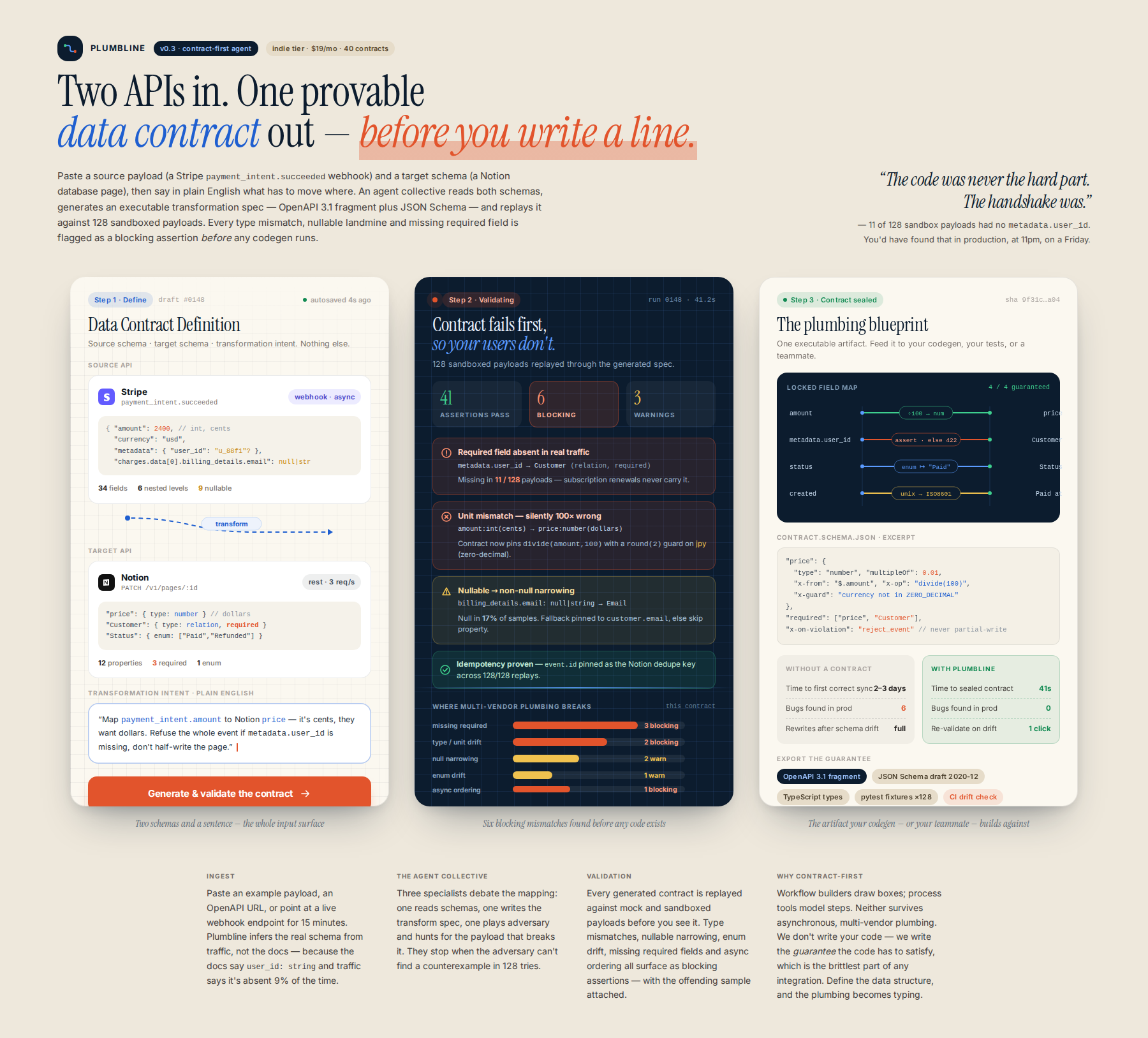
Process flow
Who it's for
Indie hackers/Developers building SaaS that rely on complex, multi-step external API integrations.
Why they need it
Current development workflows are bottlenecked by the ambiguity of data contracts when stitching together disparate, asynchronous services. Developers waste time manually mapping, validating, and debugging the complex data plumbing between services (e.g., Stripe events to Notion properties). This system automates the creation and validation of this crucial 'data plumbing contract.'
What it is
A 'Data Contract Definition' where the user inputs the source API (e.g., Stripe Webhook payload structure) and the target API (e.g., Notion API structure), specifying the required transformation logic (e.g., 'Map payment_intent.amount to Notion's price field, and ensure the associated user ID is present').
How it works
- User inputs Source API details (Schema/Example Payload) and Target API details (Schema/Example Payload) and the required transformation intent.
- Agent Collective analyzes the two schemas and the intent to generate a comprehensive, executable data transformation specification (e.g., a JSON Schema or OpenAPI definition fragment).
- The system uses a specialized validation module to test this generated contract against mock/sandboxed payloads, flagging all potential data type mismatches, missing required fields, or structural incompatibilities before any code is written.
- System outputs the validated contract, which serves as the single source of truth for subsequent code generation (the 'plumbing blueprint').
Differentiation
Existing tools are either UI-focused or process-model focused. They fail when the connection relies on complex, asynchronous, multi-vendor data plumbing. Our differentiation is proving the data contract first. We don't build the code; we build the guarantee of the data contract, which is the most brittle and hardest part of any multi-service integration. This capability surpasses simple workflow orchestration by mathematically defining the required data structure.
Implementation sketch
- Prototype the input parser to accept two schema definitions (e.g., JSON Schema files for Stripe and Notion) and a natural language mapping prompt.
- Develop the core agent module to generate a unifying intermediate representation (the 'Contract Schema') that satisfies the constraints of both source and target.
- Build a validation sandbox that ingests mock data payloads and validates them against the generated Contract Schema, reporting specific failure points (e.g., 'Source field X is string, but Target field Y requires integer').
- Focus MVP on one highly valuable, common integration flow (e.g., Stripe -> Notion) to de-risk the technical claim.
First step: Select two specific, well-documented APIs (e.g., Stripe and Airtable). Manually write a script that accepts a sample payload from Stripe and attempts to map its fields to the Airtable API structure, using Python's jsonschema library to validate the transformation logic against a manually defined intermediate contract schema. This proves the core validation loop before involving agents.
Remaining risks
- The 'Contract Schema' itself becomes too complex or abstract to be useful to a non-expert developer. If the output schema is mathematically perfect but requires deep knowledge of JSON Schema specifications to utilize, the perceived value drops to zero. — Develop a secondary, simplified 'Mapping Guide' alongside the schema. This guide translates the technical contract into plain English instructions (e.g., 'Use the value from Stripe's 'Amount' field, but ensure you cast it to an Integer before mapping it to Notion's 'Price' property').
- The system fails to account for implicit business logic or statefulness that isn't captured in the initial static schemas. For example, a contract might validate data types but miss a required sequence check (e.g., 'User must have an active subscription before attempting to update their profile'). — Introduce a 'Pre-Flight Logic Layer' prompt. After generating the contract, the agent must prompt the user: 'Does this contract assume the user is already authenticated? Are there prerequisite checks needed?' This forces the user to think about the flow around the data contract, not just the data itself.
- The initial 'first_concrete_step' (manual scripting) provides a false sense of security. Scaling this manual validation to dozens of complex, undocumented, or poorly documented enterprise APIs (which are the real market) will encounter insurmountable vendor-specific quirks and rate limits. — Shift the focus of the MVP demo from 'Schema Generation' to 'Schema Interpretation & Error Reporting.' Instead of generating the contract, build a tool that ingests a failed integration attempt (a real-world error log) and uses the agent to diagnose which part of the data contract failed and why (e.g., 'Error: Expected UUID, received string: This suggests the source field needs a lookup service').
Watch for: When developers start asking, 'Can this handle asynchronous failure states?' or 'What if the webhook payload is missing the customer_id field entirely?'
Kill criterion: If the agent cannot reliably generate a valid, executable contract for two APIs that have publicly documented, simple, and well-defined REST endpoints (e.g., GitHub webhook to Stripe), the core technical thesis is fundamentally flawed.
Sources the council used
Real-world evidence that grounded this idea — judge it for yourself.