
State Contract Definition Language for Multi-Agent Pipelines
A formal, specification-first framework that allows developers to define, validate, and test the required data contracts and state transitions between specialized AI agents *before* executing any LLM calls.
How can I formally verify data contracts between AI agents before running them?
A formal specification layer defines data contracts as state transitions: each agent declares expected input schemas and output schemas using Pydantic models. The system validates the entire pipeline against these contracts before any LLM calls, simulating data flow paths and flagging schema mismatches or unhandled transitions. This removes execution risk by proving the contract architecture is sound—guaranteeing data integrity without requiring live inference testing.
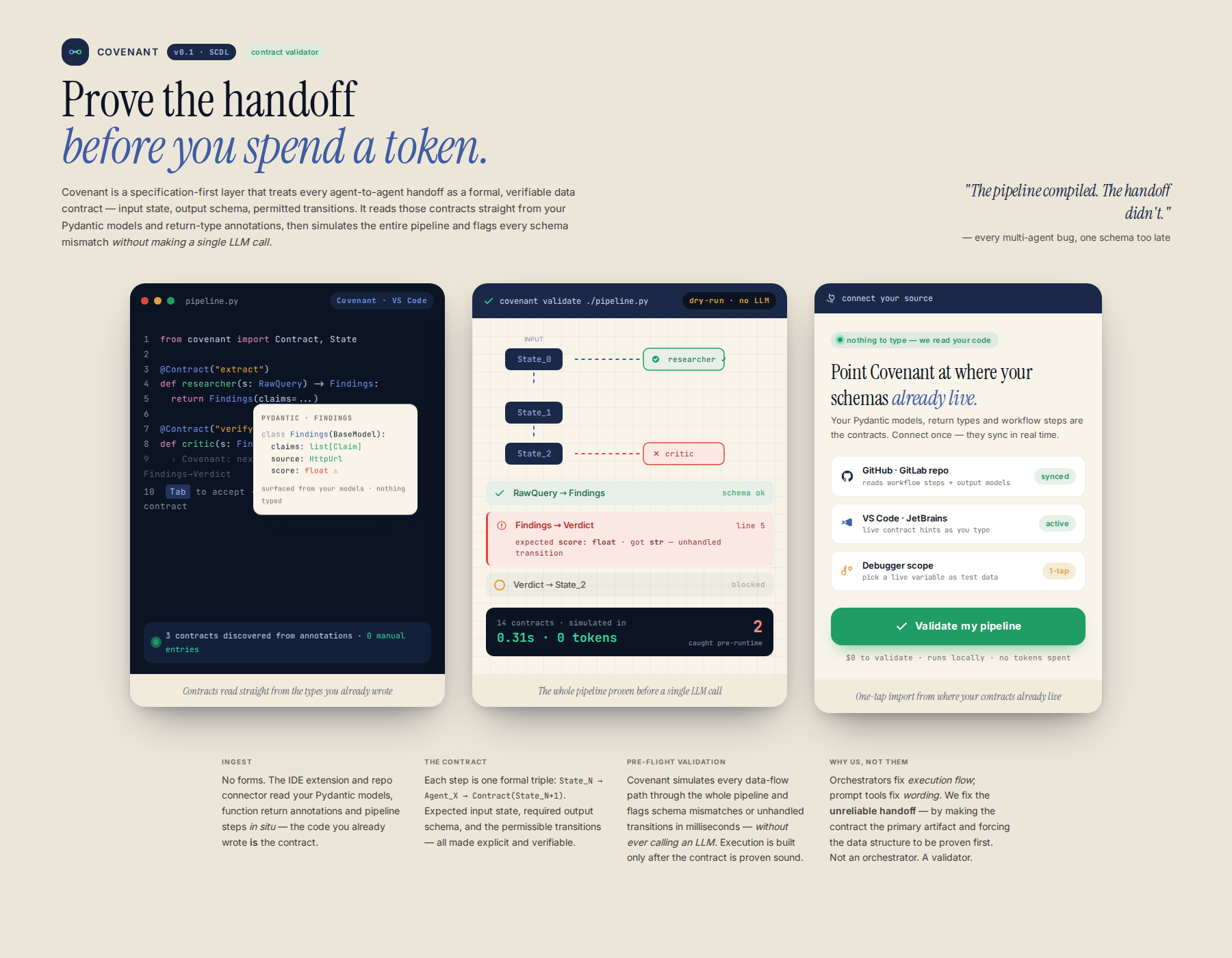
Process flow
Who it's for
Developers building complex, multi-agent AI systems who require guaranteed data integrity.
Why they need it
The core failure point in current agentic tooling is the lack of a formal guarantee on the output of an agent. Developers waste time debugging runtime failures due to context drift or schema violations, leading to a lack of confidence in production systems.
What it is
A specification layer that treats the interaction between agents as a series of formal, verifiable data contracts. It defines the expected input state, the required output schema, and the permissible state transitions, abstracting away the execution risk into a formal definition.
How it works
- Contract Definition: The user defines a workflow as a sequence of contracts:
State_N -> Agent_X(Input: State_N) -> Contract_X(Output: State_{N+1}). - Schema Enforcement: The system requires developers to define the expected output schema for every agent role using Pydantic or similar tools.
- Pre-Execution Validation: The core tool validates the entire pipeline against these contracts, simulating the data flow paths and flagging any schema mismatch or unhandled state transition without calling an LLM.
- Execution Layer (Deferred): Only after the contract is proven sound does the system build the minimal executor that attempts to satisfy those defined contracts.
Differentiation
Existing solutions like 's1' and 's2' focus on execution flow or prompting. Our differentiation is the shift to formal specification. We are not an orchestrator; we are a Contract Validator. We solve the 'unreliable handoff' gap by making the contract the primary artifact, forcing developers to prove the data structure first, which is a layer of rigor missing in current frameworks.
Implementation sketch
- Develop a Python class/library dedicated solely to parsing and validating a sequential list of Pydantic models representing state transitions.
- Implement a core validation function that takes a starting state and iterates through the defined contracts, ensuring that the output type of Contract N matches the input type of Contract N+1.
- Build a minimal CLI that accepts a YAML/JSON file defining the pipeline contracts, and outputs a pass/fail report based purely on structural integrity, requiring no LLM calls.
First step: Create a minimal Python class structure that accepts two Pydantic models (InputState, OutputState) and a function signature, and write a test case that attempts to pass an instance of InputState to a mock function, asserting that the mock function returns an object that strictly adheres to OutputState's structure.
Remaining risks
- The 'Specification First' approach might be too abstract or academically rigorous for the average developer developer who just wants a working prototype. The cognitive load of defining formal contracts for every step might create a new, equally high barrier to entry. — Develop a 'Contract Wizard' or guided tooling layer that auto-generates boilerplate contract definitions based on natural language descriptions or simple example inputs, making the formalization process feel less like pure theory and more like scaffolding.
- The core value proposition rests on the absence of LLM calls. If the market perceives this as merely a 'linter' or 'schema validator' for existing frameworks, the differentiation will be lost, and adoption will stall due to perceived low utility. — Frame the tool not as a validator, but as a 'Trust Layer' or 'Guarantor' for the LLM output, positioning it as the mandatory pre-flight check required for any production-grade agentic system, thereby elevating its perceived necessity beyond mere tooling.
- The initial implementation sketch relies heavily on Pydantic/Python typing, which is excellent for the backend but offers no immediate value to the user who is likely thinking in terms of 'user experience' or 'workflow visualization.' The lack of a visible, runnable output during the validation phase might lead to user confusion. — Even in the MVP, provide a clear, textual, or simple graph representation of the validated path (e.g., 'State successfully transitioned from Initial -> Research -> Synthesis'), proving the system works, even if the LLM hasn't run.
Watch for: Any positive feedback that suggests users are asking, 'How do I just get this running quickly?' rather than, 'What are the formal constraints I need to define for this?' This signals that the technical rigor is overwhelming the immediate use case. Kill criterion: If the initial set of early adopters cannot articulate why a simple, existing workflow tool (like a slightly extended LangChain setup) cannot solve their immediate problem, or if they express confusion about the difference between 'defining a contract' and 'running a workflow.'
Sources the council used
Real-world evidence that grounded this idea — judge it for yourself.