
Compliance-Grounded Agent Output Verification for Financial Workflow Audits
A specialized verification layer that provides cryptographically verifiable proof of execution path and source fidelity for AI agents performing regulated, multi-step financial or compliance tasks.
How can auditors prove why an AI agent approved a compliance decision, not just what it did?
By instrumenting agent execution to capture every decision point, data lookup, and rule check, then validating that trace against a governed rule set called a Compliance Graph. The system produces a Compliance Confidence Score as a vector of attestations (e.g., rule checks passed, data source validated) plus a cryptographically verifiable proof of the execution path, rather than a single opaque number. It targets compliance teams and auditors in regulated finance (KYC, AML) who need traceable justification back to specific rules and inputs, not just an activity log.
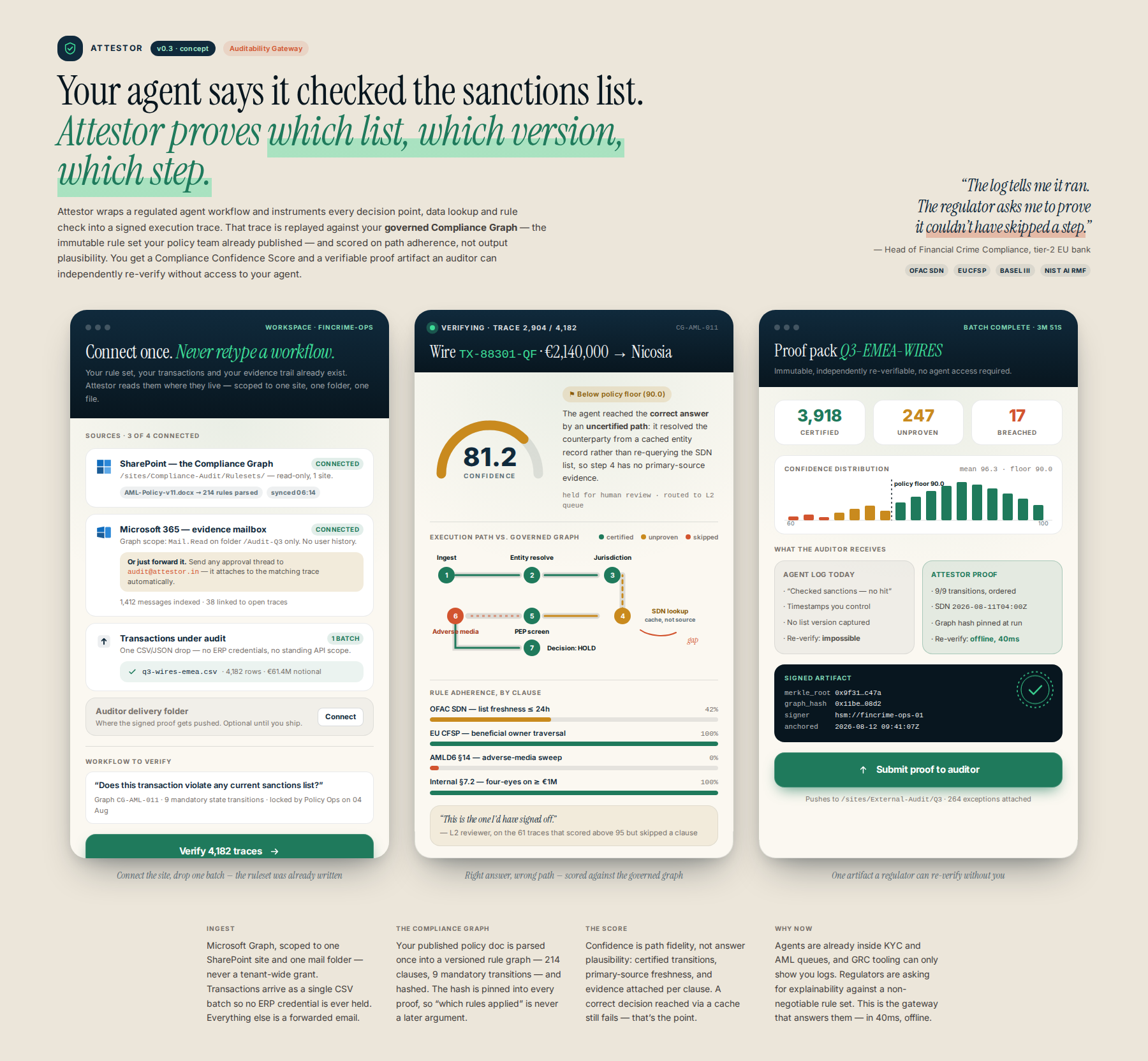
Process flow
Who it's for
Financial services compliance teams, audit departments, and internal risk management units operating within regulated industries (e.g., KYC, AML).
Why they need it
Current audit trails are insufficient because they only log what happened, not why or under what verifiable conditions the agent reached a conclusion. When an agent makes a decision affecting compliance status, auditors need an undeniable, traceable path back to the specific rules, data inputs, and logic steps that justified the final output.
What it is
A specialized provenance protocol that wraps agent execution, focusing solely on capturing and scoring the path relative to a predefined set of regulatory rules or business logic graphs. It generates a 'Compliance Confidence Score' alongside a verifiable execution proof.
How it works
- Define a specific, high-stakes workflow (e.g., 'Does this transaction violate any current sanctions list?').
- The agent executes the workflow, but the process is instrumented to capture every decision point, data lookup, and rule check result.
- The resulting trace is submitted to the layer.
- The layer runs the trace against the governed rule set (the 'Compliance Graph') and cross-references agent decisions against expected state transitions.
- The system returns a Compliance Confidence Score and a verifiable, immutable proof of adherence to the necessary compliance path.
Differentiation
We are not building general agent infrastructure; we are building the Auditability Gateway for agents. This differs from standard logging (e.g., basic transaction logs) by enforcing verification against a domain-specific, immutable rule graph (e.g., NIST, Basel III requirements) rather than just general pattern matching. It solves the 'explainability for regulators' problem, not just the 'trust' problem. The gap is the automated, auditable proof that an AI decision path complies with a predefined, complex, non-negotiable rule set, which existing GRC/audit tools cannot guarantee.
Implementation sketch
- Select one narrow, high-value use case (e.g., Sanctions Screening against OFAC lists) and build a proof-of-concept targeting only that workflow.
- Develop the 'Compliance Graph' schema: define inputs, permitted transitions, and required verification checkpoints based on a single, public regulatory document (e.g., a specific SEC rule change).
- Build the verification module to ingest agent traces and validate the path's adherence to the graph, generating the Compliance Confidence Score.
First step: Identify the single most recent, publicly available, and highly specific regulatory change (e.g., a specific amendment to a FINRA rule) and map its core logic into a simple, state-machine diagram. This diagram becomes the initial 'Compliance Graph' prototype for the MVP.
Remaining risks
- The 'Compliance Graph' becomes an unmanageable, perpetually evolving knowledge base requiring constant, expensive, and expert-level legal/domain input for every new regulation or client vertical. — Initially scope the MVP to a single, narrow, and stable regulatory domain (e.g., OFAC sanctions screening) where the rule set is highly documented and changes infrequently, proving the core mechanism before scaling the graph complexity.
- The underlying agent execution frameworks (agentcollective, etc.) fail to standardize their instrumentation points or are too slow/resource-intensive to capture the necessary fine-grained execution trace required for verification. — Develop the verification layer as an asynchronous, off-chain processor that accepts standardized, serialized trace payloads from the agent framework, rather than requiring real-time, synchronous interception of the agent's internal state machine.
- Regulators or enterprise compliance teams view the 'Compliance Confidence Score' as a black box or an oversimplification, demanding full transparency into the scoring algorithm's weights and assumptions. — Design the score not as a single number, but as a vector of attestations (e.g., [Rule_A_Passed: True, Rule_B_Passed: True, Data_Source_Validated: True]), allowing auditors to drill down into the specific components that contributed to the overall confidence.
Watch for: Any indication from potential pilot partners that the complexity of mapping all required regulatory nuances into a formal, machine-readable graph structure is greater than the perceived value of the auditability improvement. Kill criterion: If a potential pilot partner states that the effort required to map their existing, documented compliance process into the required 'Compliance Graph' structure exceeds the budget or timeline allocated for the project by a factor of 3 or more.