
Agentic Evidence Mapping for Critical Compliance Controls (Locked Spec)
A highly focused, agent-driven platform that automates the evidence collection and mapping for one critical, high-value compliance control (e.g., MFA enforcement) across disparate multi-vendor security tools for small MSPs.
Can AI automatically collect and map audit evidence for SOC 2 controls across different vendor tools?
Yes: agent-based systems can connect to identity providers and security tools like EDR platforms, pull the relevant logs via API, and map them against a specific control requirement automatically. One approach uses specialized agents dedicated to a single control, such as MFA enforcement, that process logs through a knowledge graph built on frameworks like CIS Controls and check coverage against thresholds (e.g., 99% of MFA logs over 90 days). It then compiles a proof-of-evidence package and flags remediation only where gaps exist. This is aimed at small MSPs and MSSPs that currently gather such evidence manually for frameworks like SOC 2.
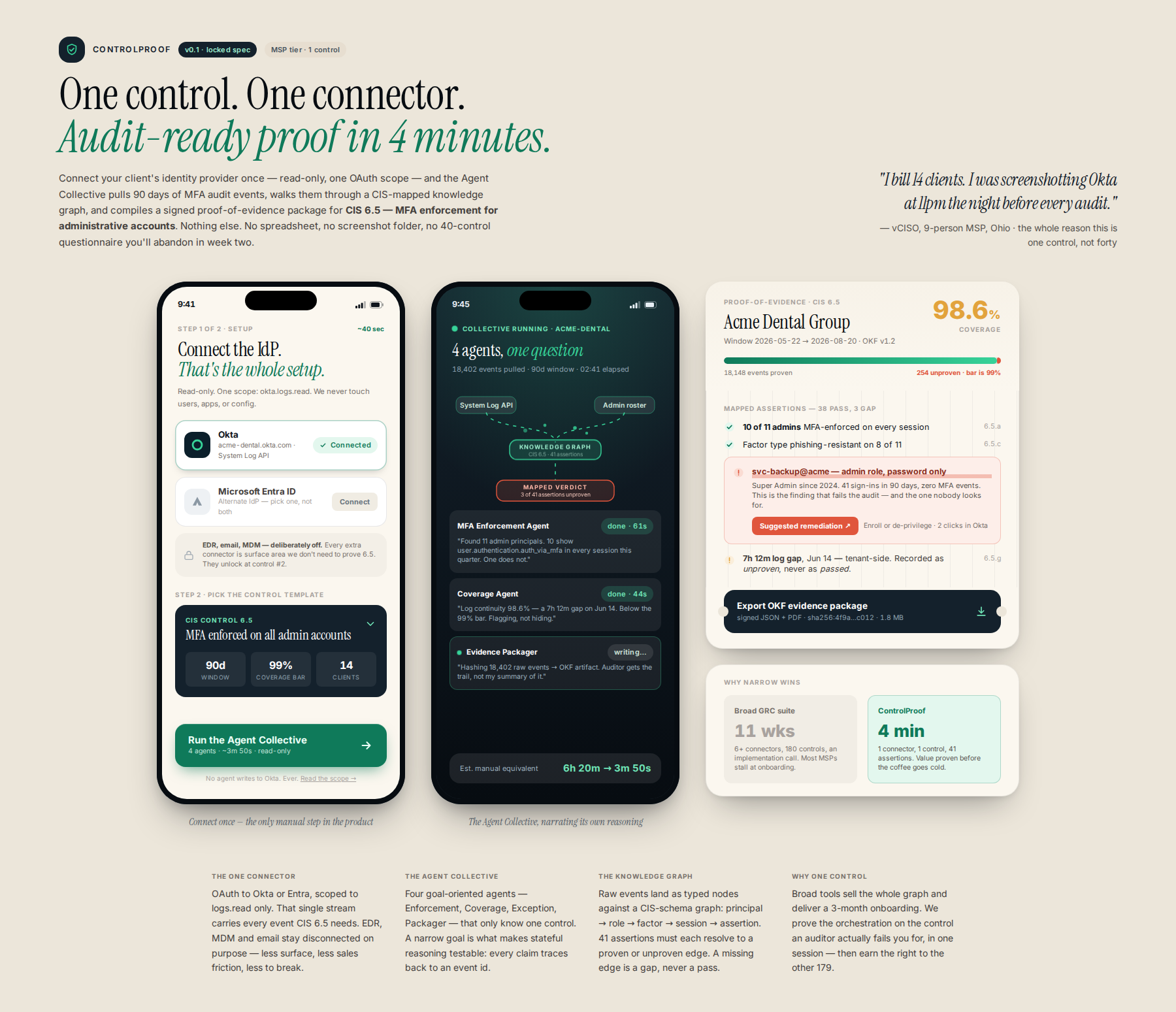
Process flow
Who it's for
Small MSP/MSSP (Targeting a single, high-urgency compliance vertical initially)
Why they need it
MSPs struggle with the operational burden and high cost of manually gathering and mapping evidence for specific, auditable controls required by frameworks like SOC 2. (Signal p1)
What it is
A specialized orchestration agent layer that ingests raw logs/APIs, processes them through goal-oriented agents, and maps findings only against a predefined, narrow compliance requirement set.
How it works
- The MSP connects credentials/APIs for the specific data sources required for the target control (e.g., EDR logs, Identity Provider logs).
- The 'Agent Collective' runs specialized agents focused solely on that control (e.g., 'MFA Enforcement Agent').
- Agents query logs/APIs, process them through a standardized Knowledge Graph built on industry-specific schemas (e.g., CIS Controls mapping), and map findings against the specific compliance requirement (e.g., 'Requires 99% coverage of MFA logs for the last 90 days').
- The system automatically compiles a proof-of-evidence package for that single control, suggesting remediation workflows only if gaps are found.
Differentiation
Unlike broad compliance tools or general aggregators, our MVP proves deep, stateful reasoning by focusing on one critical, measurable control. We automate the evidence mapping for that single control using a Knowledge Graph structure, significantly reducing the initial security surface area and proving the core orchestration value before tackling the entire compliance graph. This de-risks the initial adoption dramatically.
Implementation sketch
- Build a secure, API-gated vault layer (my-vault inspired) limited initially to ingesting data for 1-2 core controls.
- Implement a core Agent framework (agentcollective) dedicated to interpreting logs against a codified, narrow compliance graph (e.g., just MFA requirements).
- Develop a 'Proof-of-Evidence Score' (replenum inspired) that rates the completeness only for the targeted control, making the initial scope manageable and measurable.
First step: Prototype the ingestion pipeline for a single data source (e.g., Azure AD logs) and build the initial Knowledge Graph schema defining the relationships between 'User', 'MFA_Event', and 'Success/Failure' states required for the target control.
Remaining risks
- Data Source Ingestion Failure/API Volatility: The system's core dependency is ingesting and normalizing data from multiple, external, and often poorly documented vendor APIs (e.g., EDR, Identity Providers). If any single critical vendor updates its API schema or rate limits its access, the entire 'Proof-of-Evidence Score' for that control fails, halting the core value proposition. — Implement an abstraction layer with standardized, versioned connectors for each vendor API. Build robust monitoring and alerting that triggers an immediate, automated failover or alerts the MSP to the specific broken connection, rather than failing silently.
- Knowledge Graph Schema Drift/Completeness: The success relies on mapping real-world log data to a pre-defined, static Knowledge Graph schema. If the actual operational reality (e.g., a new feature rollout by a client's cloud provider) generates log data that doesn't fit the current graph schema, the system cannot process it, leading to an unexplainable gap in the evidence package. — Develop a 'Schema Drift Detection' module that flags incoming data structures that do not map cleanly to the existing graph. This forces the system to surface the unknown data point to the user for manual schema refinement, turning a failure point into a required service interaction.
- Adoption Paralysis Due to Over-Scoping the 'Control': While the MVP is narrow, the initial selection of the 'critical control' (e.g., MFA) might be too narrow or too easy to solve, leading to low perceived value. The MSP might find the initial solution trivial compared to the actual complexity of their environment. — Develop a 'Control Difficulty Index' during the sales cycle. Instead of picking the easiest control, prioritize controls that are technically hard to prove compliance for (e.g., least privilege access reviews) but whose business impact is extremely high, thus justifying the initial integration effort.
Watch for: A competitor releasing a single, highly integrated, low-code platform that allows an MSP to define any custom data source and any custom mapping logic without writing code, effectively commoditizing the 'Knowledge Graph' layer. Kill criterion: If, after initial pilot testing, the average time required for the MSP to connect and validate the data sources for the single target control exceeds 4 hours, the technical overhead outweighs the perceived value, suggesting the integration complexity is too high for the target SMB user base.
Sources the council used
Real-world evidence that grounded this idea — judge it for yourself.