
Data Residency Graph Orchestrator (MVP)
A focused, graph-based platform that simulates and enforces data sovereignty and residency constraints during cross-jurisdictional data movement.
How can we prove regulated data stayed in the right jurisdiction after it moves between clouds?
A data residency graph orchestrator models each data flow as a graph where nodes carry jurisdictional metadata (origin, required residency, masking level) and edges are validated against sovereignty rules before execution. It simulates the transfer path, flagging violations like unauthorized cross-border transit or insufficient encryption before data actually moves, then generates an immutable 'Jurisdictional Ledger' as audit evidence. It targets cloud architects, data governance officers, and CISOs handling PII/PHI transfers under GDPR, CCPA, or Schrems II, going beyond iPaaS tools that only verify connectivity, not legal compliance.
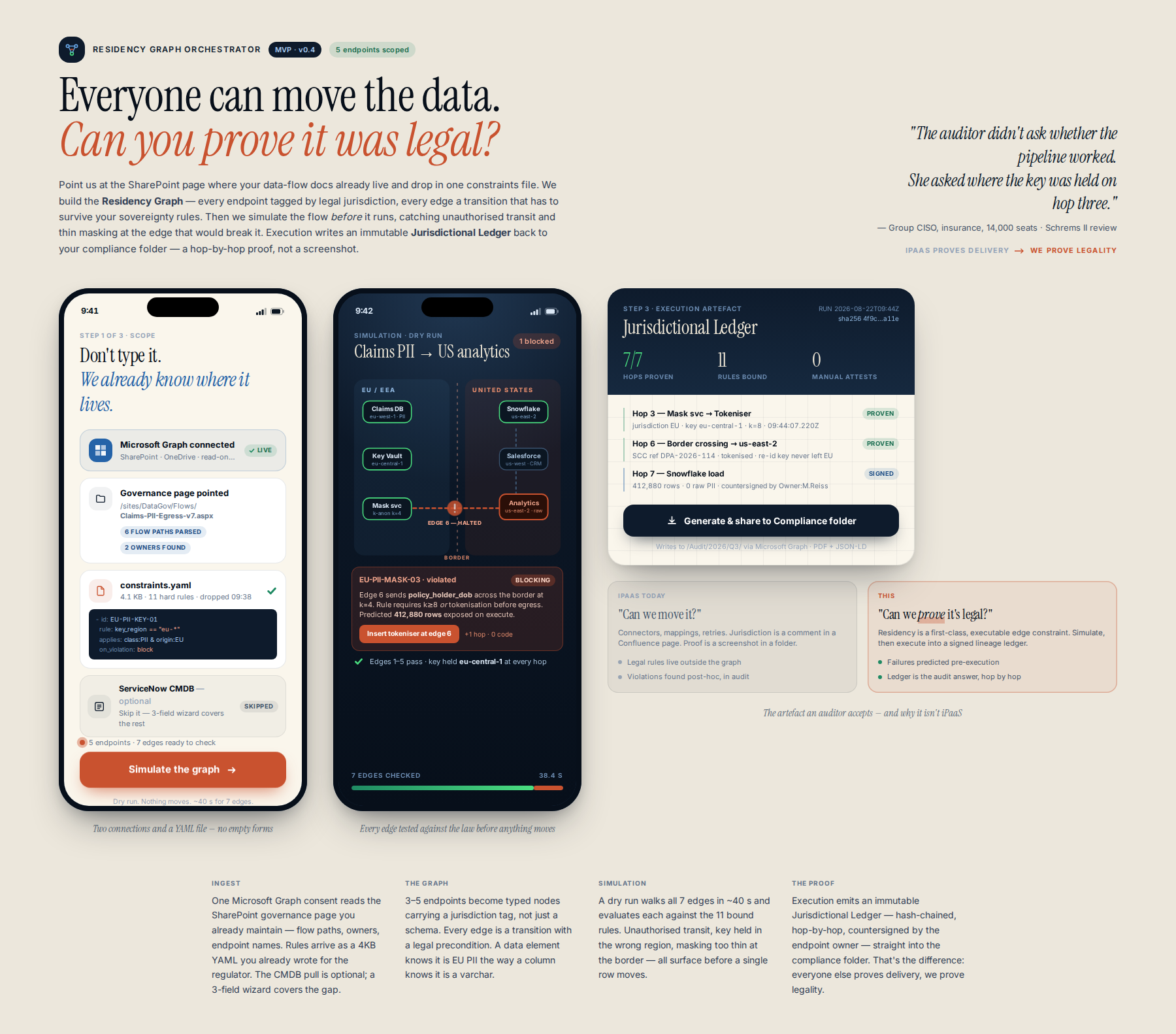
Process flow
Who it's for
Cloud Architects, Data Governance Officers, and Chief Information Security Officers (CISO).
Why they need it
Moving regulated data (PII, PHI) across international or jurisdictional boundaries requires proving continuous, auditable compliance with data residency laws (e.g., GDPR, CCPA, Schrems II). Existing iPaaS/ETL tools only prove connectivity, not jurisdictional legality at every transformation step.
What it is
A specialized simulation and orchestration layer that maps and validates data transformation paths (the 'Residency Graph') between 3-5 pre-selected, geographically constrained data endpoints. It models data elements not just by schema, but by their required legal jurisdiction.
How it works
- Scope Definition: The user defines the data flow path and the originating/target jurisdictions (e.g., EU PII data moving to US cloud endpoint).
- Graph Mapping: The system ingests metadata for the endpoints and the associated jurisdictional rules (e.g., 'EU PII must remain encrypted with key stored in EU region').
- Simulation: The core engine simulates the flow, checking every edge transition against the defined residency/sovereignty rules, predicting failures like unauthorized data transit or insufficient masking before execution.
- Execution (MVP): Executes the validated workflow, generating an immutable, auditable 'Jurisdictional Ledger' proving compliance at every hop.
Differentiation
Existing tools like 's1' (Multi) focus on prompt chaining, and established iPaaS solutions (MuleSoft, Boomi) focus on connectivity/transformation. Our core value is Jurisdictional Proof. We treat the integration graph as a verifiable, auditable data lineage ledger that models legal constraints (data sovereignty, residency) as first-class, executable graph constraints, solving 'Can we prove it's legal?' rather than just 'Can we move it?'
Implementation sketch
- Drastically narrow the scope: Target the MVP on a single, high-stakes data movement scenario (e.g., PII data deletion request moving from an EU SaaS tool to a US cloud data lake).
- Build the graph model to explicitly track jurisdictional metadata (e.g., 'Data Origin: EU,' 'Required Residency: EU,' 'Masking Level: PII').
- Develop the simulation module to run predefined compliance test vectors against the graph structure, generating a 'Jurisdictional Failure Report' detailing which specific rule/jurisdiction was violated.
First step: Research and document the specific API metadata structure required to ingest and validate a 'Jurisdictional Tag' (e.g., which endpoint reports its data's physical storage region/jurisdiction) for two competing SaaS tools relevant to EU data movement.
Remaining risks
- The 'Jurisdictional Tag' ingestion proves insufficient. If the target SaaS tools do not expose granular, machine-readable metadata regarding data residency, encryption keys, or processing location, the core premise of the 'Residency Graph' collapses into a theoretical model. — Focus the MVP on a highly controlled, internal data movement pipeline (e.g., between two internal microservices) where the data source/sink is controlled by the team, allowing for direct metadata injection and validation, thereby bypassing the immediate need for perfect external vendor metadata.
- Legal/Regulatory Ambiguity: The system's ability to predict 'legal failure' is contingent on the input rules being comprehensive and accurate. If the underlying regulatory law (e.g., a new interpretation of GDPR) changes or is ambiguous, the system will generate a false sense of security, leading to catastrophic operational risk. — Position the tool explicitly as a 'Compliance Simulation Aid' or 'Risk Modeling Tool,' never as a 'Compliance Guarantee.' Require mandatory sign-off from external legal counsel on the rule set before any simulation run, shifting liability management to the user.
- Integration Depth vs. Breadth: Even with the narrow scope (3-5 endpoints), the required integration depth for jurisdictional validation is far greater than standard API integration. It requires deep access to infrastructure metadata (key management systems, cloud provider region tags) that vendors guard fiercely. — Adopt a 'Policy-as-Code' approach where the user uploads the policy document (e.g., an OPA/Rego file) describing the constraints, and the system's job is to map the data flow against the policy, rather than trying to reverse-engineer the policy from the vendor's API documentation.
Watch for: A major, well-funded competitor (e.g., a large cloud provider or established GRC vendor) releasing a single feature that demonstrably models data sovereignty constraints across multiple, non-native cloud services, thereby de-risking the core technical moat. Kill criterion: If the first concrete step (researching metadata structure for two competing SaaS tools) reveals that the required jurisdictional metadata is not exposed via any standardized or semi-standardized API endpoint, making it an internal, non-exportable operational detail for both vendors.
Sources the council used
Real-world evidence that grounded this idea — judge it for yourself.