
CTO-to-Boardroom Technical Translator
A specialized, prompt-engineered framework that translates complex, unstructured technical documentation into highly structured, non-technical business narratives specifically for C-suite consumption.
How can I turn technical documentation into executive briefs?
You can use a constrained LLM framework to automatically translate complex technical documentation into structured executive summaries and risk reports. The system uses prompt-engineered templates to force the LLM to output role-specific narratives from raw technical artifacts like architecture diagrams and Git logs. By running locally, it maintains data privacy while proving core value without complex orchestration.
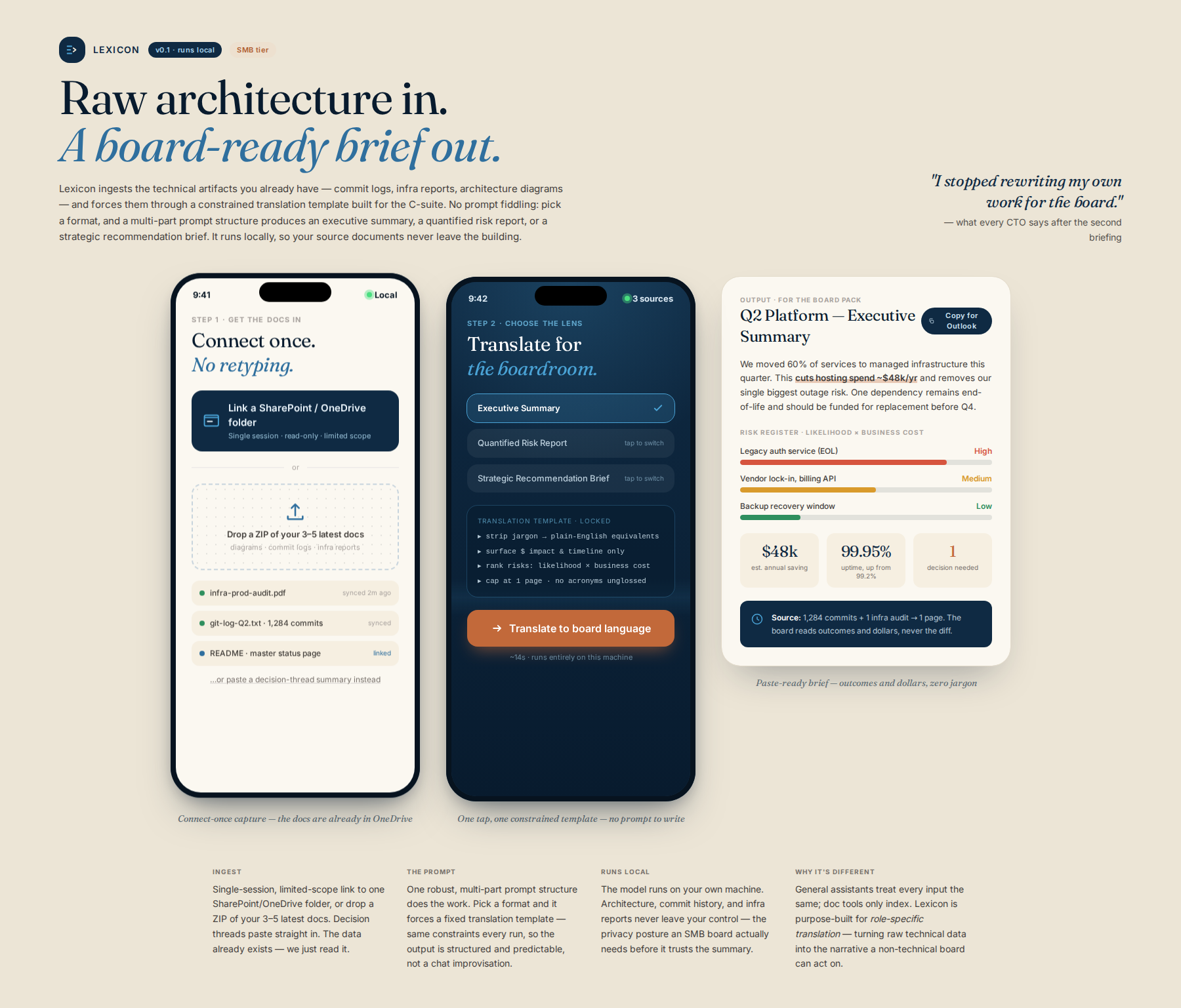
Process flow
Who it's for
CTOs and Technical Leads within small-to-medium businesses (SMBs) who must regularly report technical status, risk, or strategic decisions to non-technical executive leadership (CEO, Board).
Why they need it
The technical expert struggles to translate deep, complex technical realities (e.g., architectural debt, infra bottlenecks) into the concise, risk-aware language required by non-technical decision-makers, leading to miscommunication and poor resource allocation.
What it is
A constrained LLM interface that ingests raw technical artifacts (e.g., architecture diagrams, detailed Git commit logs, infrastructure reports) and reliably outputs structured, audience-appropriate executive summaries, quantified risk reports, and strategic recommendation briefs.
How it works
The system utilizes a single, highly robust, and multi-part LLM prompt structure. The user uploads technical text, and the prompt forces the LLM to execute a specific translation template (e.g., 'Executive Summary' format, 'Risk Assessment' format). This process is designed to run locally for maximum data privacy and control, proving the core value proposition without complex orchestration.
Differentiation
Unlike general AI assistants which treat inputs generically, or simple documentation tools which only index resources, this system is purpose-built for systematic, constrained knowledge translation across the technical-to-executive domain. It solves the specific gap of structured, role-specific narrative generation from raw technical data.
Implementation sketch
- Prototype the core function: Develop a single, robust, highly constrained LLM prompt that accepts raw technical text and reliably outputs structured summaries (e.g., JSON or markdown template).
- Curate a focused dataset of technical jargon mapped to C-suite/non-technical language (e.g., 'Kubernetes Pod Failure' -> 'Service Interruption Risk').
- Build a simple UI wrapper around this single prompt to allow users to select the target output format (e.g., 5-bullet summary, 3-paragraph risk report).
First step: Draft 3 distinct, mandatory output JSON schemas (e.g., {Summary: string, TopRisk: string, ActionRequired: string}) and write the initial system prompt to force adherence to one of these schemas using a test case derived from a sample architecture diagram README.
Remaining risks
- The input data variability remains extremely high (logs, diagrams, commits). Even with a constrained prompt, the model may hallucinate connections or misinterpret ambiguous technical jargon that lacks clear context, leading to inaccurate risk assessments. — Implement a confidence scoring mechanism alongside the output, forcing the LLM to flag any derived statement where the source evidence was weak or required significant inference. This shifts the output from 'fact' to 'informed hypothesis.'
- The 'translation' process is subjective. What one CEO considers a 'critical risk' (e.g., technical debt) another might view as 'acceptable operational overhead.' The system risks imposing a single, incorrect risk prioritization framework. — Develop a configurable 'Stakeholder Risk Profile' module. Before generation, the CTO selects the primary audience (e.g., 'Growth-Focused CEO,' 'Cost-Conscious Board,' 'Engineering-Focused CFO'), which dynamically adjusts the prompt's weighting parameters (e.g., prioritizing 'Speed' vs. 'Stability' vs. 'Cost').
- The 'local LLM' requirement, while excellent for privacy, severely limits the model's capability ceiling. Advanced, nuanced cross-domain reasoning required for truly novel strategic advice might exceed the capacity of smaller, locally runnable models. — Phased rollout strategy. MVP uses local models for data ingestion/structuring. For the 'strategic recommendation' component, allow a controlled, opt-in API call to a larger, cloud-based model only for the final, high-level synthesis, clearly demarcating this as the 'Advanced Synthesis Layer' to manage expectations and cost.
Watch for: If initial pilot users (CTOs) begin spending more time cleaning, pre-processing, or manually correcting the LLM's structured output than they save by using the tool, the core value proposition is failing. Kill criterion: If the system cannot reliably ingest and structure data from at least two different, common technical sources (e.g., a standard CI/CD pipeline log AND a standard infrastructure diagram format like Mermaid/PlantUML) into the required JSON schema without manual intervention, the technical foundation is too brittle for an MVP.
Sources the council used
Real-world evidence that grounded this idea — judge it for yourself.