
AI-Guided Goal-Oriented Financial Pathway Planner
A focused, agent-guided decision-tree simulator that teaches optimal financial planning by guiding users toward achieving a specific, measurable financial goal (e.g., down payment, emergency fund) through interactive scenario planning.
What are my options to reach a financial goal on schedule?
Define your goal (e.g., 'Save $50k down payment by 2028') and an AI coach presents branching scenarios—increase savings, cut spending—with quantified impact on your timeline. Instead of just tracking where you are, the system models and explains trade-offs: 'If you choose this, you reach your goal 3 months sooner.' This pedagogical, interactive approach teaches financial planning through scenario exploration.
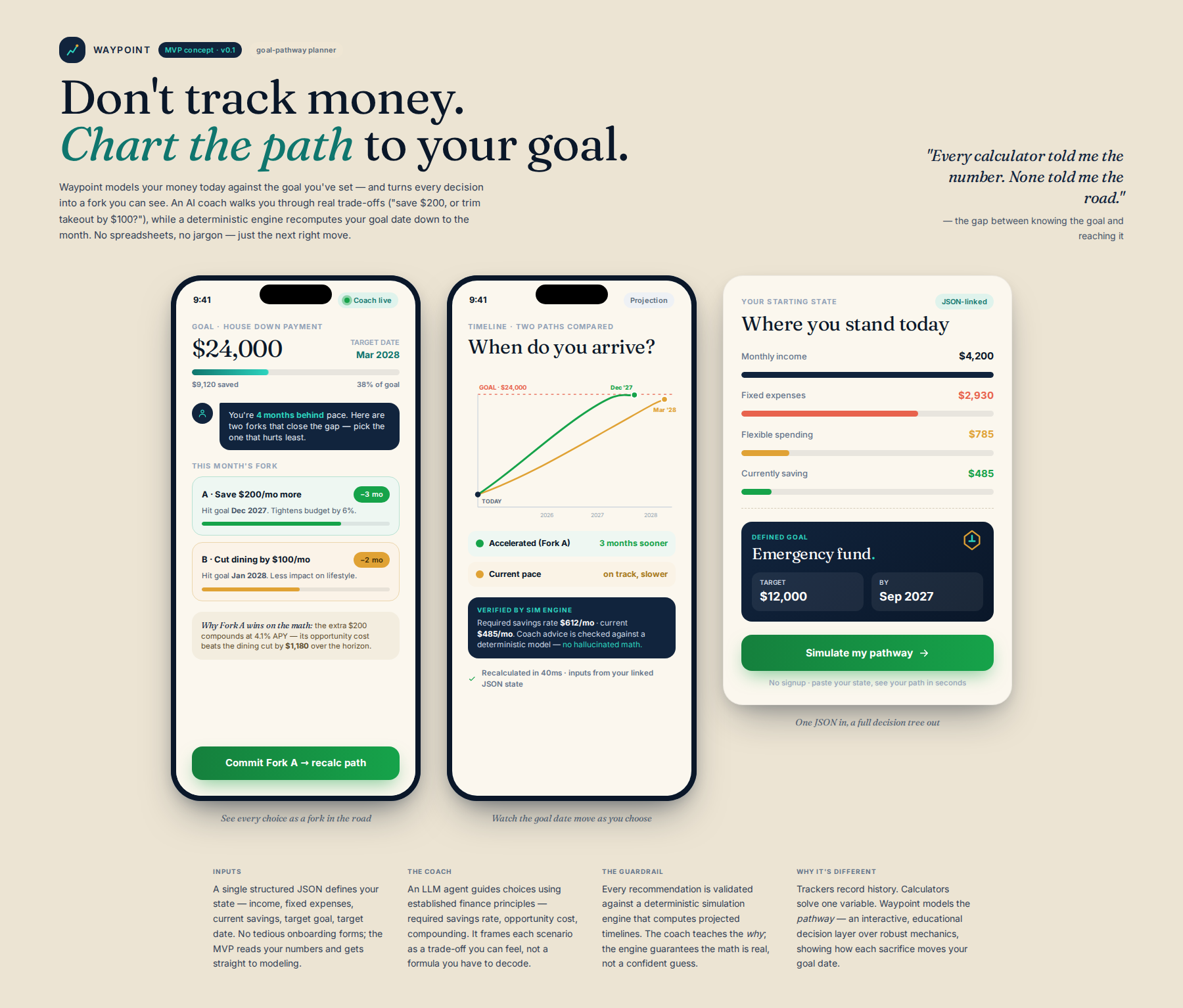
Process flow
Who it's for
Personal finance beginners who lack a clear, actionable path to achieving a specific financial objective.
Why they need it
Users struggle not just with tracking money, but with knowing the sequence of actions required to reach a major life goal. This addresses the gap between theoretical budgeting and actionable, step-by-step planning.
What it is
A focused web application that models a user's current financial state against a defined future goal. It presents decision scenarios (e.g., 'Should you save $200/month or reduce your spending on X by $100?'), projecting the impact on the goal timeline.
How it works
The system uses an LLM agent coach to guide choices based on established financial modeling principles (e.g., required savings rate, opportunity cost). The MVP will interface with a structured JSON input defining the user's current state (income, fixed expenses, current savings, target goal, target date). The Coach Agent's recommendations must be validated against a deterministic simulation engine that calculates projected timelines, ensuring financial accuracy.
Differentiation
Unlike general tracking tools or complex CLIs which only record history, or specialized calculators which solve one variable (e.g., only debt), this platform models the pathway. It provides the pedagogical 'why' behind the calculation by presenting choice trade-offs (e.g., 'If you sacrifice X, you hit your goal 3 months sooner'). The gap is the lack of an interactive, educational decision-support layer layered over robust mechanics for goal-pathway modeling.
Implementation sketch
- Develop a core state machine model focused on goal-pathway mechanics: tracking Goal Value, Target Date, and required monthly contribution, and modeling how changes in input variables (spending, income) affect the timeline.
- Build the 'Coach Agent' to present branching decision scenarios (e.g., 'Option A: Increase income by $X' vs. 'Option B: Cut spending by $Y') and coach the user toward the optimal path toward the stated goal.
- The MVP will accept initial state parameters via structured JSON/CSV and run simulations, visualizing the required savings curve and the resulting payoff timeline/date.
First step: Draft the JSON schema for the initial state input (Income, Fixed Costs, Current Savings, Goal Amount, Target Date) and build the deterministic function that calculates the required monthly contribution based on these inputs.
Remaining risks
- The 'Coach Agent' becomes a source of misleading or overly simplistic pedagogy. — Implement a strict validation layer where the LLM's proposed reasoning must be traceable back to a calculation derived from the deterministic state machine output, rather than generating general advice. The system must explicitly show the mathematical trade-off for every suggestion.
- User adoption friction due to cognitive load. — The interface must abstract the complexity. Instead of presenting raw variables, the coach should frame choices as narrative trade-offs (e.g., 'If you choose this, you gain X but must accept Y consequence on your timeline'). The MVP must prioritize extreme simplicity over comprehensive feature parity.
- The 'Goal' itself is insufficient to drive engagement. — Develop a secondary, lightweight 'Goal Refinement' module that forces the user to justify the goal's necessity and potential alternatives (e.g., 'Is this goal more important than maintaining a 3-month emergency buffer?'). This adds a layer of meta-cognition to the planning process.
Watch for: User frustration when the simulation requires iterative adjustments to the initial inputs (Income/Expenses) to make the goal achievable. This indicates the user is thinking about reality (which is messy) rather than the model (which is clean), suggesting the educational abstraction layer is failing. Kill criterion: If initial user testing shows that users are unwilling to accept the deterministic constraints of the model (i.e., they constantly demand the system 'figure out' the answer without the user manually adjusting variables), the core premise of 'guided decision-making' is flawed, and the product should pivot to a pure recommendation engine or a simpler educational content delivery model.
Sources the council used
Real-world evidence that grounded this idea — judge it for yourself.