
Niche-Focused Agent for Multi-Platform Freelancer Data Normalization
A local-first, agent-driven system that solves the high-friction data aggregation gap for freelancers by generating an actionable 'Gap Identification Dashboard' across 2-3 major payment platforms.
How do I find payment discrepancies across Stripe and PayPal?
A local-first system ingests transactions from both platforms, standardizes the data into a unified format, and flags specific mismatches—e.g., 'Invoice X paid on Stripe has no matching payout in PayPal.' Instead of manual cross-referencing, you get a prioritized dashboard of actionable gaps. All data stays on your machine; the system only surfaces the specific reconciliation failures you need to resolve.
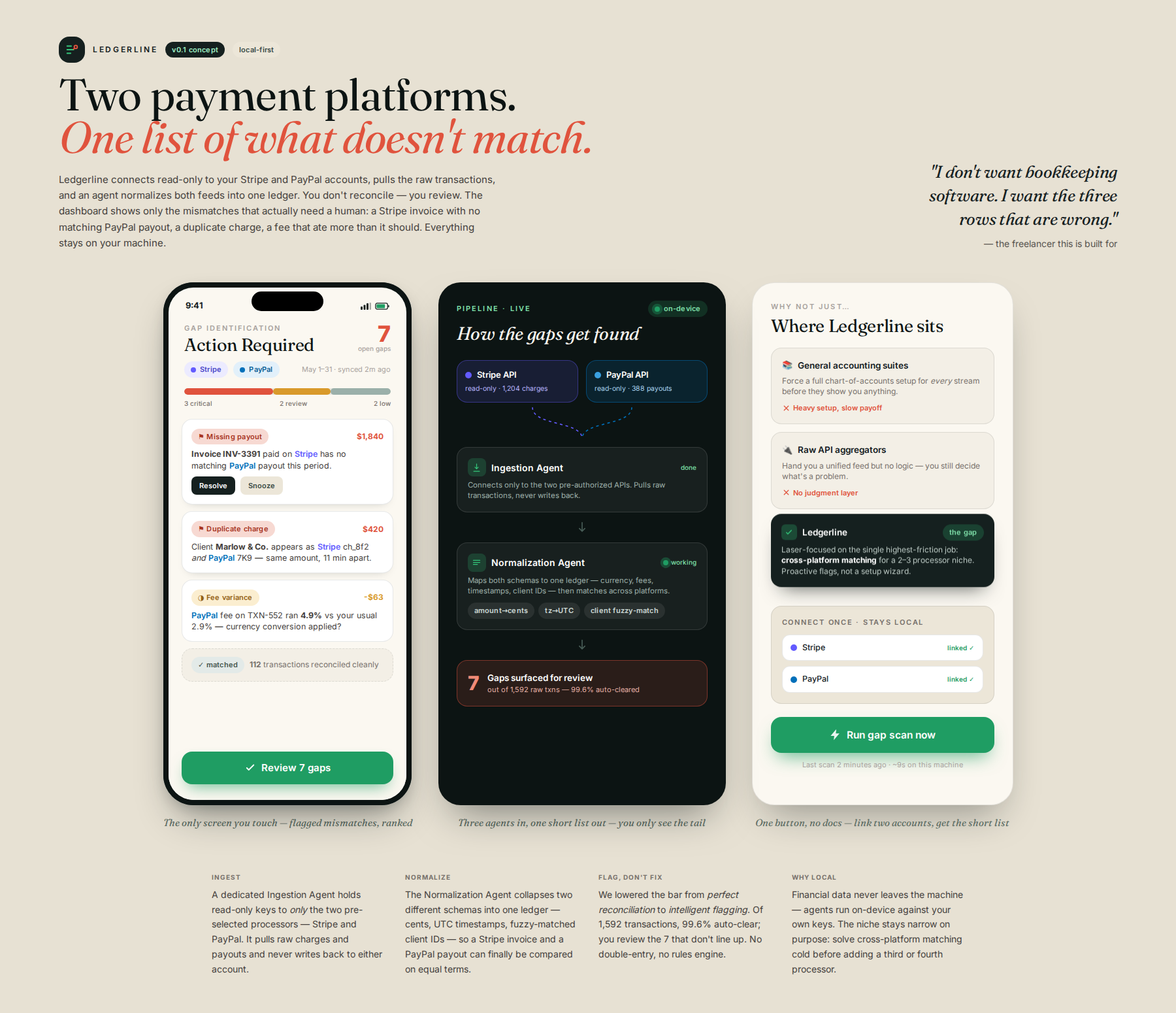
Process flow
Who it's for
Independent freelancers or micro-businesses whose primary revenue streams originate from 2-3 distinct online payment processors (e.g., Stripe, PayPal).
Why they need it
These users struggle with manually cross-referencing transactions that appear differently across multiple payment platforms, leading to lost time and inaccurate tax estimations. They need automated flagging and standardization across common, disparate digital endpoints, rather than generalized bookkeeping.
What it is
A focused, local-first agentic platform that ingests raw transaction data from 2-3 specified payment APIs (e.g., Stripe/PayPal). The system standardizes this raw data and generates a prioritized, human-readable 'Action Required' digest, flagging specific reconciliation failures (e.g., 'Invoice ID X on Stripe lacks a corresponding payout record in PayPal for this period').
How it works
The system utilizes a multi-agent architecture. A dedicated 'Ingestion Agent' connects only to the pre-selected APIs. A core 'Normalization Agent' ingests and standardizes these specialized feeds, focusing on creating a unified, raw data context. The user interaction is limited to reviewing the 'Gap Identification Dashboard,' which presents only the actionable mismatches, significantly lowering the initial automation requirement from 'perfect reconciliation' to 'intelligent flagging.' All data remains local.
Differentiation
Unlike general accounting software which forces complex setup for every possible stream, or pure API aggregators which lack user-facing management logic, this solution focuses laser-like on the highest friction point for a defined niche (e.g., Stripe/PayPal cross-platform matching). The gap filled is the lack of a simple, proactive, agent-driven Data Normalization and Gap Identification layer for highly specific, multi-source financial data.
Implementation sketch
- MVP Focus: Develop robust, local-first ingestion modules for 2 specific, common payment APIs (e.g., Stripe and PayPal).
- Implement the multi-agent orchestration layer to process and standardize raw transactions into a unified, canonical data model.
- Build the core 'Gap Identification Dashboard' focusing solely on flagging cross-platform mismatches based on primary keys or known identifiers, rather than attempting full reconciliation.
First step: Define the canonical data model structure for Stripe and PayPal transactions (e.g., mandatory fields: transaction_id, source_platform, date, amount, description). Write initial Python scaffolding to ingest raw JSON from both APIs into this model.
Remaining risks
- API/Data Drift and Maintenance Overhead: Payment processors (Stripe, PayPal) frequently update their APIs, authentication methods, or transaction data structures. Maintaining the 'Ingestion Agent' to handle these non-trivial, external changes will consume disproportionate development time, leading to technical debt and product stagnation. — Build a highly abstracted, version-controlled Adapter Layer for each external API. Treat the adapters as microservices that require dedicated, small-scope maintenance sprints, rather than embedding the logic deeply into the core normalization engine.
- The 'Local-First' Friction vs. User Expectation: While local-first is a differentiator, the user experience expectation for financial tools is 'set it and forget it.' Requiring the user to manage API credentials, run local services, and potentially troubleshoot connectivity issues introduces significant onboarding friction that might deter the target user segment. — Develop a simplified, guided onboarding flow that abstracts away the technical complexity. The initial setup should feel as seamless as connecting a cloud service, even if the underlying mechanism is local.
- Semantic Ambiguity in Flagging: The 'Gap Identification Dashboard' relies on identifying mismatches. If two transactions are semantically related (e.g., a client pays via PayPal, but the service was billed via Stripe), the system might flag them as a 'gap' when a human would know they match contextually. The AI/Agent logic might over-flag or under-flag based on context. — Implement a user-adjustable 'Confidence Threshold' for flagging. Instead of a binary 'Gap/No Gap,' show a confidence score (e.g., 'High Likelihood Match, 85% Confidence') allowing the user to manually override or train the system on edge cases.
Watch for: If early user testing reveals that the primary point of failure or confusion is the setup and maintenance of the local connections, rather than the accuracy of the flagged gaps, the entire premise of the local-first, agent-driven approach needs immediate re-evaluation. Kill criterion: If the core team cannot achieve stable, automated ingestion and standardization from two major, active payment APIs (Stripe and PayPal) within a defined, short development cycle (e.g., 4-6 weeks), the technical feasibility risk is too high to continue pursuing the current architecture.
Sources the council used
Real-world evidence that grounded this idea — judge it for yourself.