
Operational Simulation of BGP Failure Impact on Specialized AI Interconnects
An autonomous simulation platform using multi-agent LLMs to model the *pre-failure* impact of predicted BGP path degradations on the theoretical connectivity graph between critical, specialized AI compute nodes.
What happens to AI compute access if my network routing changes?
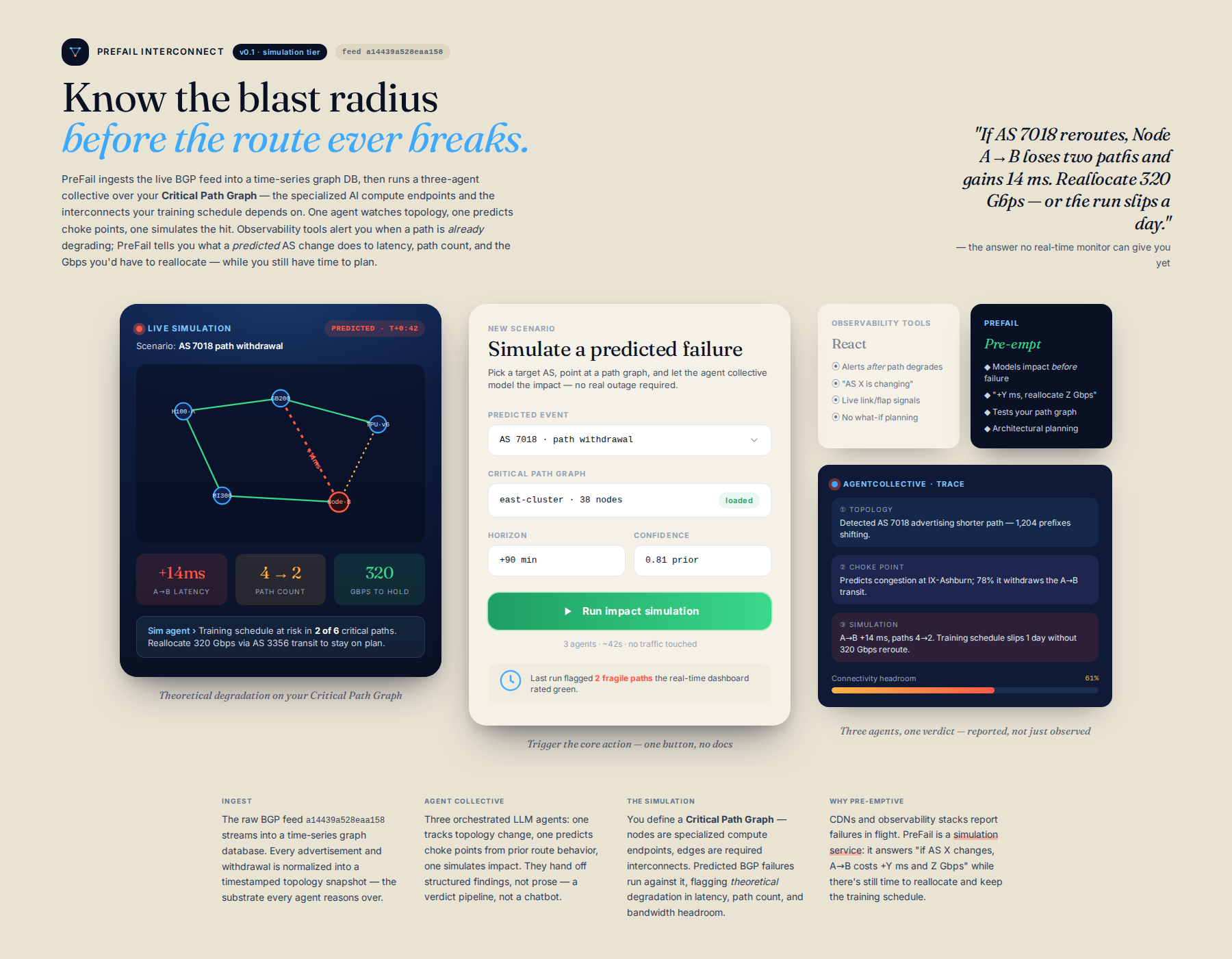
Simulate the impact of predicted BGP path degradations on your critical compute interconnects before they fail. The system takes your specialized hardware connectivity graph and runs simulations showing theoretical latency increases and bandwidth reallocation needs. This pre-emptive, scenario-based planning lets you calculate failover paths and required adjustments before external routing instability threatens your training schedule.
Process flow
Who it's for
Tier-1 AI Cloud Providers, Supercomputing Centers, and large-scale AI Model Developers.
Why they need it
Advanced AI workloads depend on maintaining ultra-low-latency, high-bandwidth connectivity between specialized hardware clusters (e.g., NVLink/InfiniBand fabrics). The critical, unaddressed risk is the lack of proactive simulation capability: clients cannot accurately pre-calculate failover paths or required bandwidth adjustments when an external BGP path change threatens access to their specialized compute endpoints. We move beyond mere alerting to providing pre-emptive architectural planning.
What it is
A dedicated, agent-orchestrated platform that ingests, normalizes, and models BGP routing table changes, allowing users to simulate the theoretical impact (latency, path count reduction) on predefined, critical compute connectivity graphs.
How it works
- Ingest the raw BGP feed (a14439a528eaa158) into a time-series graph database. 2. Deploy the 'agentcollective' framework: one agent monitors topology changes, a second predicts potential choke points, and a third simulates the impact. 3. (Revision Focus) The simulation agent ingests the client-defined 'Critical Path Graph' (nodes = specialized compute endpoints; edges = required interconnects) and runs simulations against predicted BGP failures, flagging the theoretical degradation in connectivity metrics.
Differentiation
Existing observability tools primarily provide real-time alerts on known path degradation or link failure. The gap we fill is the pre-emptive, simulation-based architectural planning. We do not just report 'AS X is changing'; we simulate: 'If AS X changes, the path between Node A and Node B will increase latency by Y ms, requiring a bandwidth reallocation of Z Gbps to maintain the current training schedule.' This is a simulation service, not just a monitoring service. (Cite gap vs. established CDNs/Observability IDs).
Implementation sketch
- Integrate BGP feed consumer into the 'agentcollective' environment.
- Develop a 'Topology Change Agent' to ingest and structure BGP updates into a queryable graph format.
- Build the Simulation Layer: The 'Predictive Agent' must be engineered to accept a client-provided 'Target Graph' (critical interconnect map) and run graph traversal algorithms (e.g., Dijkstra's) parameterized by simulated link failures derived from BGP predictions.
First step: Draft a detailed technical specification for the 'Target Graph' input schema, defining how a client would map their specialized interconnect nodes and required connectivity edges for the simulation engine.
Remaining risks
- The required input data (the 'Critical Path Graph' and its mapping to BGP ASNs) is proprietary, highly siloed, and requires deep, non-public access to client operational data, creating an insurmountable initial integration hurdle. — Initially scope the service to simulate the impact of BGP changes on publicly advertised connectivity between major cloud provider peering points (e.g., simulating the impact of a major IXP failure on advertised routes between AWS/Azure/GCP endpoints), thereby reducing reliance on proprietary internal interconnect maps.
- The simulation layer's computational complexity and latency requirements will exceed the practical constraints of a real-time, commercial SaaS offering, leading to high operational costs and poor user experience. — De-scope from 'real-time simulation' to 'on-demand, scheduled simulation.' Market the service as a 'Strategic Planning Tool' run nightly or weekly, rather than an always-on operational alert system, to manage performance expectations and costs.
- The core value proposition remains highly academic: proving a theoretical link between external routing instability and internal hardware failure modes. If the client's internal networking team dismisses the BGP data as too far removed from their immediate operational concerns, adoption stalls. — Develop a secondary, lower-risk module that focuses purely on network diversity scoring—alerting only when the BGP path count to a known endpoint drops below a statistically significant redundancy threshold (e.g., < 3 distinct AS paths), which is a more easily quantifiable and less speculative metric.
Watch for: Any signal or conversation suggesting that major cloud providers or supercomputing centers are developing internal, proprietary 'digital twin' simulation environments for network resilience that incorporate external BGP feeds. Kill criterion: If the primary target customer (Tier-1 Cloud Provider) confirms that their internal network assurance stack already possesses the necessary graph traversal algorithms and data ingestion pipelines to ingest BGP feeds and run customized failure simulations, rendering the 'agent-orchestrated' layer redundant.