
State Contract Definition Language (STDL) for Multi-Agent Workflows
A standardized, formal language defining the required state transitions and data contracts for multi-agent AI workflows, guaranteeing verifiable interoperability and predictability in complex autonomous systems.
How do I prevent multi-agent AI workflows from failing silently between steps?
Yes, by enforcing a formal state contract between agents instead of only validating data schemas. A specification language defines required inputs, permissible state transitions, and expected outputs at each hand-off; a lightweight validator checks each agent's output against the contract the next agent requires and halts the workflow with a specific violation report on failure. Intended for enterprise architects, governance teams, and developers building mission-critical multi-agent systems in finance and healthcare, where unchecked state drift causes opaque, unrecoverable failures.
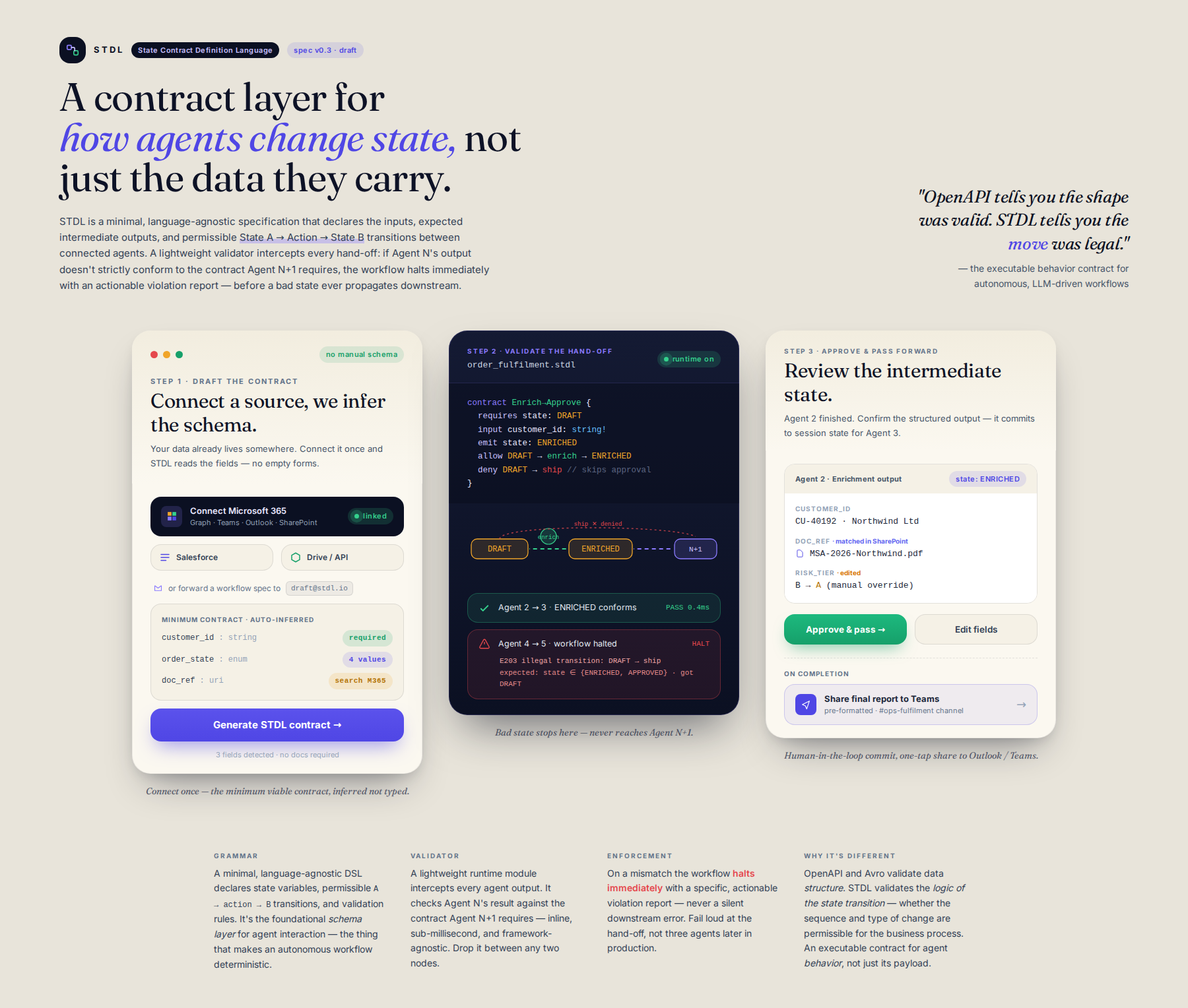
Process flow
Who it's for
Enterprise Architects, AI Governance Teams, and Developers building mission-critical, multi-agent enterprise applications.
Why they need it
The current ecosystem lacks a verifiable standard for state management in autonomous agents. Without a formal contract, complex workflows are brittle, leading to opaque, unrecoverable failures in high-stakes environments (e.g., finance, medical diagnostics). We must shift from measuring internal states to enforcing external, machine-readable state contracts.
What it is
A minimal, formal, and language-agnostic specification language (STDL) that defines the necessary inputs, expected intermediate outputs, and permissible state transitions between interconnected agents. It acts as the foundational 'schema' layer for agent interaction, making workflows deterministic.
How it works
- Define STDL Grammar: Create a DSL specifying state variables, required transitions (State A → Action → State B), and validation rules.
- Contract Validator: Develop a lightweight runtime module that intercepts agent outputs.
- Enforcement: The Validator checks if Agent N's output strictly conforms to the STDL contract required by Agent N+
- If validation fails, the workflow halts immediately with a specific, actionable contract violation report, preventing downstream errors.
Differentiation
Unlike general data schema validation (e.g., OpenAPI, Avro) which only validates data structure, STDL validates the logic of state transition itself—ensuring that the sequence and type of state change are permissible for the business process. The gap is the lack of a standard, executable contract layer that governs the behavior of autonomous, LLM-driven agents, not just the data they carry.
Implementation sketch
- Develop a minimal working grammar/DSL for STDL, focusing initially on JSON Schema augmentation to define state transitions.
- Build a proof-of-concept 'Contract Validator' using Python's Pydantic model validation against a simulated agent output stream.
- Map the STDL concept to a high-stakes, industry-specific use case (e.g., a 3-step financial compliance check) to define initial, concrete constraints.
First step: Draft a 5-page specification document detailing the STDL grammar, using a concrete example like 'Processing a Customer Refund Request' to define three mandatory, sequential state transitions and the required data payload for each step.
Remaining risks
- Adoption inertia and ecosystem lock-in. — Focus initial marketing and implementation efforts on integrating with one dominant, existing enterprise workflow orchestration platform (e.g., LangChain Enterprise, Microsoft Flow) to force adoption through compatibility rather than pure standard appeal.
- The 'Governance' vs. 'Utility' conflict. — Develop a tiered product roadmap: Tier 1 (Governance/Audit) for high-compliance industries (Finance/Health) where failure cost is highest. Tier 2 (Utility) for general developer use cases to build volume and visibility.
- Over-specification leading to complexity. — Strictly limit the initial scope of the STDL grammar to only the most critical, high-variance state transitions (e.g., success/failure/retry/escalate) and treat all other state changes as 'unvalidated' by default, keeping the core mechanism simple.
Watch for: A major, established industry player (e.g., IBM, Oracle, major cloud provider) announcing a native, first-class state contract layer for their agent/workflow services. This would signal the market has already solved the problem, rendering STDL redundant. Kill criterion: If the first three pilot customers cannot agree on a single, shared, high-stakes use case that requires STDL validation to prevent a multi-million dollar loss, the concept lacks sufficient commercial urgency.