
AgentSpec: Governance Protocol for Trustless AI Execution
A verifiable, open-source protocol and governance framework that mandates secure, governed, and financially responsible AI interactions across diverse, multi-cloud agent ecosystems.
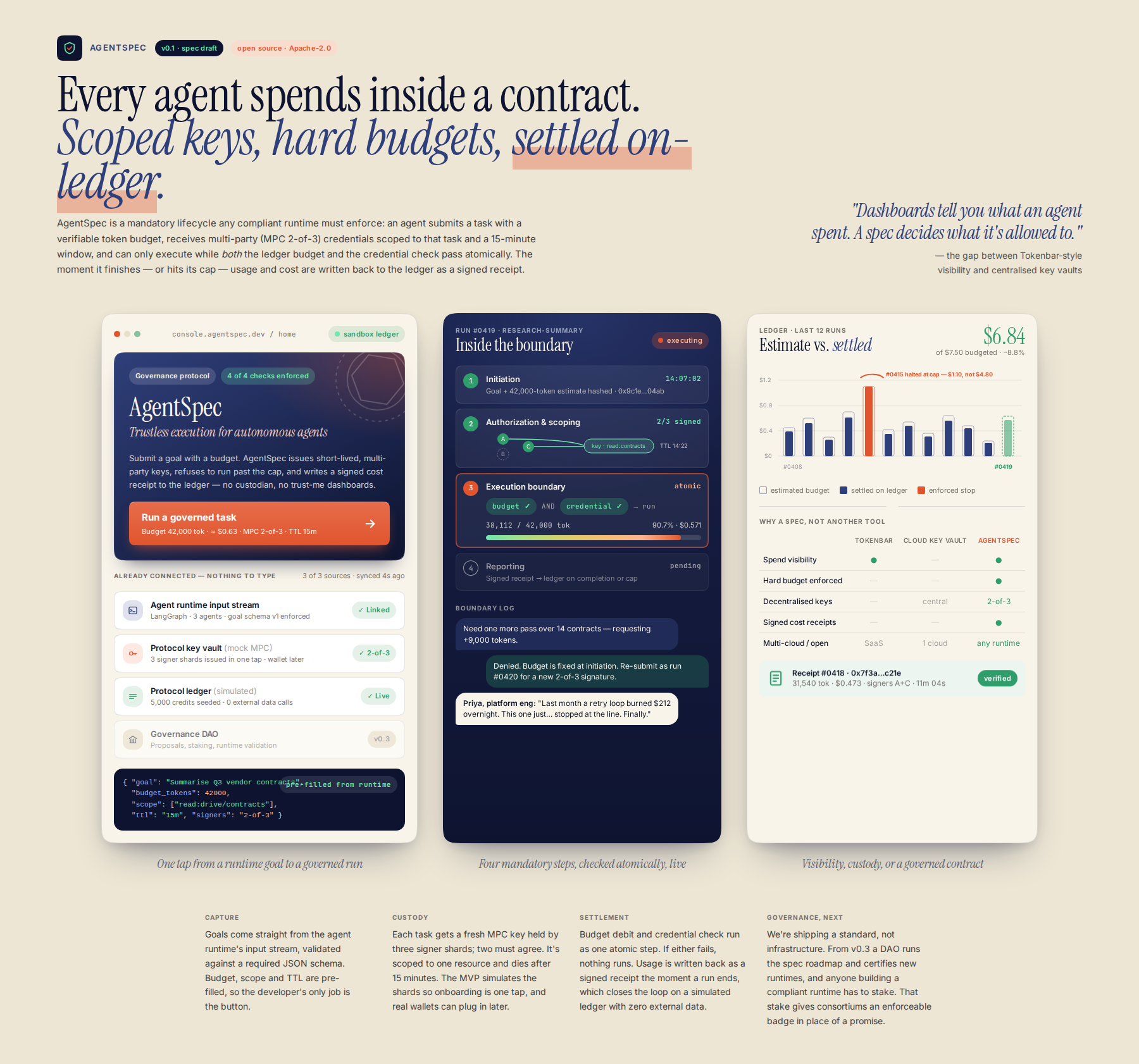
Process flow
Who it's for
Developers building complex autonomous AI agents, Web3 infrastructure teams, and industry consortiums defining the next generation of decentralized AI standards.
Why they need it
The market needs more than just a technical standard; it requires a mandatory adoption mechanism. Our protocol solves the unaddressed intersection of decentralized security and verifiable financial guardrails by defining the rules of safe execution, coupled with a governance layer (DAO) that incentivizes industry-wide compliance and adoption, moving it beyond a mere technical specification.
What it is
The AgentSpec Protocol and Governance Model: A standardized, auditable, and mandatory specification that dictates the full lifecycle of agent execution, from task submission to cost reporting. It includes the technical protocol (mandatory checks) and the economic layer (the governance DAO) required for industry-wide adoption.
How it works
The protocol defines the following mandatory steps, enforced by any compliant runtime:
- Initiation: Agent submits a task request and a verifiable, estimated token budget.
- Authorization & Scoping: The runtime executes a verifiable, multi-party credential generation mechanism (MPC/Multi-Sig) limited in scope and time.
- Execution Boundary: The protocol enforces atomic checks: budget validity (on-chain ledger) AND credential validity (MPC).
- Reporting: Mandatory, immediate, atomic reporting of usage and cost back to the ledger. Governance Layer: To ensure adoption, the protocol defines a governing DAO structure that manages the protocol's roadmap, validates new integrations, and issues compliance incentives (e.g., staking required to build a compliant runtime).
Differentiation
We are defining the mandatory specification and governance layer, not the infrastructure. This moves us from a brittle implementation to a resilient, reusable standard. We combine the mandatory spending control of the ideal pattern with the trustless, decentralized key management model, creating a complete, open-source contract that addresses the gap: the lack of a unified, governed standard for both financial guardrails and decentralized key management for autonomous agents. Existing tools like Tokenbar only provide visibility, and AWS Key Vault is centralized; neither offers this combined, governed standard.
Implementation sketch
- Finalize the core AgentSpec JSON/YAML specification, defining mandatory fields for budget, MPC scope, and reporting payload.
- Develop a reference implementation (e.g., in Rust/Go) that demonstrates the full protocol loop and includes mock integration points for the DAO governance logic.
- Draft the initial DAO whitepaper, detailing the governance token structure, membership requirements for compliance, and the incentive model for anchor clients.
- Build a comprehensive test suite verifying protocol compliance across all failure modes (e.g., budget exhaustion, credential failure, API downtime) and the DAO enforcement mechanisms.
First step: Draft the initial DAO governance charter and a 'Compliance Requirements' document, detailing which major Web3 infrastructure providers (e.g., key MPC providers, L2 networks) would be the initial anchor partners for validation and compliance.
Remaining risks
- Regulatory Overreach/Ambiguity: The intersection of autonomous agents, financial transactions, and key management is legally undefined. A sudden, adverse regulatory ruling (e.g., classifying agents as autonomous financial entities or requiring specific data localization) could render the entire protocol non-compliant or require costly, unforeseen modifications, regardless of technical perfection. — Structure the governance model to include legal experts and regulatory advisors from the outset. Focus initial compliance efforts on jurisdictions with clear digital asset or AI regulatory sandboxes, using early compliance as a marketing feature rather than a post-facto requirement.
- LLM Provider Lock-in/API Volatility: The protocol relies on external, proprietary LLM APIs (e.g., OpenAI, Anthropic). These providers maintain unilateral control over their APIs, pricing, and feature sets. They could change their terms, deprecate endpoints, or introduce a mandatory, non-compliant integrated billing solution, effectively bypassing the need for the AgentSpec protocol. — Design the protocol with extreme abstraction layers, treating the LLM provider as a highly volatile 'service endpoint' rather than a core dependency. Prioritize support for multiple, competing LLM providers from day one, making the protocol valuable even if one major provider changes its rules.
- Governance Capture/Stagnation: The DAO model, while solving the adoption problem, introduces the risk of governance capture by a single large entity (e.g., a major Web3 VC or infrastructure player). If the governance mechanism becomes centralized or overly slow, the protocol's ability to adapt to technical breakthroughs or market needs will stall, rendering it a desirable but inert standard. — Implement a genuinely distributed governance structure that mandates diverse voting power (e.g., weighting votes by technical contribution, financial stake, and regulatory compliance). Establish a clear, measurable process for 'forking' or creating a competing standard if the core DAO fails to act.
Watch for: A sustained lack of engagement from a major, non-Web3 infrastructure player (e.g., a major cloud provider like Google or Microsoft) to participate in the initial working group. This indicates the problem is viewed as niche or too complex for mainstream adoption. Kill criterion: A major, foundational LLM provider announces a proprietary, integrated, and mandatory billing and security layer that is demonstrably superior to the AgentSpec protocol and is adopted by the majority of the developer community.
Sources the council used
Real-world evidence that grounded this idea — judge it for yourself.