
Structured Data Intake Agent for Bookkeeping Process Validation
How do I validate bookkeeping data without manual entry errors?
Guide users through a structured input form for a single high-risk process—like mileage logging—and validate the collected data against best practices. An agent analyzes the structured input, assigns a completeness and compliance score, and flags specific discrepancies (e.g., missing receipt documentation). This shift from diagnosis to structured validation reduces false positives and focuses review effort on genuine gaps.
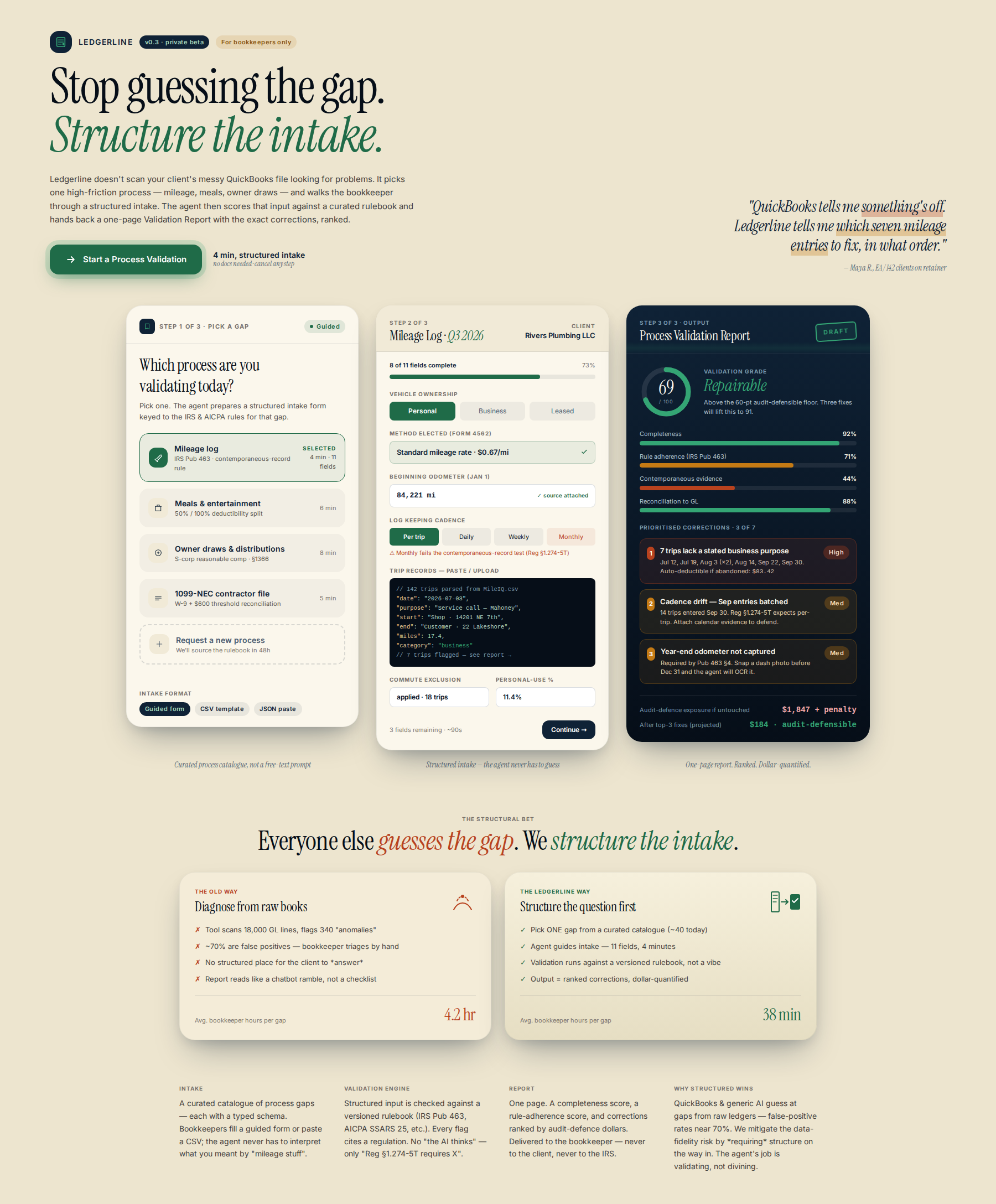
Process flow
Who it's for
Bookkeeping professionals
Why they need it
Bookkeepers waste significant time interpreting vague, recurring client data gaps that require subjective judgment and manual follow-up, leading to inefficiency and client friction.
What it is
A SaaS platform that prompts the bookkeeper to upload or input structured data (via guided forms/JSON) pertaining to a defined process gap, which the agent then validates, scores, and synthesizes into a concise, actionable 'Process Validation Report' for the bookkeeper.
How it works
- Data Intake: The system guides the bookkeeper through a structured input mechanism (e.g., a questionnaire or CSV upload template) for a single process gap (e.g., 'Mileage Log'). 2. Validation Engine: The LLM agent analyzes the structured input against a curated knowledge base of best practices for that process. 3. Reporting Module: Generates a 'Validation Report' detailing completeness, adherence to rules, and a prioritized list of required corrections, delivered solely to the bookkeeper's dashboard.
Differentiation
Existing tools (e.g., QuickBooks, general AI analysis) attempt to diagnose gaps from raw, unstructured data, leading to high false positives. Our differentiation is the structured intake layer: we do not guess the gap; we guide the user to provide the necessary data in a structured format, and our agent's value is validating that structure against best practices, thereby mitigating the data fidelity risk.
Implementation sketch
- Define the MVP scope: Focus exclusively on 'Mileage Log' validation, requiring a structured input format (e.g., Date, Start Location, End Location, Purpose, Distance).
- Develop the guided input UI/form that forces the bookkeeper to structure the data collection from the client.
- Prompt engineer the agent to compare the structured input against a hard-coded set of business rules (e.g., 'Distance must correlate logically with start/end points').
- Build the output: A simple dashboard showing 'Validation Score' and a 'Top 3 Action Items' checklist.
First step: Draft the precise JSON schema/template required for the 'Mileage Log' process gap. This defines the structured input the bookkeeper must guide the client to provide, making the technical scope immediately concrete.
Remaining risks
- Adoption Friction in the Workflow (Bookkeeper Side) — If the process of using the structured intake form (even if guided) is perceived by the bookkeeper as adding more manual work (i.e., they have to coach the client and use the tool), the perceived efficiency gain will be lost. The value proposition must shift from 'validation' to 'time saved on review/dispute resolution.' Focus initial marketing on the time saved by reducing client pushback, not just by validating data.
- Scope Creep on Process Definition (Knowledge Base) — The knowledge base of 'best practices' for a single process (Mileage Log) is manageable. However, the moment the team considers adding a second process (e.g., Inventory Tracking, Contractor Payments), the complexity of defining the 'hard-coded business rules' and the required structured input schema explodes exponentially. The team must enforce a strict, multi-year roadmap commitment to only tackle one process until it achieves market saturation/proof of concept.
- Regulatory Classification Ambiguity — Even if the tool only validates structured data, the act of advising on financial compliance (e.g., 'This mileage calculation is incorrect for tax purposes') touches on professional advice territory. The platform must be architected from Day 1 with explicit, non-negotiable disclaimers stating it is a data validation tool and not a substitute for CPA advice. Legal review must be integrated into the core feature set, not bolted on.
Watch for: If bookkeepers begin asking, 'What if I just give you a spreadsheet of my 10 most common problems?' This signals they are bypassing the structured input layer because they believe the agent should be able to intuit the structure, indicating a failure in the structured intake design. Kill criterion: If the first 5 pilot bookkeepers cannot articulate the value of the structured input mechanism (i.e., they don't understand why they have to fill out the form vs. just sending raw data), the core differentiation premise is flawed, and the product needs to pivot entirely away from structured input.
Sources the council used
Real-world evidence that grounded this idea — judge it for yourself.