
Automated Vendor Asset Risk Scoring Engine
An AI framework that ingests vendor-supplied asset configurations and automatically calculates a quantifiable 'Operational Risk Score,' prioritizing remediation efforts based on measurable security deviation from established internal baselines.
How can we quantify vendor security risk instead of drowning in compliance checklists?
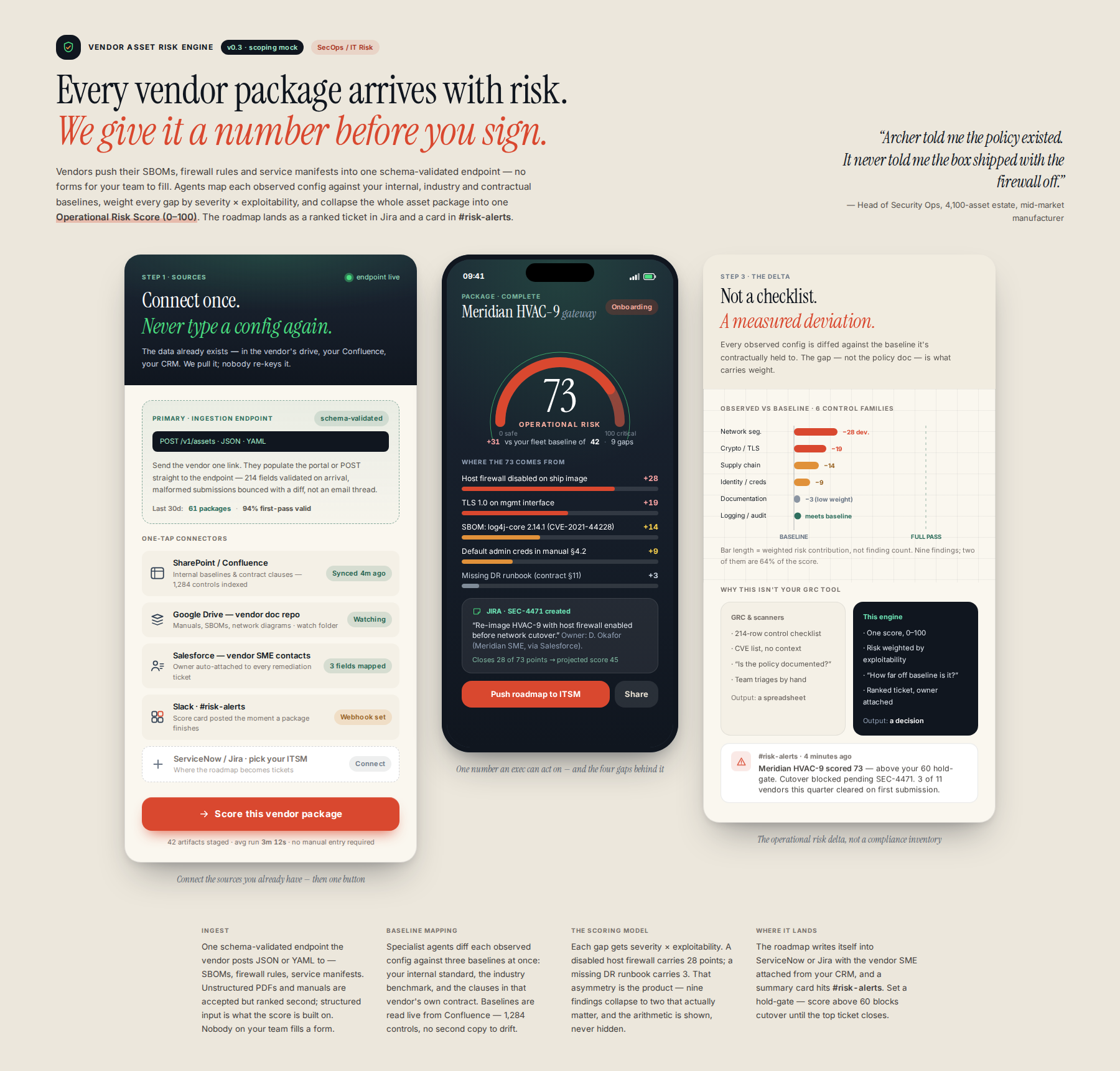
Vendor security risk can be quantified with an automated scoring engine that ingests vendor artifacts like SBOMs, config files, and manuals, then maps them against internal, regulatory, and contractual baselines. A scoring agent weighs the severity and exploitability of each gap—such as a disabled firewall versus missing documentation—to produce a single 0-100 'Operational Risk Score' with a drill-down showing exactly which failures drove it. This is built for security operations managers and IT risk teams, replacing unprioritized compliance backlogs with a ranked remediation roadmap fed directly into their ITSM tool.
Process flow
Who it's for
Security Operations Managers and IT Risk Teams responsible for vendor onboarding and asset management.
Why they need it
Manual security vetting of vendor assets is slow, prone to human error, and results in massive, unprioritized compliance backlogs. The critical gap is translating technical non-compliance into immediate, quantifiable business risk.
What it is
A multi-agent system that ingests diverse vendor artifacts (SBOMs, config files, manuals) and processes them through a risk scoring model. Instead of generating a checklist, it outputs a single, actionable 'Operational Risk Score' (0-100) and a prioritized remediation roadmap.
How it works
- Ingest & Normalize: System ingests vendor documentation and raw configuration data (e.g., firewall rules, service manifests).
- Baseline Mapping: Specialized agents map observed configurations against internal, industry-standard, and contractual security baselines.
- Risk Calculation: A core scoring agent calculates the 'Operational Risk Score' by weighting the severity and exploitability of identified gaps (e.g., disabled firewall = high weight; missing documentation = low weight).
- Output & Prioritization: Outputs a single, prioritized score and a suggested remediation ticket directly into the client's ITSM tool, focusing the team's attention on the highest risk items first.
Differentiation
Unlike traditional GRC platforms (e.g., Archer, ServiceNow GRC) which focus on policy documentation and checklists, or simple vulnerability scanners (e.g., Nessus) which only report CVEs, this system focuses on the operational risk delta. It quantifies the risk introduced by the entire asset package upon integration, providing a single, executive-digestible metric (Operational Risk Score) that guides immediate resource allocation, rather than managing a list of compliance failures.
Implementation sketch
- Develop a core agent orchestrator capable of managing specialized auditors (e.g., Config Auditor Agent, Policy Agent).
- Build a standardized data pipeline to ingest and normalize disparate vendor data sources (e.g., JSON, YAML, raw text, SBOMs).
- Develop the initial scoring model: Define weighted risk factors (Severity * Likelihood * Impact) and map them to the 0-100 score.
First step: Draft a proof-of-concept scoring matrix using 3 known vendor asset types (e.g., Router, Server VM, SaaS Connector) and manually assign weights for 5 critical failure modes (e.g., No MFA, Outdated OS, Unrestricted Port). Use this matrix to calculate a dummy 'Risk Score' for a known 'bad' configuration file.
Remaining risks
- The 'Operational Risk Score' becomes a 'Black Box' metric, leading to distrust from end-users (Security/IT Managers). If the scoring model is perceived as arbitrary or opaque, teams will ignore the score and revert to manual, familiar processes. — The system must provide full, auditable transparency for every point contributing to the score. Instead of just outputting 'Score: 85,' it must generate a drill-down report showing: 'Score 85 derived from: (A) MFA Missing [Weight: 30] + (B) Outdated OS [Weight: 25] + (C) Unrestricted Port [Weight: 20]...' This grounds the score in traceable technical evidence.
- The 'Baseline Mapping' agents become overly complex and brittle. Different industries (Finance vs. Healthcare vs. Retail) have vastly different, non-standardized regulatory requirements, making a single, universal 'Internal Baseline' impossible to define or maintain. — The system must adopt a modular, plug-in architecture for baselines. Instead of building one master baseline, it should ingest external regulatory profiles (e.g., HIPAA, PCI-DSS, SOC 2) and allow the client to select and weight multiple applicable profiles simultaneously, creating a composite, weighted baseline rather than a single standard.
- The 'Ingest & Normalize' pipeline fails when encountering novel or proprietary vendor formats (e.g., specialized industrial control system manifests or undocumented legacy hardware outputs). This forces the system back into manual intervention, negating the 'automation' promise. — Invest heavily in a low-code/no-code 'Schema Definition Layer.' When a new data format is encountered, the system should prompt the internal user to map the fields of the new data to existing internal control concepts (e.g., 'This field labeled 'Firmware Version' maps to our internal 'Patch Level' control'). This turns the data ingestion bottleneck into a guided, repeatable knowledge-capture process.
Watch for: Any early indication that the highest-value use case requires interpreting intent or business process (e.g., 'This firewall rule is necessary for our proprietary billing process') rather than just technical configuration state. If the solution needs to reason about why a gap exists, the scoring model is insufficient. Kill criterion: If the core scoring model cannot be demonstrated to calculate a meaningful, differential score (i.e., if the difference between a 'bad' score and a 'good' score is merely a matter of adding or subtracting weights without changing the nature of the risk), the product is merely a sophisticated checklist and should be scrapped.
Sources the council used
Real-world evidence that grounded this idea — judge it for yourself.