
Verifiable Governance Layer for Regulated Knowledge Graphs
A specialized middleware platform that enforces auditable trust and lineage tracing over existing, siloed, and high-stakes enterprise knowledge graphs, directly mitigating regulatory risk at the point of AI context retrieval.
How can I prove to auditors that AI-retrieved context from our knowledge graph is trustworthy and compliant?
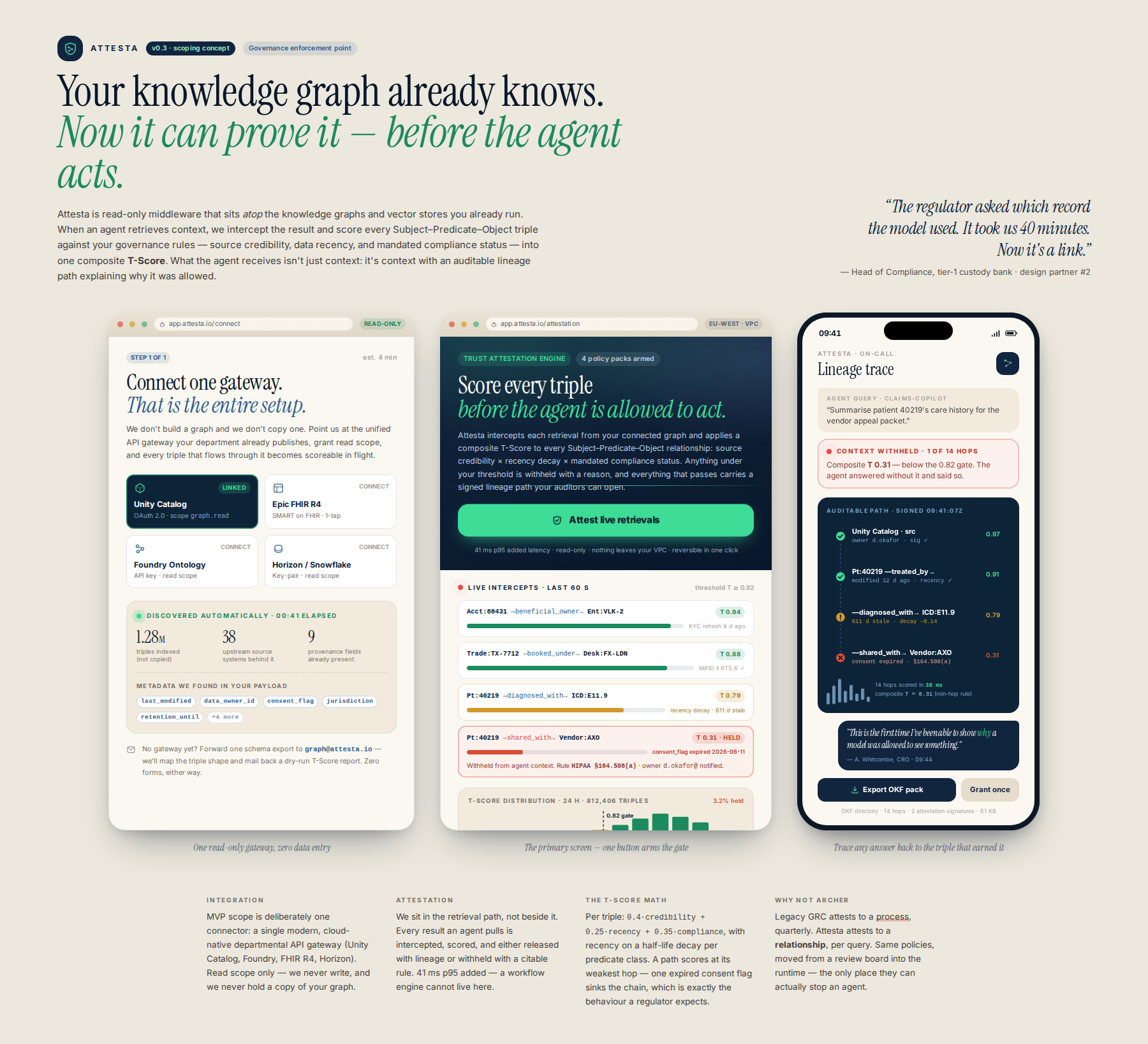
A trust attestation layer that sits between existing knowledge graphs and AI agents can score every retrieved fact before it's used, rather than requiring you to rebuild the graph. It applies a composite Trust Score to each subject-predicate-object triple based on source credibility, data recency, and mandated compliance flags, then returns a full audit trail showing why the context passed or failed. Aimed at CROs and compliance teams in finance and healthcare, it lets agents refuse context that falls below a governance threshold, turning compliance checks into a real-time gate rather than a after-the-fact review.
Process flow
Who it's for
Chief Risk Officers (CROs), Heads of Compliance, and AI Governance Teams in regulated industries (Finance, Healthcare).
Why they need it
AI context grounding fails in regulated environments because the system cannot prove why the context is trustworthy, leading to non-compliance risk (e.g., GDPR, HIPAA violations) when using unverified data.
What it is
A secure, attribution-focused middleware layer that sits atop existing Knowledge Graphs (KGs) and Vector Databases. It functions as a 'Trust Attestation Engine,' intercepting and scoring every retrieved relationship pathway against defined, auditable governance rules before the agent is permitted to act.
How it works
- Integration (Focus): Connects via APIs to existing, domain-specific KGs (e.g., medical record systems, transaction logs).
- Attestation: When an agent queries context, the platform intercepts the results. It does not build the graph; it scores the relationships.
- Scoring & Tracing: It applies a composite Trust Score (T-Score) to every Subject-Predicate-Object triple, aggregating source credibility, data recency, and mandated compliance status. The output is not just context, but a complete, auditable lineage path showing why the context is trustworthy and compliant.
Differentiation
Unlike general KG builders or basic RAG systems, our solution is explicitly a governance enforcement point. We solve the trust gap by providing an executable, quantifiable compliance check. We are superior to existing GRC tools (e.g., Archer, ServiceNow GRC) because we embed the policy check directly into the real-time context retrieval loop, offering operational speed and granularity that traditional workflow engines cannot match.
Implementation sketch
- Develop a standardized API wrapper that accepts structured query results (triples) from an upstream KG/Vector DB.
- Implement the core Trust Scoring Algorithm (T-Score) incorporating weights for source type, data recency, and mandatory compliance flags.
- Build a read-only, auditable endpoint that returns the context and the full T-Score breakdown, enabling agents to fail gracefully (refuse context) if the score falls below the pre-set governance threshold.
First step: Draft a detailed technical specification for the T-Score API endpoint, focusing solely on accepting a batch of 100 triples and returning a JSON array containing the score, the failure reason (if applicable), and the specific compliance rule violated, using a simulated, highly regulated dataset (e.g., mock HIPAA data points).
Remaining risks
- Regulatory Scope Creep/Definition Drift: The definition of 'compliance' and 'trust' is inherently fluid and defined by changing laws (e.g., new interpretations of GDPR, sector-specific mandates). The system risks becoming obsolete the moment a major regulation updates or a new industry standard emerges. — Design the T-Score algorithm not as a fixed set of rules, but as a meta-rules engine. The primary deliverable must be a 'Compliance Rule Ingestion API' that allows legal/governance teams to upload, version, and test new regulatory rule sets (e.g., 'IF Data_Type=PII AND Region=EU AND Source_Trust<0.8 THEN FAIL').
- Integration Debt and Data Schema Heterogeneity: Even by limiting scope to 'existing KGs,' the underlying data sources (e.g., different hospital EHR systems, legacy financial mainframes) will use incompatible schemas, vocabularies, and data models. The middleware will become a complex, brittle translation layer for every single client, leading to unmanageable technical debt. — Mandate the use of a standardized, industry-agnostic ontology layer (e.g., FHIR for healthcare, FIBO for finance) before the middleware layer. The initial sales cycle must focus on proving value by mapping the client's existing data to this agreed-upon external standard, making the standardization effort the paid, initial service.
- Operational Overhead vs. Value Proposition: CROs and Compliance Officers are already overwhelmed by existing GRC tools (Archer, etc.). Introducing a new, mandatory 'gate' layer adds friction to the existing workflow, potentially leading to organizational rejection because the perceived overhead of governance exceeds the perceived risk reduction. — Focus initial marketing and proof-of-concept demonstrations exclusively on 'Audit Failure Simulation.' Instead of showing how it enables action, show how it stops an action and generates an immediate, perfect audit trail proving non-compliance, which is a much more emotionally resonant pain point for risk officers.
Watch for: Any resistance from the target buyer (CRO/Compliance) to defining the 'failure state' or the exact threshold for the T-Score. If they cannot agree on what constitutes an unacceptable risk threshold, the product has no measurable output. Kill criterion: If the initial pilot client cannot provide a clear, quantifiable, and legally actionable 'Failure Scenario' that requires the T-Score mechanism to prevent a regulatory violation, the product lacks a concrete, urgent, and measurable value proposition.
Sources the council used
Real-world evidence that grounded this idea — judge it for yourself.