
MatterFlow: Agent-Powered Inventory & Operational Cost Orchestrator
An autonomous, multi-stage AI agent system providing real-time, end-to-end physical inventory tracking for small manufacturers, coupled with a foundational, automated Cost of Goods Sold (COGS) ledger.
Can AI automate raw-material-to-finished-goods inventory tracking for a small manufacturer?
Yes: an agent-based system can read a Bill of Materials, simulate production runs, and automatically deduct raw materials while incrementing finished goods, logging every transfer for an audit-ready ledger. It targets small manufacturers whose physical inventory logic outgrows spreadsheets or QuickBooks but who can't justify a full ERP. A separate reporting agent also generates a preliminary, material-cost-based COGS report, giving owners cost-basis visibility without manual reconciliation.
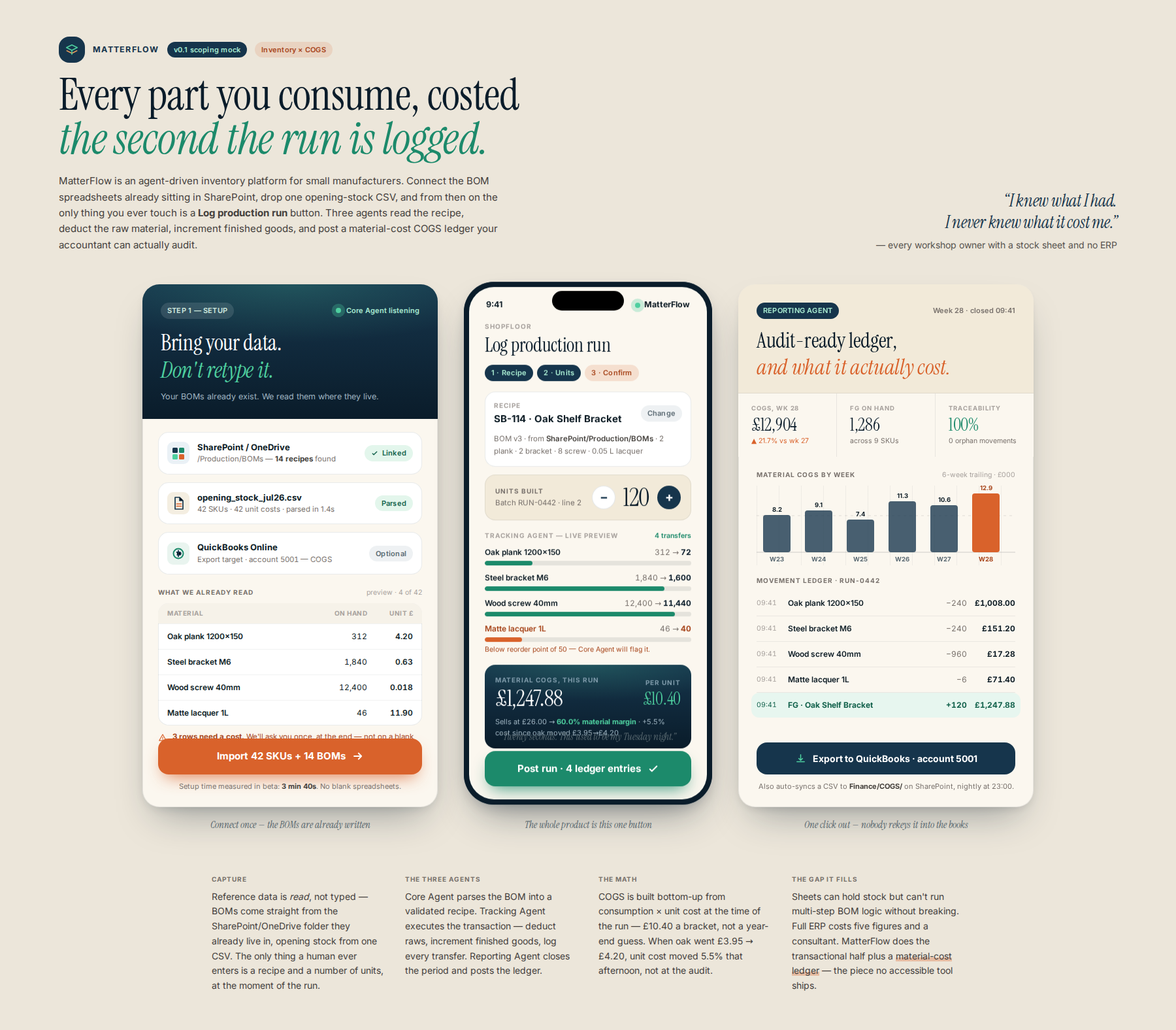
Process flow
Who it's for
Small business owner managing physical goods and requiring basic material cost visibility.
Why they need it
Existing tools (QuickBooks Online) fail to automate the complex, multi-step transactional logic of raw materials to finished goods. Furthermore, owners need automated visibility into the material cost basis of their output to manage profitability.
What it is
A modular, agent-driven SaaS platform that ingests raw material manifests, tracks consumption via simulated production runs, outputs fully traceable finished goods inventory levels, AND calculates a preliminary, material-cost-based COGS ledger.
How it works
- User inputs initial raw material stock data (via CSV/manual entry) and associated unit costs.
- The Core Agent reads the Bill of Materials (BOM) and defines the production recipe.
- The Tracking Agent simulates the production workflow, deducting consumed raw materials and incrementing finished goods stock, logging every transfer event.
- The Reporting Agent generates an audit-ready ledger (inventory movements) AND a dedicated COGS report that calculates the cost basis of goods consumed.
Differentiation
This platform differs from s3 (Google Docs/Sheets) because it automates complex, multi-step BOM transactional logic, eliminating manual data entry errors. It surpasses s1 and s2 because it is a functional, integrated tool. Crucially, it bridges the operational gap with the necessary material cost tracking gap by integrating a foundational COGS ledger, which is not natively available in accessible, non-ERP tools.
Implementation sketch
- Build the core agent framework using the agentcollective architecture to handle discrete state transitions (e.g., 'Raw Material Received' -> 'In Production' -> 'Finished Goods').
- Develop a structured API layer to ingest and validate BOM/Recipe JSON files, requiring mandatory 'Unit Cost' fields for all raw materials.
- Implement a simplified, local-first UI for basic input and status visualization, prioritizing data integrity, and building the COGS calculation logic into the final reporting agent.
First step: Draft the core BOM/Recipe JSON schema, ensuring it includes fields for 'Material ID', 'Quantity Required', and 'Unit Cost ($)' to guide the initial data ingestion API endpoint.
Remaining risks
- Data Ingestion Complexity & User Friction: Forcing users to input mandatory 'Unit Cost' data for every raw material (as required by the locked spec) significantly increases the initial setup burden and ongoing data maintenance effort, potentially causing users who are already struggling with manual data entry to abandon the tool. — Implement a 'Cost Source' module where users can upload invoices or purchase order summaries (e.g., a PDF batch) which the agent attempts to parse and populate the unit costs, rather than requiring manual entry for every single item.
- Scope Creep Misinterpretation: The integration of COGS, while necessary, might lead users or stakeholders to assume the tool handles full accounting functions (e.g., depreciation, overhead allocation, tax liability), leading to unmet expectations when they realize it is only a 'material cost basis' tracker. — The UI and all documentation must aggressively and repeatedly use qualifying language, such as 'Preliminary Material Cost Basis,' 'Operational Estimate Only,' and explicitly state that it is not a certified accounting ledger.
- Agent State Management Failure: The multi-stage, transactional nature (Tracking Agent) is highly complex. If the agent fails to correctly transition states or reconcile material consumption across multiple, partially completed production runs, the resulting inventory and COGS ledger will become instantly untrustworthy, leading to catastrophic operational decisions by the user. — Implement an aggressive, read-only 'Audit Log' view that allows the user to manually step back through the agent's state transitions and verify the calculation at each step, building trust through transparency rather than pure automation.
Watch for: Any indication that the target user base is more concerned with regulatory compliance (e.g., GAAP/IFRS adherence) than with operational tracking efficiency, as this signals the need for a full, expensive ERP integration. Kill criterion: If initial testing reveals that the average time required for a user to successfully input the BOM and the associated unit costs exceeds 30 minutes, the current data input model is unviable for the intended small business owner.
Sources the council used
Real-world evidence that grounded this idea — judge it for yourself.
- reddit.com
- reddit.com
- selecthub.com
- softwareconnect.com
- docs.google.com
- alternativeto.net
- reddit.com
- reddit.com