Agentic Code Review for Local Models: Structured Validation Assembly
A system using multiple local LLMs as specialized agents to autonomously audit proprietary codebases by generating distinct, structured, machine-verifiable reports for developer review.
Can AI code review agents actually be trusted, or do they just hallucinate summaries?
Narrative AI code review summaries risk hallucination and hide conflicting findings, so a structured multi-agent approach instead runs separate local LLMs as specialized reviewers (security, performance, style) that each output findings in a strict, machine-verifiable JSON schema rather than a merged narrative. Developers review distinct, discrete reports per domain and manually reconcile any conflicts, avoiding a single AI-synthesized verdict that could mask errors. It's aimed at small teams or individual developers working on sensitive or proprietary codebases who need verifiable audit artifacts, not prose summaries.
Process flow
Who it's for
Small development teams or individual developers working with sensitive or proprietary codebases, especially those integrating multiple specialized LLM workflows.
Why they need it
The complexity of local, specialized LLMs running on private infrastructure creates an unmanaged risk surface. Relying on narrative summaries introduces unacceptable risks of hallucination and ambiguity; therefore, the system must provide discrete, verifiable artifacts.
What it is
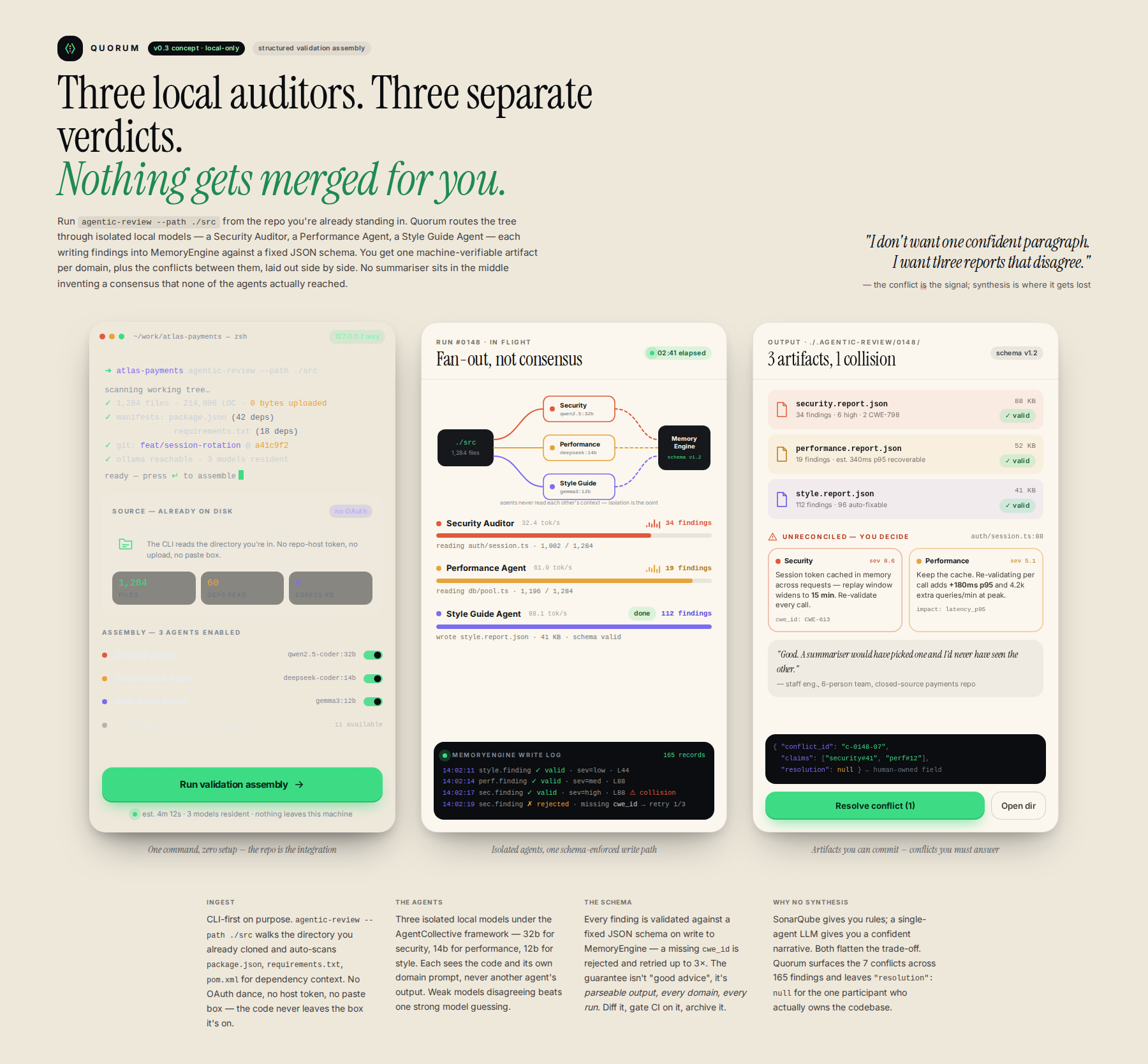
A multi-agent orchestration framework that executes specialized code reviews (security, performance, style) using distinct local LLMs. It outputs a consolidated set of structured JSON reports, one artifact per specialized domain, rather than a single synthesized summary.
How it works
- Ingest the target code repository or file set.
- Route the code through specialized agents (e.g., 'Security Auditor Agent', 'Performance Agent', 'Style Guide Agent') running via the Agentcollective framework.
- Each agent performs its analysis and outputs findings to a central memory repository (Memoryengine) strictly adhering to a predefined, structured JSON schema.
- The system presents the human developer with a collection of these distinct, structured JSON reports, forcing manual, domain-specific review and resolution of conflicts.
Differentiation
Unlike standard static analysis tools (e.g., SonarQube) or single-agent LLM reviews, this system leverages the synergistic weakness-combining ability of multiple, isolated local agents. Its core value is the guarantee of structured output across multiple domains, directly addressing the gap of 'Holistic, Multi-Perspective, Locally-Verified Auditing' where conflicting reports must be manually reconciled by the developer, rather than being synthesized into a potentially flawed narrative.
Implementation sketch
- Prototype the multi-agent communication layer using the Agentcollective structure.
- Define and enforce a strict, standardized JSON output schema for every specialized agent's findings (e.g.,
{'file': str, 'line': int, 'severity': str, 'issue': str, 'suggested_fix': str}). - Develop the 'Report Assembly' logic to ingest and present the set of structured JSON reports, rather than attempting to merge them into one artifact.
First step: Implement a mock Agentcollective communication layer that accepts three distinct JSON inputs (Security, Performance, Style) and prints them sequentially to confirm the structured data transfer mechanism is robust before integrating actual LLM calls.
Remaining risks
- The 'Report Assembly' logic, while avoiding synthesis, still requires the developer to manually reconcile conflicting findings across multiple structured reports (e.g., Security Agent flags a function as insecure, but Performance Agent flags the same function as optimal). The cognitive load of cross-referencing multiple JSON artifacts could become a new, unmanaged bottleneck. — Develop a visualization or dashboard layer that groups findings by file/line number, flagging conflicts explicitly (e.g., 'Conflict: Security suggests X, Performance suggests Y. Developer choice required.') to reduce cognitive load and guide manual resolution.
- The reliance on multiple, specialized local LLMs introduces significant overhead in terms of inference cost, latency, and hardware requirements. If the combined latency of three or more agents exceeds the time saved by the review, the tool becomes a productivity drag. — Implement a tiered execution strategy: allow the user to select the minimum necessary agents based on the code context (e.g., only run 'Security Auditor' if the code touches network I/O; only run 'Performance Agent' on computationally intensive modules). Benchmark and publish clear latency SLAs.
- The system assumes that the output structure (JSON) is the primary value. However, if the specialized agents are highly sensitive to prompt engineering or local model version drift, a minor change in the underlying model (e.g., switching from Llama 3 8B to 7B) could cause the structured output schema to break silently, leading to an unusable 'successful' run. — Integrate a runtime schema validation and self-testing mechanism. Before presenting the reports, the system must run a small, deterministic test case against the output structure to confirm compliance, failing loudly if the schema contract is violated.
Watch for: If developers start using the structured reports as a checklist rather than a guide—i.e., they only fix issues flagged by the tool and ignore other necessary refactors—it signals that the tool is becoming a mandatory, restrictive gatekeeper, which is a fragile dependency. Kill criterion: If the time taken for the 'Report Assembly' to ingest and present the structured reports consistently exceeds 15% of the estimated time a human developer would spend performing the same manual cross-domain review, the value proposition is negated.