Intelligent Data Provenance Agent for Verifiable Workflows
An autonomous agent system that standardizes, validates, and secures multi-stage data pipelines, ensuring verifiable data provenance across any critical workflow—from small business compliance records to advanced ML model training.
How can I make sure data stays accurate and traceable across a multi-step pipeline?
An agent-based provenance framework can validate and track data at every stage of a pipeline, from a single form submission to complex ML preprocessing. It models the workflow as a graph, running validation agents that check schema and null values for business processes or deep structural and encoding integrity for ML data, then outputs a verified, auditable artifact showing exactly how the data was transformed. It's built for mid-sized businesses needing compliance audit trails and AI/ML developers handling sensitive data.
Process flow
Who it's for
Mid-sized businesses needing compliance/audit trails, and AI/ML developers working with sensitive data.
Why they need it
Modern operations fail when data sources are inconsistent or transformations are opaque. We solve the universal need for reliable, verifiable data flow, whether the process is a simple form submission or complex code filtering.
What it is
A specialized, stateful agent framework that treats all data transformation stages—from initial input to final output—as verifiable, self-correcting computational graphs.
How it works
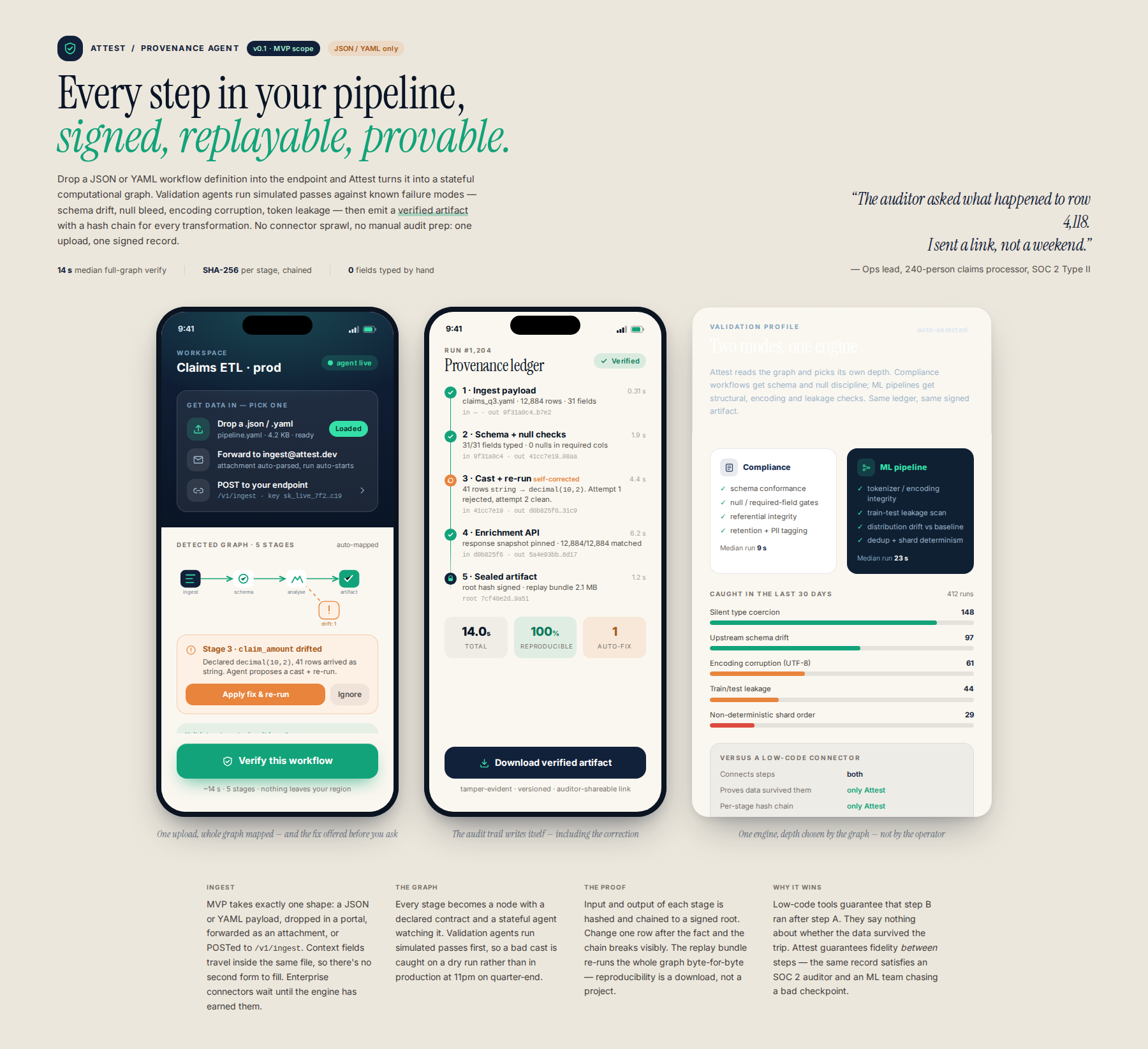
- Workflow Definition: User defines the desired data transformation sequence (e.g., Form Submission -> API Call -> Analysis, or Source Code -> Filter -> Tokenize).
- Adaptive Ingestion: The framework ingests initial data (structured, unstructured, or raw code) and maps required transformations against known failure modes.
- Autonomous Validation: Validation agents execute simulated runs, identifying discrepancies or drift. The system dynamically applies validation logic: basic schema/null checks for business workflows, or deep structural/encoding integrity checks for ML pipelines.
- Verified Artifact: The system outputs a verified, reproducible artifact, providing an auditable, traceable provenance record for every step taken.
Differentiation
Existing low-code tools are too general, lacking the programmatic depth to verify data transformation integrity. Unlike general workflow tools, our system doesn't just connect steps; it guarantees the fidelity of the data passing between them, creating a verifiable, auditable provenance record suitable for both regulatory compliance and advanced AI development.
Implementation sketch
- Build a core graph representation model (e.g., using a directed acyclic graph structure) to map the data flow.
- Develop a modular validation agent interface capable of accepting pluggable validation modules: one for schema/business rules (p1/p2) and one for deep structural/encoding checks.
- Implement a 'Use Case Selector' layer to guide the user in defining the required validation depth, managing the technical complexity.
First step: Create a minimal, proof-of-concept graph structure in Python/Pydantic that can model three nodes: Input -> Transformation A -> Output, and successfully validate that the Output schema matches the expected schema, regardless of whether the transformation is a simple JSON merge or a placeholder for a complex filtering function.
Remaining risks
- Over-engineering the MVP scope by trying to solve both low-complexity business process automation (p1/p2) and high-complexity ML data provenance simultaneously. This risks creating a product that is too complex, too expensive to build, and too difficult for any single user segment to adopt. — Strictly define the MVP scope by selecting ONE primary target user (either SMB compliance or ML Dev) and building the initial feature set only for that niche. Defer the other use case until the core technical mechanism is proven viable in the first niche.
- The 'Use Case Selector' layer becomes a point of failure, forcing the user to become an expert in which validation layer they need (basic schema vs. deep graph theory), leading to user confusion and adoption friction. — Abstract the complexity. Instead of a selector, build a 'Confidence Score' mechanism. The system should automatically suggest the appropriate validation depth based on the type of input data provided (e.g., if it detects code syntax, automatically enable deep integrity checks).
- The technical jargon ('computational graphs,' 'provenance record') alienates the core SMB user base (p1/p2), who are looking for simple, reliable 'audit trails' without needing to understand Directed Acyclic Graphs (DAGs). — Develop a parallel, non-technical user interface layer for the SMB segment. This UI must translate complex graph validation failures into plain-language, actionable business risks (e.g., 'Warning: 15% of records are missing the required Customer ID field, halting compliance audit').
Watch for: If early user feedback consistently asks, 'Can this just do X simple thing?' without referencing data fidelity, provenance, or graph structure, it signals that the technical novelty is irrelevant to the immediate pain point. Kill criterion: If initial testing reveals that the cost/time required to build the validation module for the least complex use case (e.g., basic JSON validation for p1/p2) is disproportionately high compared to the perceived value gain over existing low-code tools (s1/s3).
Sources the council used
Real-world evidence that grounded this idea — judge it for yourself.