
Autonomous Decision Orchestration Engine for SMB Intelligence
How can I automate go/no-go business decisions by combining data from multiple disconnected sources?
An agent-driven platform synthesizes actionable business decisions by orchestrating data acquisition from 3+ disparate sources and logical inference across them. You define the decision logic (e.g., lead scoring rules), and the system deploys micro-agents to gather required inputs, then runs a reasoning layer that synthesizes a recommendation based on combined state. This moves beyond data aggregation to provide synthesized, actionable intelligence for complex business decisions.
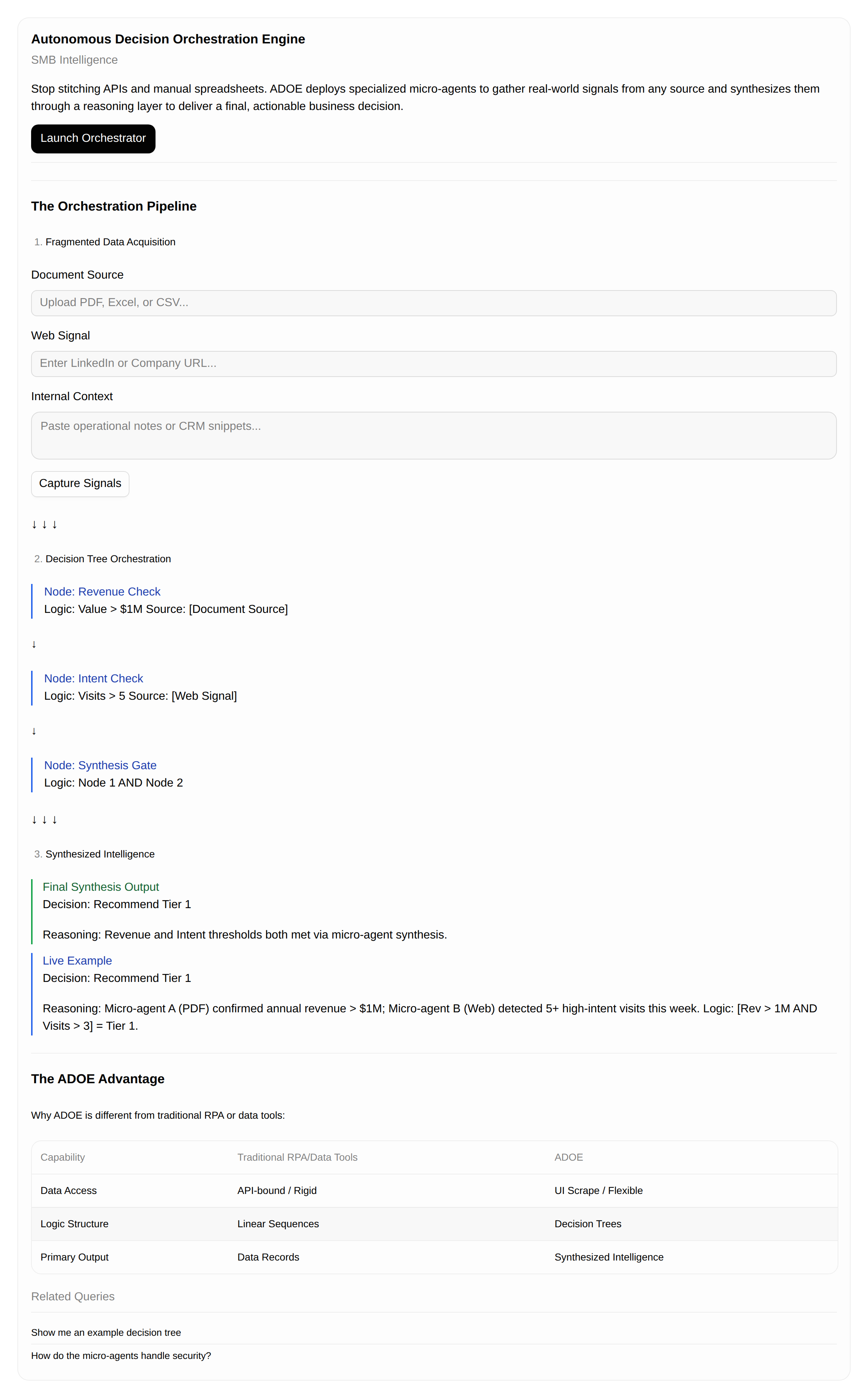
Process flow
Who it's for
Small business owner or operations manager needing to automate complex decision-making based on fragmented, real-world data signals.
Why they need it
They cannot manually synthesize intelligence by pulling data from disconnected sources (e.g., a lead's web activity, a CRM entry, and an industry report) to make a critical go/no-go decision. Current tools are either data-movers or simple automation scripts, not decision synthesizers.
What it is
A system utilizing a visual workflow builder where the user defines a decision tree (the desired outcome) rather than a data flow. Specialized 'micro-agents' execute the necessary data gathering (UI scrape, file parse) and feed the results into a core reasoning agent for final synthesis and decision output.
How it works
The user defines the decision logic (e.g., 'IF Lead Score > X AND Web Activity > Y THEN Recommend Tier 1'). The Orchestrator maps this logic, deploying agents to gather the required inputs. The core innovation is the reasoning layer that interprets the gathered state data against the defined decision rules, providing a synthesized 'recommendation' rather than just a data record.
Differentiation
Unlike generalized RPA tools which treat workflows as rigid sequences, or pure data synthesis tools that assume API access, this platform focuses exclusively on the Decision Orchestration Layer. It moves beyond mere data movement/stitching by embedding a reasoning agent that synthesizes a final, actionable 'intelligence' output based on the combined state, filling the gap between 'data aggregation' and 'automated decision-making.'
Implementation sketch
- Develop a standardized 'Decision Logic Definition Language' (DDL) that structures IF/THEN/ELSE decision nodes and required input parameters.
- Build the core Orchestrator agent, integrating 'memoryengine' for state persistence and dependency resolution across failed data acquisition steps.
- Develop and rigorously test the primary plug-ins: Web Scrape Plugin, File Parsing Plugin, and Structured Write Plugin, focusing initial development on reliable state capture for decision inputs.
First step: Draft a detailed mock-up of the 'Decision Logic Definition Language' (DDL) using a simple, high-value use case (e.g., lead scoring) to define the exact inputs and the required conditional branching logic for the first sprint.
Remaining risks
- The 'Reasoning Layer' itself may be brittle or hallucinate complex business logic, leading to incorrect, yet highly confident, 'decisions.' — Implement a mandatory 'Human-in-the-Loop' verification step for any decision output that falls outside of pre-defined, simple IF/THEN/ELSE rules. Start by limiting the reasoning agent's scope to simple scoring/thresholding rather than open-ended synthesis.
- The complexity of the 'Decision Logic Definition Language' (DDL) will overwhelm the target user (SMB owner), leading to a steep learning curve and low adoption. — Focus the initial MVP UI entirely on visual, drag-and-drop flow charting that mimics existing, familiar business process mapping tools, abstracting away the underlying DDL syntax until the core value proposition (the decision output) is proven.
- The system's reliance on multiple, unreliable external data sources (web scraping, varied file formats) means the overall system reliability will be dictated by the weakest link, leading to unpredictable failures. — Develop and rigorously test a 'Source Confidence Score' metric for every piece of input data. If the confidence score for a critical input drops below a threshold, the Orchestrator must halt and prompt the user for manual verification rather than guessing or proceeding.
Watch for: Any early signal that users are more concerned with the data acquisition difficulty (e.g., 'This scraper failed on the second try') than with the quality of the final synthesized decision. Kill criterion: If initial user testing reveals that the time required for a user to define a decision logic (DDL) exceeds the time it would take them to manually perform the necessary data gathering and decision-making process.
Sources the council used
Real-world evidence that grounded this idea — judge it for yourself.