Niche Workflow Modeling Platform: Process Definition Language
How can I document a business workflow's logic independently of any specific software?
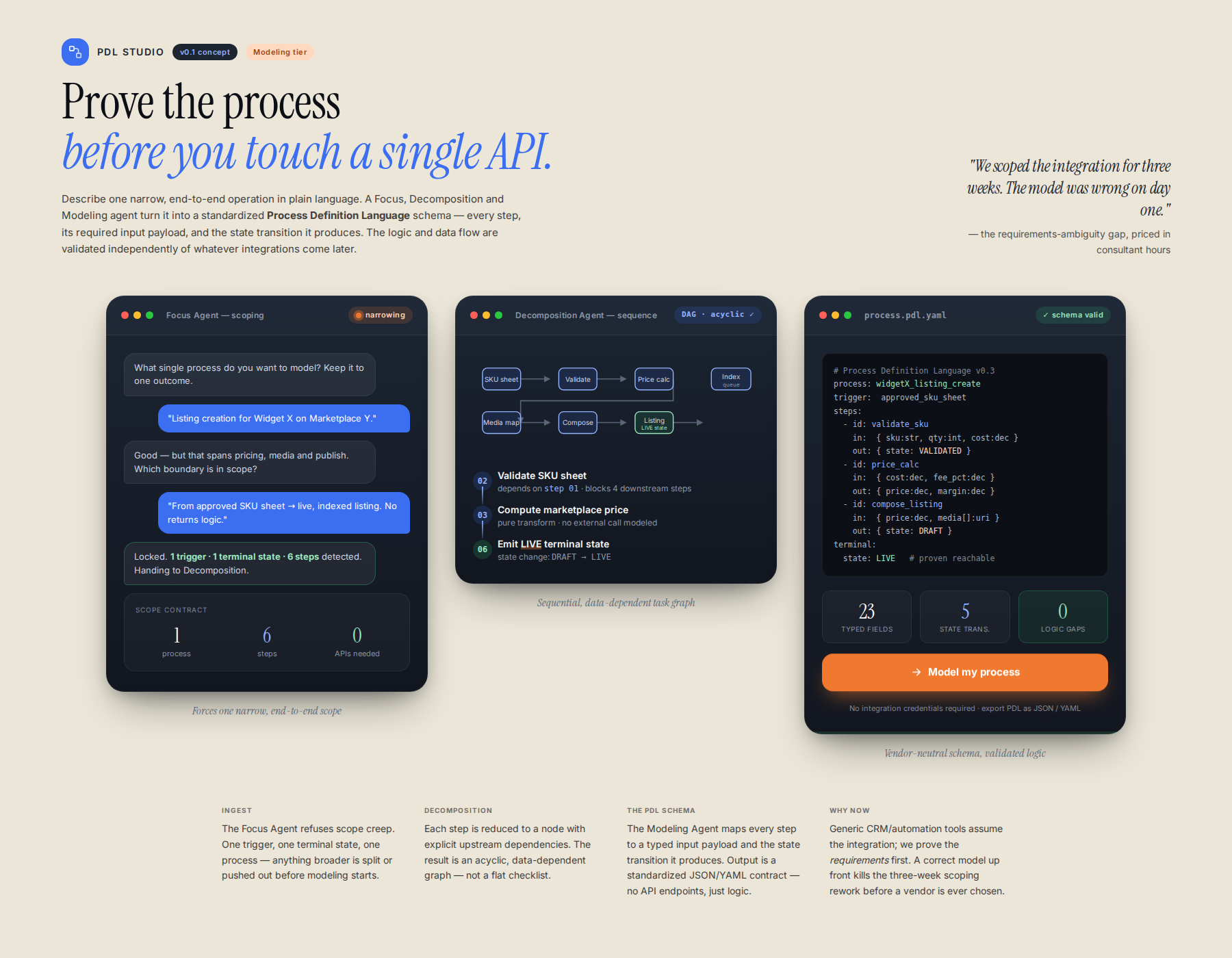
A multi-agent system translates a natural language description of your operational process into a standardized, machine-readable Process Definition Language (PDL) schema. The PDL captures the sequence of steps, required input data structures, and expected state updates at each stage without referencing specific APIs or vendor software. This proves the workflow's logic is sound before implementation, solving the "requirements ambiguity" gap between vision and development.
Process flow
Who it's for
AI automation consultants and SMEs (Subject Matter Experts) who need to scope automation projects for SMBs.
Why they need it
They need to move beyond vague 'wish lists' of automation to a standardized, unambiguous technical specification that can be handed off to developers or used for proof-of-concept development, mitigating the risk of ambiguous requirements.
What it is
A platform that takes a narrow, defined process (e.g., 'Listing Creation for Widget X on Marketplace Y') and uses specialized agents to decompose it into sequential, data-dependent steps, outputting a structured PDL schema that models the required state transitions and data payloads.
How it works
The core mechanism retains the multi-agent setup but shifts focus entirely to modeling. 1. Focus Agent: Guides the user to define a single, narrow, end-to-end process. 2. Decomposition Agent: Breaks the process into discrete, sequential tasks. 3. Modeling Agent: Maps these tasks not to live APIs, but to required data transformations and state changes. It generates the PDL (a custom JSON/YAML schema) detailing: a) the sequence, b) the required input data structure for each step, and c) the expected output/state update. This proves the model, not the integration.
Differentiation
Existing tools are either too general (CRM/Accounting) or too focused on pre-defined integration endpoints. We differentiate by Process Abstraction and Standardization. We create the universal language (PDL) for automation requirements, allowing the model to be proven correct before any vendor-specific API integration is attempted, thus solving the 'requirements ambiguity' gap.
Implementation sketch
- Develop the initial PDL schema definition (e.g., a YAML structure defining
StepID,ActionType,InputSchema,OutputSchema,Dependencies). - Build the Decomposition Agent to take natural language input and map it directly into the structure of the PDL schema, focusing only on logic flow.
- Create a simple UI/CLI interface that accepts a niche process description and outputs the validated PDL document, along with a high-level 'Logic Completeness Score'.
First step: Define the core JSON/YAML structure for the Process Definition Language (PDL) and use zero-shot prompting to have the LLM output the schema for a simple, known process (e.g., 'User signs up on Site A').
Remaining risks
- The 'Logic Completeness Score' is subjective and lacks objective calibration. If the score is easily gamed by users or appears arbitrary, the primary output loses its perceived value as a 'validation' tool. — Ground the scoring system on quantifiable metrics derived from the PDL structure itself, such as 'Number of undefined state transitions' or 'Number of required data inputs lacking a defined source,' rather than a holistic score.
- The PDL, while abstracting away APIs, risks becoming an academic artifact—a beautiful but unusable schema—if the resulting model cannot be demonstrably mapped back to any real-world execution path, even conceptually. — Develop a secondary, lightweight 'Conceptual Mapping' agent that, upon generating the PDL, automatically suggests 2-3 potential integration points or data sources based on the required input/output schemas, forcing the model to maintain a conceptual link to reality.
- The initial focus on 'Process Mapping Language' might be too niche for early adoption. Consultants might prefer to see the PDL applied to a specific industry vertical (e.g., logistics, e-commerce) to gain immediate perceived utility, slowing down the abstract 'language' development. — Bundle the MVP launch around a single, highly visible, and complex industry use case (e.g., cross-border e-commerce fulfillment) and use that vertical's terminology and examples exclusively in the initial marketing and demo materials.
Watch for: A lack of early engagement from professional developers or technical architects who are forced to interact with the PDL. If they cannot immediately see how the abstract schema accelerates their work over manual documentation, the value proposition stalls. Kill criterion: If the initial zero-shot prompting exercise fails to generate a PDL schema that is logically sound and comprehensive for a simple, well-documented process (e.g., 'User signs up on Site A'), it suggests the LLM is not yet capable of reliably translating natural language intent into a rigorous, structured data model.
Sources the council used
Real-world evidence that grounded this idea — judge it for yourself.