Secure, Context-Aware Agent Workflow Orchestrator for Mixed-Environment AI
An orchestration engine that allows developers to build complex, multi-step AI workflows, seamlessly managing context and securely handling credentials whether running entirely locally, in a private VPC, or through controlled cloud endpoints.
How do I stop secrets and context from leaking when an AI agent workflow mixes local and cloud API calls?
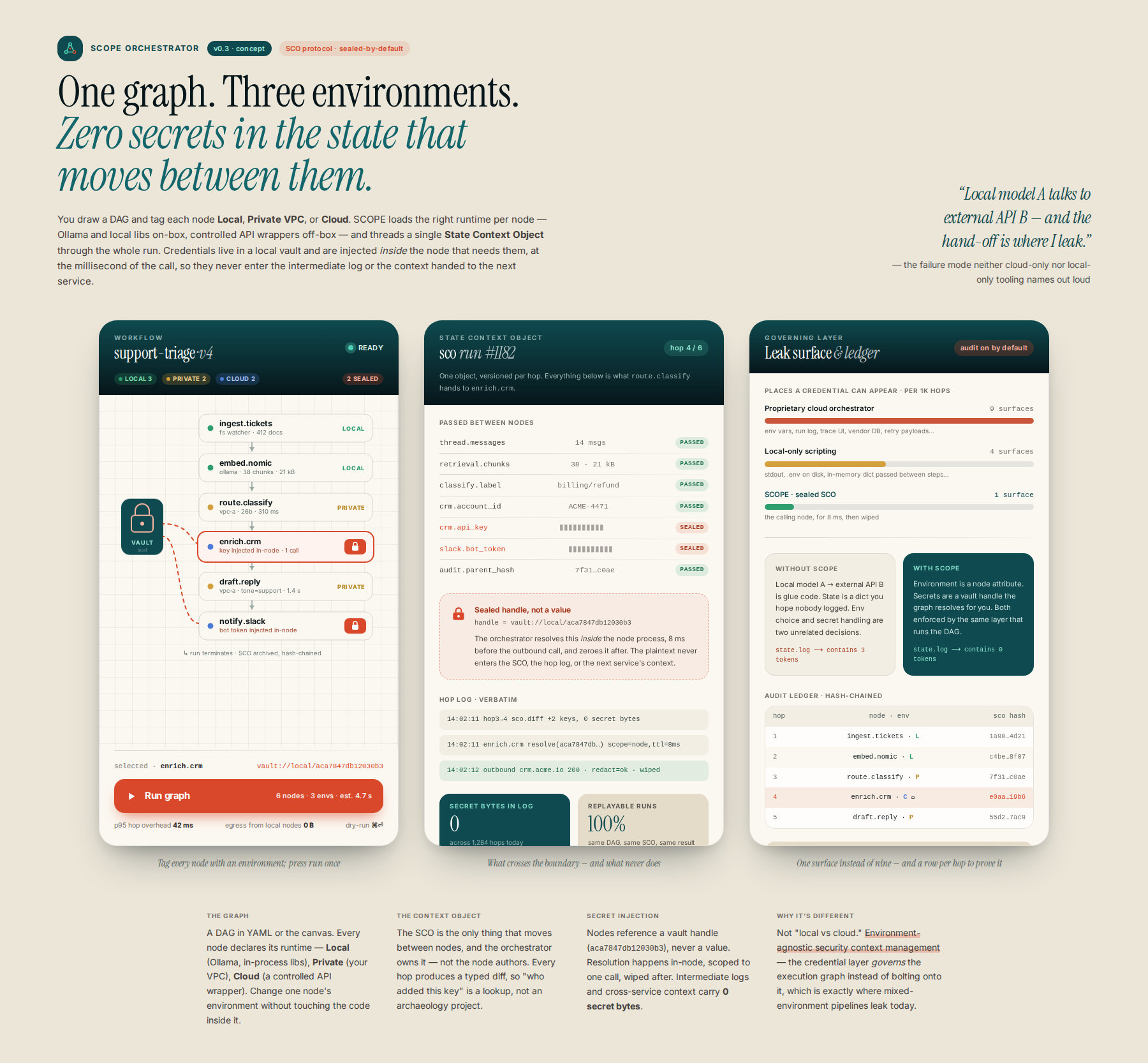
A secure workflow orchestrator prevents this by passing a managed State Context Object between every node in the agent pipeline instead of raw shared state. A 'Context Gateway' intercepts data at each step, injecting credentials from a local or private vault only at the point of use and stripping them from logs and inter-service context, so secrets never surface in intermediate state. This targets developers building production agent pipelines that combine local models (e.g., Ollama) with private VPC or external cloud APIs, where mismatched trust boundaries typically cause context leakage.
Process flow
Who it's for
Tech founders/developers building production-grade AI agents who require predictable, auditable execution pipelines.
Why they need it
Developers need robust workflow orchestration that guarantees state integrity and secure credential handling, regardless of deployment environment. This solves the universal problem of context leakage and state management failure when stitching together multiple services, especially when integrating private/local models with external APIs.
What it is
A graph-based workflow management system designed to coordinate multiple agents, tools, and data sources, with the core mechanism being a secure, auditable state context that passes through every node.
How it works
- The user defines a DAG representing the required sequence of steps. Nodes can specify execution environments (Local/Private/Cloud).
- The system loads necessary components. For local steps, it uses Ollama/local libs; for external steps, it uses controlled API wrappers.
- Crucially, the workflow passes a State Context Object (SCO) between nodes. This SCO is managed by the orchestrator, ensuring that secrets (retrieved via a local/private vault, e.g., 'aca7847db12030b3') are injected only at the point of need and are never exposed in the intermediate state log or context passed between services. This prevents context leakage.
Differentiation
Unlike proprietary cloud workflow tools or purely local tools, this system offers Environment Agnostic Security Context Management. It explicitly solves the failure mode where state passing between disparate services (local model A -> external API B) leads to context leakage or inconsistent state management. The secure credential handling is thus not an add-on, but the governing layer of the entire execution graph, addressing a gap not covered by simple 'local vs. cloud' comparison.
Implementation sketch
- Build a visual DAG editor UI that allows defining nodes and specifying required execution environments (Local, Private, Public).
- Implement the 'Context Gateway' module: This module intercepts all data passing between nodes, sanitizing and injecting necessary credentials/state fragments based on the defined workflow policy, mitigating leakage risks.
- Integrate support for varied backends (Ollama, HTTP clients, DB connectors) all governed by the Context Gateway, ensuring the execution context is always validated before passing state.
First step: Prototype the core State Context Object (SCO) serialization/deserialization logic in Python, focusing only on passing a dictionary state between two mocked functions: one simulating a local Ollama call and the other simulating an external REST API call. The goal is to prove that the state object can pass through a mock 'Gateway' function without exposing raw secrets.
Remaining risks
- The 'Context Gateway' becomes an unmanageable performance bottleneck or complexity sink. — Initially scope the Gateway to only handle the most critical, high-risk data types (e.g., secrets, PII) and use a simpler, proven serialization/deserialization mechanism (like JSON Schema validation) for all other state transfers, deferring generalized data interception until the core security mechanism is proven.
- The developer experience (DX) for defining the DAG becomes prohibitively complex due to environment specification. — Abstract the environment specification away from the core DAG definition. Instead of forcing the user to think 'Local/Private/Cloud' at every node, build a high-level abstraction layer that allows the user to select a 'Service Type' (e.g., 'Local LLM Call', 'External API') and let the framework map that to the required execution context, simplifying the visual editor.
- Adoption stalls because the system requires developers to master multiple, disparate integration points (Ollama setup, Vault integration, API wrappers) before building a simple workflow. — Develop a robust, curated set of 'Golden Paths' or templates for the top 3 use cases identified in the niche (e.g., 'Local RAG Chain', 'Private Data Extraction Flow'). Marketing and onboarding must focus entirely on making these templates 'one-click' to deploy, hiding the underlying complexity.
Watch for: If early technical prototypes struggle to prove the state integrity across a simple, two-step flow (e.g., Ollama -> Mock API) without introducing significant, non-linear overhead, the core technical premise is too ambitious for the current state of tooling. Kill criterion: If the time required to secure the state transfer between two well-defined, non-trivial components (e.g., a local vector store query result passed to a private API call) exceeds 3x the time required to build the same workflow using existing, established, albeit less secure, orchestration tools.
Sources the council used
Real-world evidence that grounded this idea — judge it for yourself.