Compliance-Driven Agent Governance Framework (Model-First)
A specification-first governance framework that enables verifiable, auditable compliance for local LLM agents operating in regulated environments (HIPAA, FINRA).
How can regulated companies prove their local AI agents comply with HIPAA or FINRA rules?
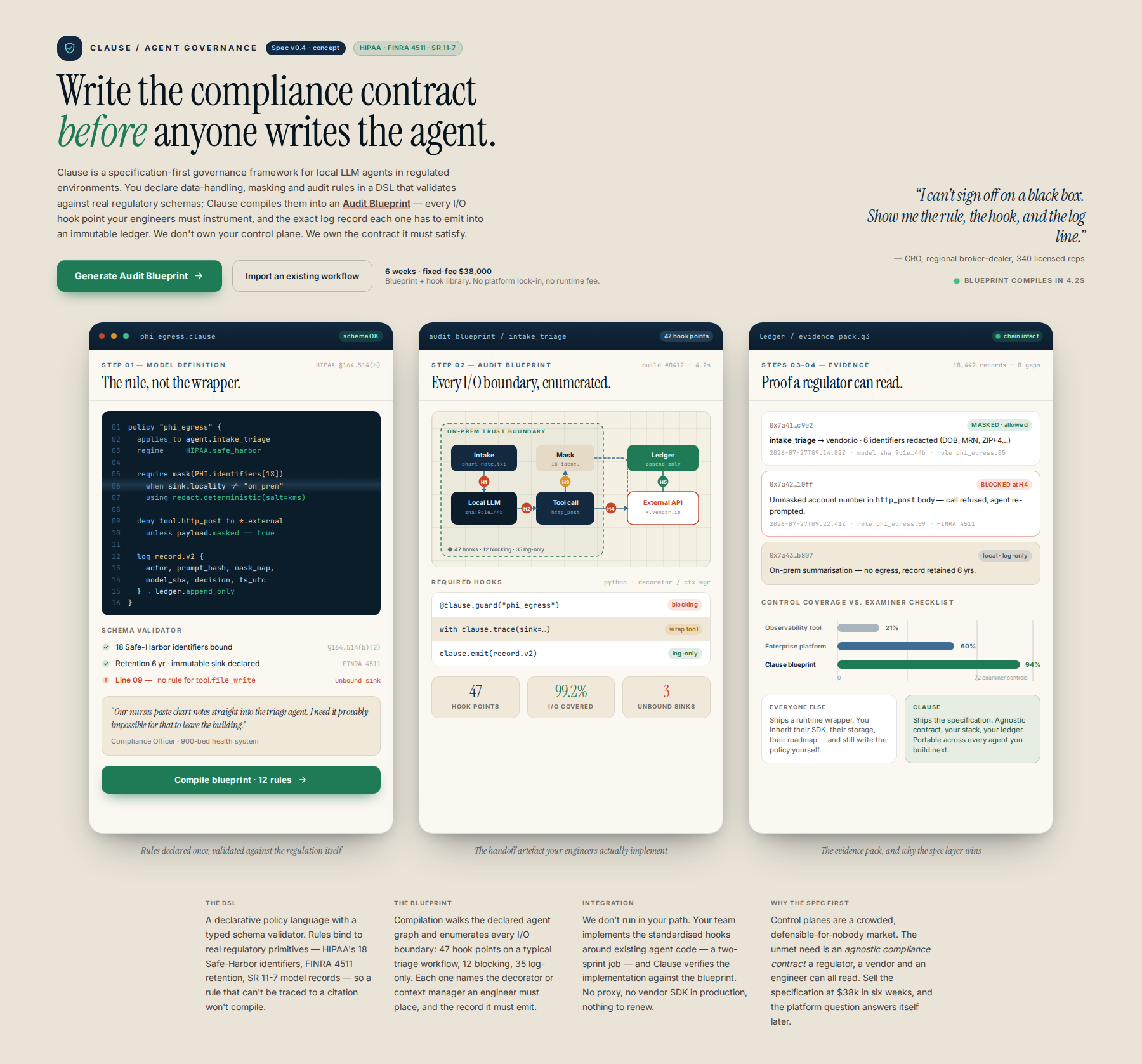
Compliance-driven agent governance defines machine-readable rules, such as PHI masking, in a domain-specific language that validates an agent's workflow before integration rather than relying on generic observability. The framework outputs an Audit Blueprint specifying every required I/O hook and validation check, which engineers implement as standardized decorators around existing agent code, with results written to an immutable audit log. This gives compliance and risk officers at regulated firms verifiable, auditable proof of control over local LLM deployments.
Process flow
Who it's for
Compliance Officers, Chief Risk Officers, Regulated Industry AI Architects
Why they need it
Regulated organizations face existential liability risks from autonomous agents. Current tooling either ignores compliance (general observability) or locks them into proprietary ecosystems, leaving a critical gap in verifiable, auditable control for local deployments.
What it is
A set of reusable, verifiable compliance models (a Domain Specific Language/Schema Validator) that dictates the required data handling, masking, and audit logging rules for specific agent workflows before integration. It proves the need for control, rather than attempting to build the entire control plane itself.
How it works
- Model Definition: Users define compliance rules (e.g., 'PHI must be masked if outputting to non-local system X') using the framework's DSL, which validates against known regulatory schemas.
- Audit Blueprint Generation: The framework generates a concrete 'Audit Blueprint' detailing every required I/O hook point and the necessary validation checks.
- Guidance & Integration: This blueprint guides the client's internal engineering team to implement the necessary, standardized hooks (e.g., Python decorators/context managers) around their existing agent code, ensuring compliance at the point of execution.
- Immutable Logging: It mandates and standardizes the structure of the audit log, which is then written to an immutable ledger.
Differentiation
We pivot from building a 'Wrapper' to creating the 'Specification Layer.' Unlike general observability tools which lack compliance rigor, and unlike proprietary enterprise platforms which lock users into their ecosystems, our framework delivers the verifiable compliance specification first. We fill the gap of an agnostic, industry-standard compliance contract that dictates the necessary guardrails, making the initial offering a high-value, low-overhead consulting/specification product.
Implementation sketch
- Develop a minimal viable DSL parser that accepts common regulatory constraints (e.g., regex patterns for SSN/PHI).
- Build a schema validator that takes a sample agent workflow (input/output JSON) and maps it against the defined DSL rules, flagging all compliance violations.
- Create a template/guide that translates the flagged violations into concrete, required runtime hooks (e.g., 'At this function call, you must implement a context manager that calls the
mask_pii()utility').
First step: Draft a simple, executable Proof-of-Concept (PoC) demonstrating the DSL validation against a synthetic workflow (e.g., a simulated medical record processing script) to prove the model's ability to detect compliance gaps without touching the client's runtime code.
Remaining risks
- The 'Specification Layer' is perceived as merely a high-overhead consulting deliverable, failing to establish product viability. Compliance Officers/CROs are used to purchasing large, integrated platform solutions (like p1), and a framework/DSL might be dismissed as academic or too early-stage to mandate process change. — Develop a tiered product roadmap: Phase 1 is the specification/consulting service (low-overhead entry); Phase 2 is a lightweight, opinionated, SaaS 'Blueprint Generator' that automates the creation of the required integration hooks/documentation, thereby providing a tangible, repeatable product artifact rather than just a document.
- The 'DSL' for compliance rules, while aiming for generality, may prove too complex or too abstract to be adopted by non-expert compliance personnel. If the learning curve for defining a 'PHI mask' or 'Audit Blueprint' is steep, adoption will stall. — Focus the initial DSL implementation on the single most painful, easiest-to-quantify compliance violation (e.g., PII leakage via specific regex patterns). Build a highly guided, wizard-style UI around the DSL to abstract away the underlying complexity, making the input process feel like filling out a compliance questionnaire.
- The framework's value is entirely dependent on the client's willingness to perform the integration work guided by the blueprint. If the client's internal engineering team lacks the capacity, expertise, or budget to implement the mandated hooks, the framework remains theoretical. — Develop and offer a 'Golden Path' integration package. Instead of just providing the blueprint, offer to build the first, most critical integration hook (e.g., the PII masking decorator) for a small, paid pilot project, effectively de-risking the integration effort for the client.
Watch for: Any mention of an established, non-AI-specific enterprise governance tool (e.g., specialized data loss prevention (DLP) platforms) that can ingest and validate LLM outputs against compliance schemas without requiring deep runtime code modification. Kill criterion: If key industry decision-makers (CROs/Compliance Officers) consistently state that their current process relies on manual sign-off or existing, non-AI-specific DLP/Audit logging tools, and show no immediate interest in adopting a novel, code-level specification layer.
Sources the council used
Real-world evidence that grounded this idea — judge it for yourself.