
Autonomous AI Policy Interrogation Framework: Niche Compliance Validation Engine
How do I measure if my AI documentation meets regulatory standards?
An agent-orchestrated system evaluates your documentation against a specific regulatory checklist by running specialized agents that assign weighted risk scores to compliance gaps. Instead of a simple pass/fail, you get a quantifiable Compliance Readiness Score (0-100) with prioritized, actionable remediation steps. This predictive approach concentrates effort on the highest-risk gaps, speeding pre-market validation for regulated products.
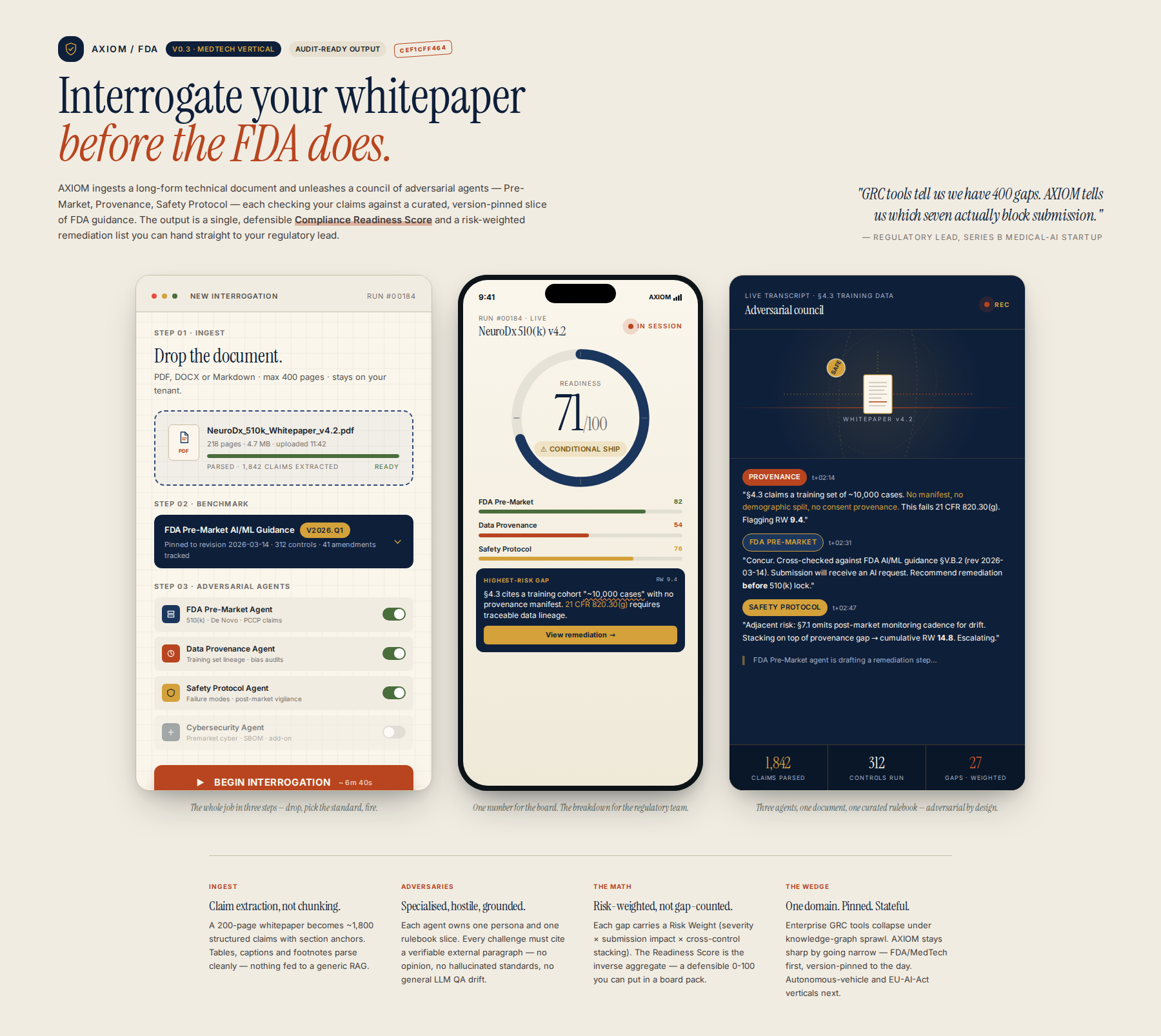
Process flow
Who it's for
AI researchers and technical writers creating whitepapers or documentation for regulated AI domains (e.g., medical devices, autonomous vehicles).
Why they need it
The high stakes of AI governance require verifiable proof of compliance readiness. Stakeholders need a measurable score that quantifies reduction in human audit time or risk exposure against a narrowly defined standard, moving beyond abstract gap reports.
What it is
A dedicated pipeline that ingests long-form documents and deploys specialized, adversarial AI agents to systematically check for factual, logical, and compliance discrepancies, outputting a quantitative 'Compliance Readiness Score' and a prioritized remediation checklist.
How it works
The system ingests a document. It triggers specialized agents (e.g., 'FDA Pre-Market Agent', 'Data Provenance Agent', 'Safety Protocol Agent'). These agents execute structured checks against a limited, curated external knowledge base (e.g., specific sections of FDA guidance). Instead of listing all gaps, they assign a weighted 'Risk Weight' to each gap, and the final output is a single, aggregated, and quantifiable 'Compliance Readiness Score' (0-100) with traceable remediation steps.
Differentiation
It differs from general LLM QA (and existing GRC tools) by enforcing adversarial roles and grounding every challenge in verifiable, external standards, but critically, it focuses on a single, manageable domain (e.g., FDA/MedTech). The gap is the lack of a dedicated, automated, stateful engine for niche, rapidly evolving compliance proof points, preventing the 'knowledge graph explosion' seen in general enterprise tools. (Cites: 'cef1cff464d14a6b').
Implementation sketch
- Select 'agentcollective' as the architectural backbone, ensuring local, isolated agent execution.
- Define the initial, narrow scope: Select one target standard (e.g., FDA guidance for SaMD).
- Develop the core 'Benchmark Agent Set' for that single standard, mapping key requirements into structured prompt templates, and build the state machine to calculate the weighted score based only on those defined criteria.
First step: Draft the prompt set and knowledge base structure for the most critical, narrow section of the chosen standard (e.g., the specific documentation requirements for 'Software as a Medical Device' pre-submission filing) to prove the scoring mechanism works on a minimal viable set of rules.
Remaining risks
- The 'single, highly specified' niche standard, while narrowing the scope, might itself be too volatile or require proprietary access that cannot be easily replicated via prompt engineering or public knowledge bases (e.g., requiring internal FDA review data). — Develop a modular 'Standard Adapter' layer that allows swapping out the entire knowledge base and agent set for a new niche standard with minimal changes to the core orchestration logic, proving adaptability rather than just depth in one area.
- The 'Compliance Readiness Score' itself becomes a target for gaming or 'score-washing.' Users might learn to optimize their documentation specifically to maximize the score without actually addressing the underlying, unmeasured, or emergent risks. — Introduce a mandatory 'Emergent Risk Penalty' component into the scoring algorithm. This component would use general reasoning agents to flag areas of the document that touch upon un-scored, high-risk concepts (e.g., 'potential for bias in data selection' even if not explicitly covered by the current FDA checklist) and deduct points for unaddressed conceptual gaps.
- The core reliance on 'agentcollective' and state management, while necessary, introduces single points of failure related to complex, multi-step reasoning chains. A failure in state tracking could lead to an inaccurate, misleadingly high score. — Implement a mandatory, human-readable 'Audit Trail Traceability Log' that records the exact input, the agent triggered, the specific rule checked, the weight assigned, and the resulting score adjustment for every single point in the final calculation. This shifts trust from the black-box score to the transparent, verifiable calculation steps.
Watch for: If the initial POC cannot demonstrate a measurable, reduction in the required human review time (e.g., 'We reduced the time spent on cross-referencing X section from 10 hours to 2 hours'), the value proposition remains theoretical. Kill criterion: If the cost/time required to maintain the knowledge base for the single niche standard exceeds the demonstrable time savings for the target user group, the project is not economically viable.