AI Contract Risk & Obligation Extractor for SMBs
Can AI quickly find risky clauses in vendor contracts?
Yes—an AI system grounded in the contract text extracts obligations, identifies risk indicators like indemnity or liability cap changes, and flags key dates. The output is a first-pass risk summary directly quoted from the contract, not AI speculation. This assists in identifying potential areas for legal review, though any flagged items should still be confirmed by a qualified attorney before acting on them.
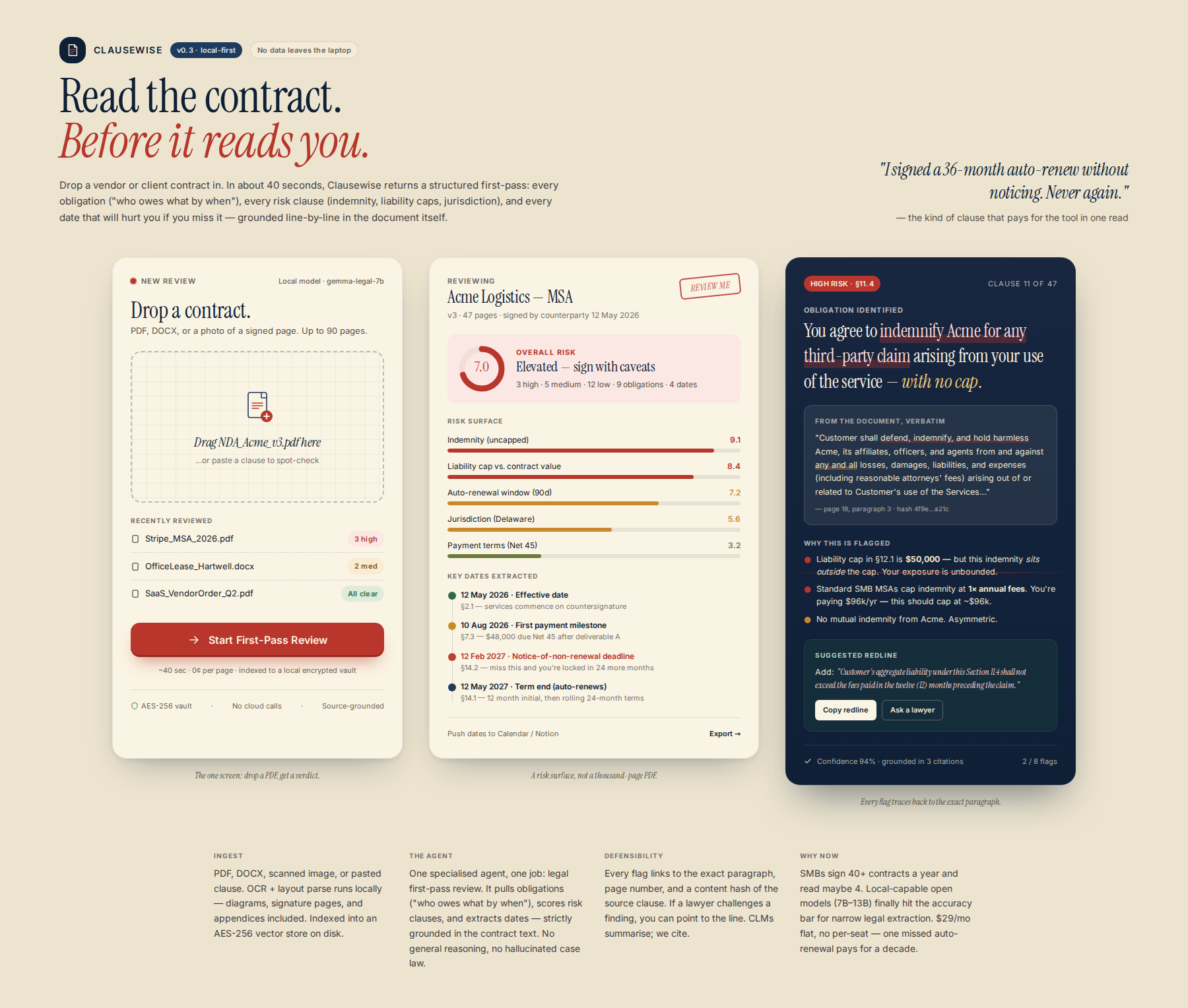
Process flow
Who it's for
Small business owners and operational teams that frequently sign vendor or client contracts.
Why they need it
SMBs often lack in-house legal counsel, leading to them missing critical clauses, misunderstanding complex obligations, or being unaware of potential financial risks embedded in standard agreements.
What it is
A specialized, multimodal AI workflow that acts as a 'Legal First-Pass Reviewer,' grounding its analysis strictly in the provided contract text to identify and structure specific contractual data points.
How it works
The system ingests diverse documents (PDF contracts). It uses a local, encrypted vector store to index the document content. A specialized agentic layer (focused solely on contract analysis) performs structured extraction: 1. Obligation Identification: Pulling out 'who must do what by when.' 2. Risk Scoring: Flagging clauses related to indemnity, liability caps, or jurisdiction changes. 3. Key Date Extraction: Identifying termination dates, renewal triggers, and payment milestones. The output is a structured, human-readable risk summary, not a general workflow trigger.
Differentiation
Unlike general document AI or contract management systems (like existing CLM platforms), our product's core value is Defensible, Grounded Risk Assessment. We do not attempt to 'manage' the entire business; we provide a single, highly accurate, and localized intelligence layer that answers one acute question: 'What am I legally committing to with this document?' This narrow focus allows for superior accuracy and a faster, more defensible MVP.
Implementation sketch
- Develop a secure, file-based knowledge graph/memory layer optimized for document chunking and embedding (Contracts only).
- Implement a single, specialized agentic orchestration layer dedicated solely to legal NLP tasks (Obligation/Risk/Date Extraction).
- Develop and rigorously test the 'Guardrail' mechanism: ensuring every output point is directly traceable back to a specific sentence or paragraph in the source contract, minimizing hallucination risk.
First step: Identify 3 specific, non-negotiable contract clauses (e.g., Indemnity, Governing Law, Payment Terms) that represent the highest immediate risk for SMBs and build a minimal, prompt-engineered proof-of-concept to extract only those 3 items from 5 sample contracts, validating the output structure manually against expert review.
Remaining risks
- Legal Liability and Misinterpretation: Even with a 'Guardrail' mechanism, the system's output is presented as a definitive assessment of legal risk. If the system misinterprets a clause or misses a crucial nuance (e.g., jurisdiction-specific law), and an SMB acts on that flawed advice, the company faces significant professional and potential legal liability. — Implement an explicit, non-negotiable disclaimer on every output, stating clearly that the output is a first-pass analysis and not legal advice, requiring mandatory review by a qualified attorney. Limit initial marketing claims to 'Assists in identifying potential areas for review' rather than 'Assesses risk.'
- Data Ingestion Complexity and Format Variability: Contracts are notoriously messy. The system relies on ingesting diverse PDFs (scanned, image-based, complex tables, variable formatting) which can introduce OCR errors, layout distortions, or unreadable sections, causing the entire extraction pipeline to fail or hallucinate based on corrupted input data. — In the MVP, restrict input to a single, highly structured format (e.g., plain text uploads or specific, machine-readable Word documents) and build a dedicated, visible pre-processing step that flags low-confidence sections or poor image quality, forcing user intervention before analysis.
- Domain Expertise Bottleneck: The 'Guardrail' mechanism requires deep, expert knowledge to build the ground truth validation logic (e.g., knowing the difference between a mutual indemnity and a one-sided one). Relying on general AI prompt engineering for this guardrail is insufficient; the team is critically dependent on expensive, hard-to-retain legal domain experts. — Structure the initial development to treat the domain expertise as a consultancy service rather than an internal engineering task. Build a small, paid advisory board of contract lawyers to validate the logic of the extraction rules, rather than trying to embed all legal knowledge into the LLM itself.
Watch for: If early pilot users begin asking the system to 'negotiate' or 'draft a response' based on the extracted risks, it signals that the market views the tool as a full operational replacement rather than a review aid, forcing an immediate, unplanned scope creep back toward the 'Virtual COO' problem. Kill criterion: If the first 10 paying pilot users cannot articulate a specific, measurable, and immediate ROI that is better or faster than hiring a junior paralegal for a single contract review, the core value proposition is insufficient to justify the technical risk.
Sources the council used
Real-world evidence that grounded this idea — judge it for yourself.