
Automated Cross-Industry Regulatory Compliance Cross-Referencing Agent
A specialized agent workflow that automatically cross-references a company's technical documentation and product feature set against a continuously updated corpus of global industry regulations to generate a prioritized compliance gap report.
How can I detect compliance gaps between product features and regulations?
A specialized agent workflow cross-references product documentation against a continuously updated regulatory corpus to identify gaps and contradictions. Using specialized agents for each jurisdiction (e.g., GDPR Agent, Security Agent), the system infers requirement relationships and outputs a prioritized remediation report. Unlike general compliance tools, it automatically maps specific product features to regulatory articles, generating actionable next-steps with estimated effort and ownership.
Process flow
Who it's for
Mid-to-large tech companies operating in regulated industries (FinTech, HealthTech, Global SaaS) facing complex, multi-jurisdictional compliance burdens.
Why they need it
Manual compliance checking is prohibitively slow, expensive, and error-prone when dealing with evolving, multi-jurisdictional regulations. Existing GRC tools are either too broad or too siloed, failing to automate the deep, relational inference between product implementation details and specific legal articles.
What it is
A directed, multi-step agent process that ingests product specs and regulatory texts, uses specialized agents for interpretation, cross-referencing, and gap identification, outputting a structured, actionable remediation plan.
How it works
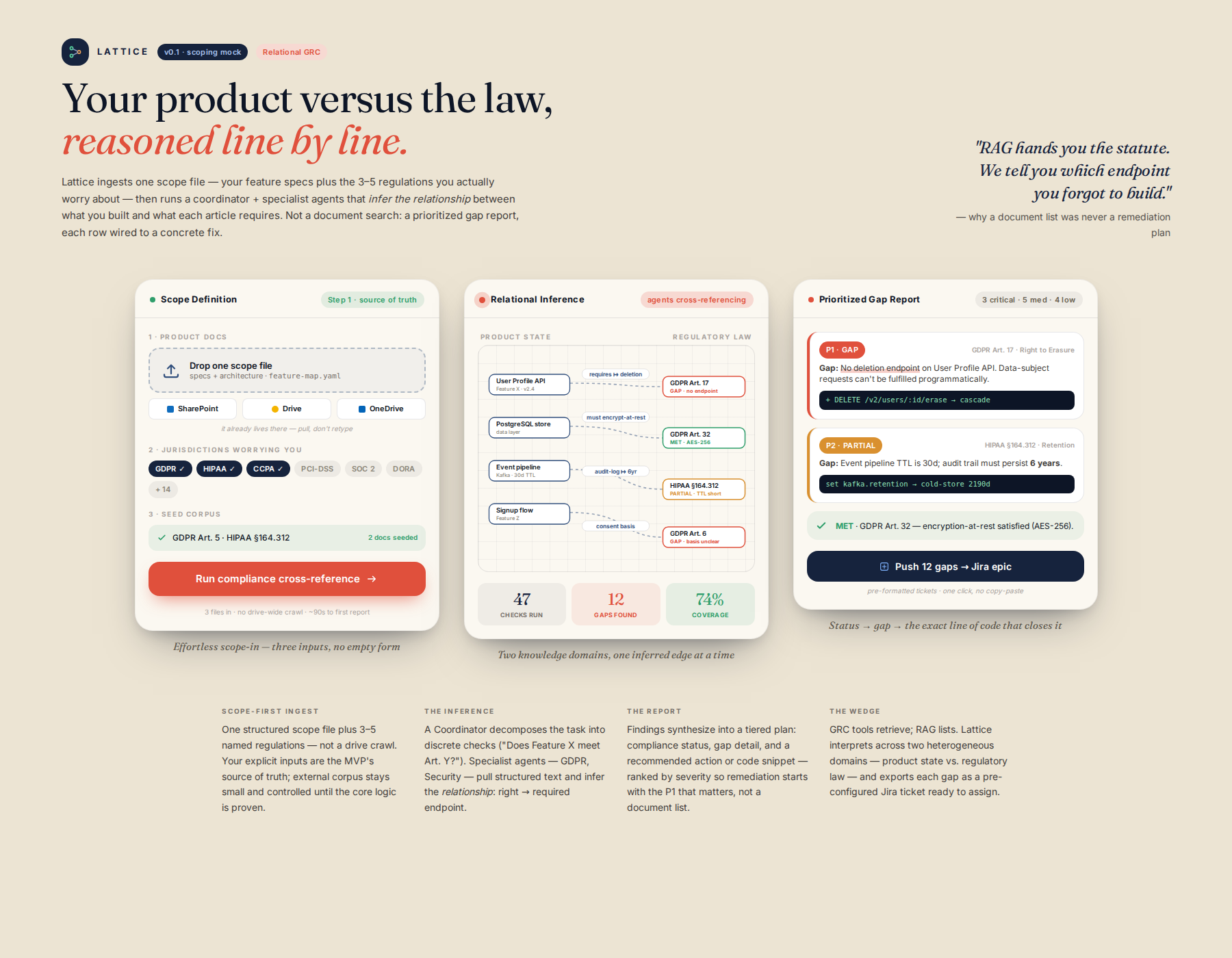
- Ingestion: User uploads product documentation (specs, architecture diagrams) and specifies target jurisdictions/regulations.
- Decomposition: The Coordinator Agent breaks the compliance task into discrete checks (e.g., 'Does Feature X meet GDPR Article Y?').
- Specialization: Specialized Agents (e.g., 'GDPR Agent', 'Security Agent') pull relevant regulatory text from the MemoryEngine.
- Cross-Referencing: Agents compare the inputs against the retrieved, structured regulations, focusing on inferring relationship types (e.g., 'Data Subject Access Right' → 'Requirement for Deletion Endpoint').
- Synthesis & Output: The Coordinator synthesizes all findings into a tiered report: [Compliance Status] → [Gap Detail] → [Recommended Action/Code Snippet].
Differentiation
Unlike general RAG systems that only retrieve documents, this system interprets the relationship between two distinct knowledge domains (Product State vs. Regulatory Law). We explicitly target the gap where existing GRC platforms fail to automate relational inference across heterogeneous data types, providing a structured, prioritized action plan rather than just a document list.
Implementation sketch
- Define the workflow stages using a state machine approach (Coordinator).
- Develop specialized knowledge retrievers for distinct regulatory frameworks (MemoryEngine).
- Build a comparison/scoring module within the Coordinator that scores gaps based on severity (Critical, High, Medium).
- Integrate an output validation step that forces the final report to adhere to a strict JSON schema for direct consumption by compliance teams.
First step: Identify one narrow, high-value regulatory niche (e.g., US HIPAA data retention for specific medical device telemetry) and manually map 3-5 key required relationships between a sample product spec and the relevant regulation. This defines the minimum viable relationship graph for a proof-of-concept.
Remaining risks
- The 'relational inference' step requires solving a foundational AI problem (mapping Product State $ ightarrow$ Regulatory Law relationship), which current middleware cannot guarantee. The system risks producing plausible but factually incorrect 'hallucinated compliance' reports. — Limit the initial scope to a single, highly structured regulatory domain (e.g., HIPAA data retention for a single device type) where the required relationships can be manually mapped and validated against a small, deterministic knowledge graph, treating the AI as a scoring/prioritizing layer over known relationships, not the source of inference.
- The 'Product State' input is heterogeneous (specs, diagrams, APIs), leading to massive, unstandardized data ingestion challenges. The system will fail when encountering real-world, messy enterprise documentation. — Mandate the use of a structured intermediate representation (IR) for all inputs, requiring the client to pre-process their documentation into a standardized format (e.g., YAML/JSON schema defining components, data flows, and owners) before the agent workflow can begin.
- The market adoption cycle is gated by legal/compliance sign-off, which is inherently slow and requires deep trust. The technical success does not guarantee commercial success due to regulatory inertia. — Focus the initial go-to-market strategy not on replacing existing GRC tools, but on acting as an 'Augmentation Layer' that feeds pre-validated, prioritized findings directly into the existing compliance team's workflow, minimizing the perceived risk of adopting a novel black-box system.
Watch for: Any indication from potential pilot customers that they are willing to accept a compliance report generated by an AI that cannot cite its source relationship directly back to the specific clause/line item in both the product spec and the regulation. Kill criterion: If the first three pilot attempts fail because the required input data cannot be standardized into a machine-readable, structured format (IR) within a reasonable timeframe (e.g., 2 weeks per client), indicating the input standardization problem is insurmountable for the target niche.