AI Knowledge Synthesizer for Post-Incorporation Compliance Roadmap
A focused AI platform that synthesizes and sequences the necessary, non-negotiable operational knowledge required for founders in the critical 30 days following legal incorporation.
What must I know in the 30 days after incorporating?
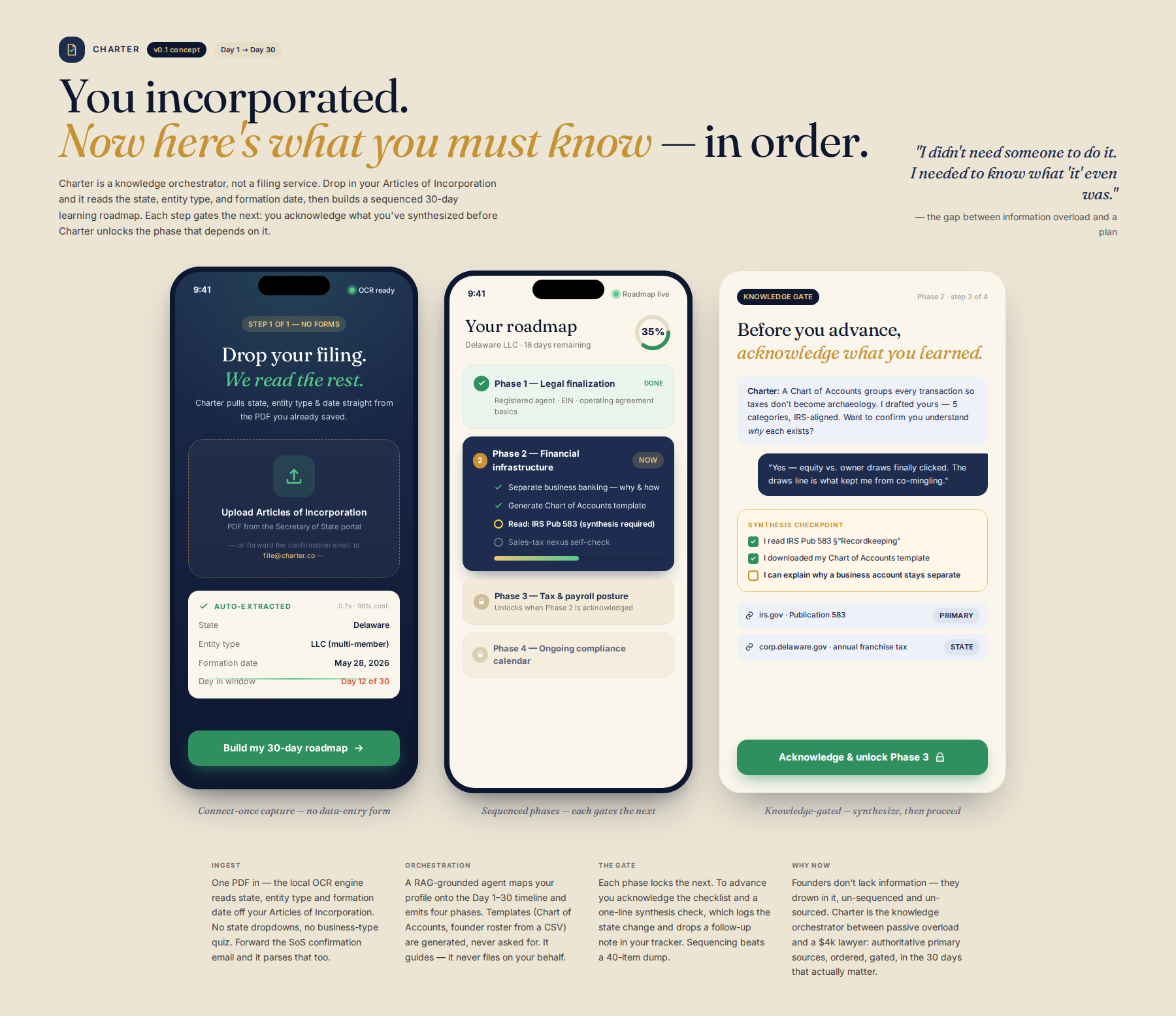
An AI Knowledge Synthesizer generates a phased compliance roadmap specific to your state and business type, sequencing essential operational knowledge you must acquire. The system provides actionable checklists, mandatory templates, and curated official guidelines, forcing you to acknowledge information before advancing. It guides knowledge acquisition without executing compliance tasks, solving the gap between overload and actionable self-study.
Process flow
Who it's for
New small business owners/entrepreneurs who have already incorporated (or are in the final stages of incorporation).
Why they need it
These founders are overwhelmed by the sheer volume of authoritative, sequential tasks (tax, bookkeeping, regulatory) and need an AI-guided roadmap that structures the knowledge required to proceed, preventing costly early errors through structured learning and resource mapping.
What it is
A dedicated, conversational AI agent suite that acts as a 'Compliance Roadmap Generator.' It provides step-by-step, knowledge-gated guidance, generating structured study plans, creating foundational templates (e.g., Chart of Accounts), and directing users exclusively to primary source documentation and vetted, simplified educational materials. It guides the process without executing the compliance tasks.
How it works
The user inputs their state and business type. The core agent runs a highly specialized, RAG-grounded workflow focused on the 'Day 1 to Day 30' timeline. It generates a phased roadmap (e.g., Phase 1: Legal Finalization Knowledge; Phase 2: Financial Infrastructure Knowledge). For each step, it provides actionable checklists, mandatory templates, and curated links to official state/federal guidelines, forcing the user to acknowledge and synthesize the information before advancing.
Differentiation
We are not a compliance execution service or a general coaching tool. We are a Knowledge Orchestrator. We solve the 'what do I need to know right now?' problem. We combine the authoritative checklist structure of existing compliance guides with a guided, educational synthesis layer, filling the gap between passive information overload and actionable, sequenced self-study plans. General advice sites or pure marketplaces fail because they either lack sequencing or lack authoritative, primary-source grounding.
Implementation sketch
- Develop the core state machine/workflow orchestrator, strictly scoped to the 30-day post-incorporation knowledge acquisition timeline.
- Curate and ingest initial knowledge bases: 1) Core State-Specific Legal Requirements (EIN, initial tax filing knowledge), 2) Foundational Financial Setup (Bookkeeping flow/Chart of Accounts principles).
- Build the 'Knowledge Synthesis Agent': This agent focuses only on sequencing and validating understanding (e.g., 'Can you explain the difference between an LLC and a Corporation for tax purposes?'). It requires user output/confirmation of knowledge synthesis for progression, eliminating the need for external API handoffs.
First step: Identify 3 key state-level compliance checklists (e.g., California, Texas, Delaware) and ingest the raw, public-facing text from the first 3 critical steps of each, structuring them into a testable, sequential knowledge graph for the MVP.
Remaining risks
- Knowledge Staleness/Jurisdictional Drift: The core value relies on ingesting and synthesizing complex, constantly changing, and highly localized legal/tax code (state/county level). Even if we only synthesize knowledge, the underlying source material (e.g., a state tax code update, a new IRS ruling) can render the entire knowledge graph inaccurate or incomplete overnight, leading to catastrophic failure in trust. — Implement a mandatory, automated 'Source Validation Pipeline' that flags any ingested knowledge segment older than 12 months or linked to a jurisdiction that has undergone legislative changes in the last 6 months. The system must default to 'Knowledge Pending Review' rather than presenting potentially outdated information.
- The 'Knowledge Synthesis' Trap: Users may treat the platform as a substitute for actual professional advice, believing that synthesizing the knowledge (e.g., understanding the difference between an S-Corp and LLC) is equivalent to receiving the advice or filing the paperwork. This creates a high risk of user malpractice and liability claims, even if the platform explicitly disclaims execution. — Design the user flow to require explicit, multi-step confirmation of understanding and mandatory, prominent 'Disclaimer Gates' before accessing any core knowledge module. Furthermore, the system must proactively suggest, at the end of every module, a consultation with a human expert (even if it's just a link to a vetted, paid service) to reinforce the boundary between education and action.
- Information Overload/Cognitive Friction: While the scope is narrowed, the sheer density of required foundational knowledge (tax law, accounting principles, state statutes) is inherently overwhelming. The 'Knowledge Synthesis Agent' might fail to create a genuinely digestible, non-linear learning path, resulting in users abandoning the platform due to cognitive fatigue. — Introduce gamified, micro-learning modules that break down concepts into 'Concept Quests' rather than linear chapters. Success should be measured by the breadth of concepts understood across different domains, rather than the depth in any single one, keeping the initial engagement low-friction.
Watch for: If early user feedback indicates that users are spending more time trying to find the next required external action (e.g., 'Where do I actually file this form?') than they are engaging with the synthesized knowledge, it signals that the core pain point is execution/marketplace access, not knowledge gap filling. Kill criterion: If the first 10 paying pilot users cannot articulate a clear, non-AI-dependent workflow for their next 30 days, it suggests the problem is not the knowledge gap, but the process gap, requiring a pivot back toward a highly curated, paid service model rather than a generalized knowledge synthesizer.
Sources the council used
Real-world evidence that grounded this idea — judge it for yourself.