
AI Feature Risk Interrogation Agent
What compliance questions does a new feature create?
An AI system can analyze your feature against regulatory requirements to identify the three highest-risk, most ambiguous compliance questions your team needs to resolve. It grounds each question in specific regulatory text and flags conflicting or underspecified concepts within the law. This consultative approach accelerates the pre-deployment legal review by surfacing ambiguity before full compliance analysis begins.
Process flow
Who it's for
Product Managers and Compliance Officers launching new features into regulated markets (e.g., EU, California).
Why they need it
Manual cross-referencing of new features against evolving regulations is slow and error-prone. The current process forces teams to wait for legal review, delaying time-to-market. (Source: 8b93a874c5840906, inferred pain from market reports).
What it is
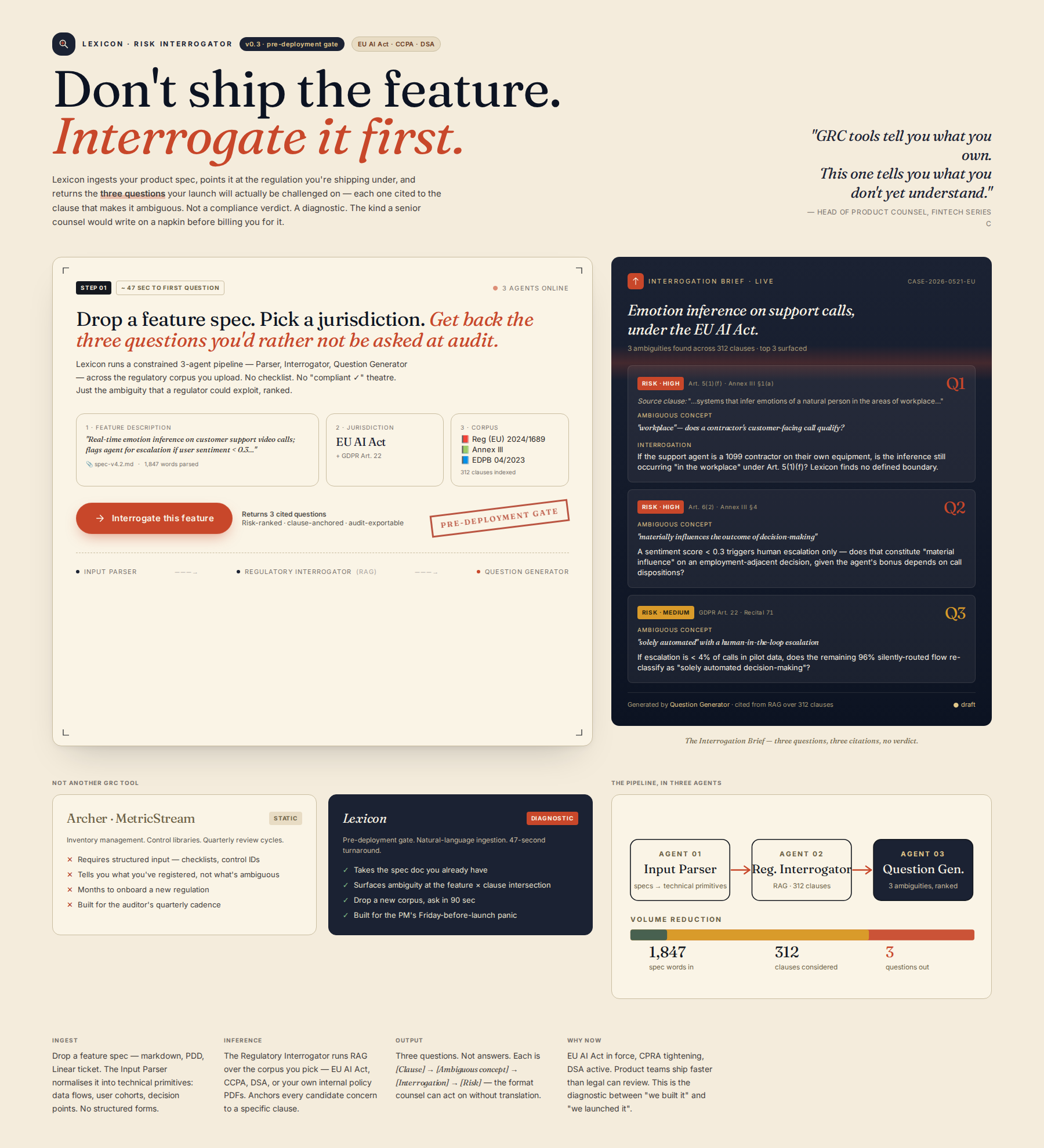
A constrained agent workflow that takes three inputs: 1) A specific new feature description; 2) A target jurisdiction/regulation; and 3) The relevant regulatory documents. It outputs a prioritized list of the top 3 highest-risk, most ambiguous compliance questions, each cited to its source text.
How it works
The system uses a focused agent pipeline: an 'Input Parser' extracts key technical specifications from the feature description; a 'Regulatory Interrogator' uses RAG to find relevant clauses; and a 'Question Generator' synthesizes the output into a structured format: [Source Clause] $\rightarrow$ [Ambiguous Concept] $\rightarrow$ [Interrogation Question] $\rightarrow$ [Risk Level]. This focuses on consultative questioning rather than definitive compliance statements.
Differentiation
Unlike general GRC tools (e.g., Archer, MetricStream) which manage static inventories and rely on structured data input, this is a dynamic diagnostic tool. It solves the immediate 'Pre-Deployment Compliance Gate' problem by leveraging natural language reasoning to identify ambiguity in the intersection of novel technical features and abstract legal concepts, a capability existing GRC tools cannot replicate.
Implementation sketch
- Constrain the scope: Select one specific, high-stakes regulation (e.g., EU AI Act Article X).
- Build the feature input parser to reliably extract key technical specifications from PM documentation.
- Develop the agent workflow to perform a single-axis lookup: Feature Specification $\rightarrow$ Relevant Regulatory Clause $\rightarrow$ Top 3 Ambiguity Question (The contained win).
- Build the output dashboard focused solely on 'Top 3 Questions' with clear citation paths.
First step: Identify 3-5 specific, highly technical feature descriptions from recent product roadmaps (internal data) and pair them with the most recent draft text of the EU AI Act. Manually run these 3-5 pairs through a basic RAG pipeline to see if the model can generate any structured question pairs, validating the core semantic mapping hypothesis.
Remaining risks
- The 'Ambiguity' Output is Subjective and Unactionable. — Structure the output to force the LLM to justify why a question is ambiguous by citing two or more conflicting or underspecified concepts within the source text, rather than just stating the ambiguity exists. This shifts the burden from 'Is this ambiguous?' to 'Show me the conflicting source material.'
- Input Feature Specification Drift (The 'Parser' Failure). — Do not rely on a single, monolithic 'Input Parser.' Instead, require the PM to fill out a highly structured, mandatory JSON/YAML template describing the feature's inputs, outputs, data flows, and decision points. This front-loads the necessary structure, making the system's input requirements explicit and manageable.
- Jurisdictional Overlap and Conflict Resolution. — Do not attempt to compare multiple jurisdictions simultaneously. The system must be architected to process one jurisdiction at a time, forcing the user to explicitly select the primary governing law. If multiple laws are required, the output must flag the conflict between the laws, rather than attempting to reconcile them.
Watch for: If the initial manual validation (first_concrete_step) fails to generate any structured question pairs across multiple feature/law combinations, it indicates the core semantic mapping hypothesis is flawed, suggesting the gap is in the data representation, not the process. Kill criterion: If the target user (Product Manager/Compliance Officer) cannot articulate a concrete, manual step they perform today that the system cannot demonstrably replicate or improve upon within 30 seconds, the value proposition is too abstract and lacks immediate operational utility.