
Specialized Context Graph Agent for Scientific Literature Review
A focused, local-first orchestration system that ingests, structures, and queries scientific literature using a persistent, queryable context graph to automate complex research workflows, outperforming standard RAG/chaining methods.
Can AI find contradictions and relationships between findings across multiple research papers?
Yes, by modeling literature as a graph of linked facts rather than isolated text chunks. Scientific abstracts are parsed into Entity, Relationship, and Evidence nodes with source citations and confidence scores, and a research question is answered by traversing the graph for paths and evidence chains instead of running vector similarity search. This surfaces relational dependencies, such as one study contradicting another on a specific mechanism, that standard RAG treats as unconnected passages. It is built for academic researchers and scientific analysts synthesizing findings across many papers.
Process flow
Who it's for
Academic researchers, scientific analysts, and specialized knowledge workers.
Why they need it
Current methods (e.g., standard RAG) treat literature chunks as isolated data points, failing to map the complex, relational dependencies (e.g., 'Study A contradicts findings from Study B regarding Mechanism X'). Researchers need a tool that models relationships between concepts derived from multiple papers simultaneously.
What it is
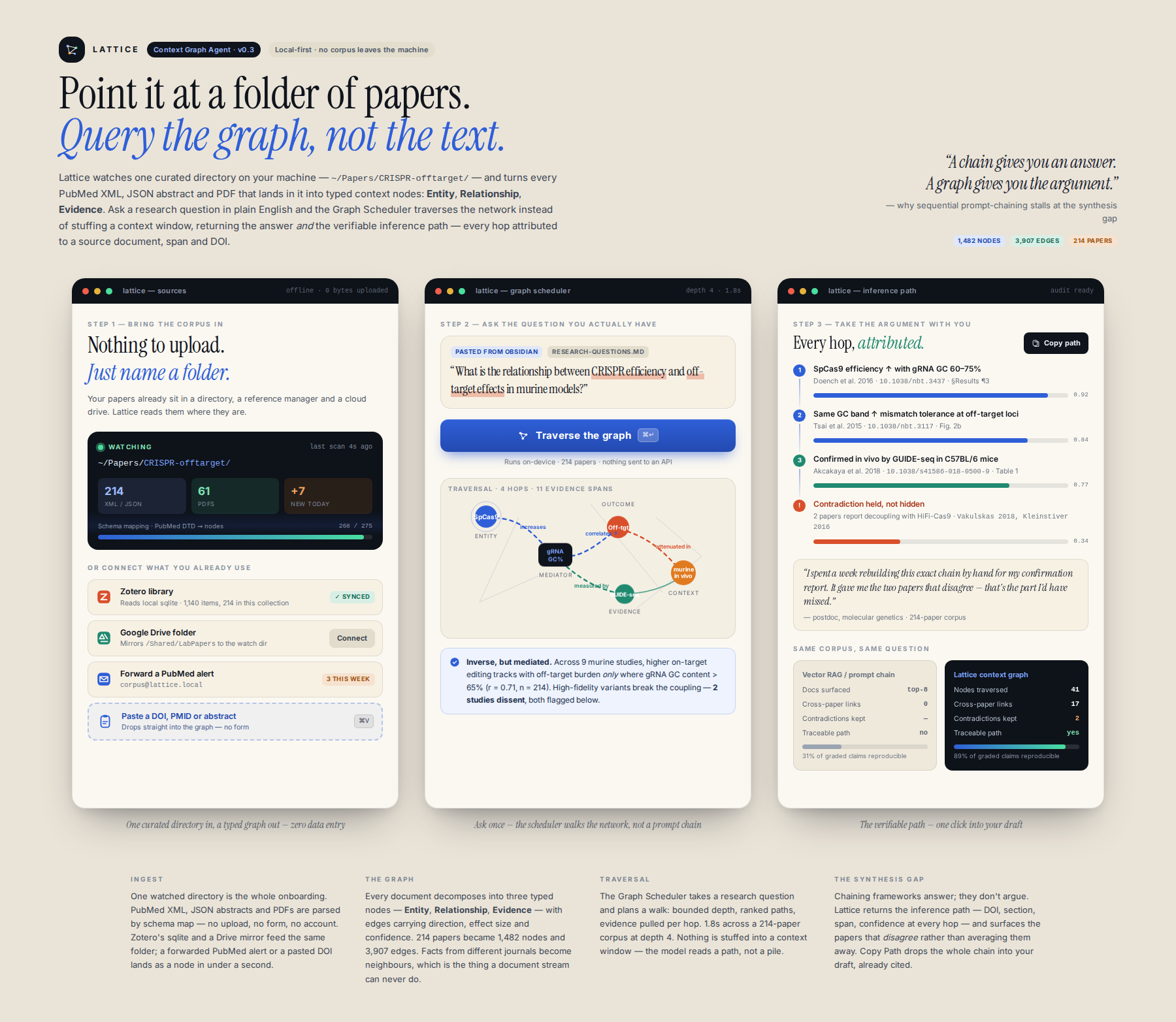
A lightweight, file-based runtime environment specialized for scientific text. It ingests structured corpus data, processes it into interconnected context nodes (Entity, Relationship, Evidence), and allows users to query the graph rather than just the text.
How it works
- User uploads a corpus of structured scientific data (e.g., PubMed XML/JSON abstracts).
- The system processes the data into interconnected context nodes (Entity, Relationship, Evidence) using pre-defined schema mapping.
- The Graph Scheduler is invoked with a high-level research question (e.g., 'What is the relationship between CRISPR efficiency and off-target effects in murine models?').
- The system traverses the context graph, retrieving paths and evidence chains, presenting not just answers, but the verifiable path of inference across the source documents.
Differentiation
Unlike general-purpose LLM orchestration frameworks (LangChain, etc.), which focus on sequential prompt chaining, this solution is built around a Relational Context Graph. It moves beyond simple context window stuffing or basic retrieval by enforcing structured, queryable links between facts derived from disparate sources. This solves the 'Synthesis Gap' in academic research, which current solutions do not address by treating knowledge as a network rather than a document stream.
Implementation sketch
- Refactor the initial MVP scope: Bypass PDF/OCR entirely. Use a public domain, structured dataset (e.g., a subset of PubMed abstracts in JSON format) as the initial corpus.
- Develop the MemoryEngine to focus solely on defining and persisting Node/Edge structures (e.g., using Neo4j or a file-based graph structure like SQLite with specific graph extensions).
- Build a basic query execution layer that accepts a Cypher-like query structure based on the research question, forcing graph traversal instead of simple vector similarity search.
First step: Download a small, clean, public-domain dataset of scientific abstracts (e.g., 50-100 records from PubMed/PMC) formatted as JSON. Write a Python script to load this JSON and manually map 3-5 key relationships (Entity A -> Relationship -> Entity B) into a local graph structure (e.g., an in-memory graph object) to prove the traversal logic works.
Remaining risks
- The 'Graph Traversal' mechanism, while novel, may prove too complex or slow to execute in a truly interactive, real-time user experience, leading to user frustration. — Implement progressive visualization and result streaming. Instead of waiting for the full graph traversal, show the user the initial nodes/edges found, and stream the path as it is confirmed, managing expectations around latency.
- The assumption that structured data (JSON/XML) is sufficient ignores the majority of real-world scientific literature, which remains in unstructured, complex PDF formats. The MVP success might create an illusion of feasibility for the general problem. — Develop a clear, phased roadmap that explicitly acknowledges the PDF gap. The next major milestone must be a dedicated, scoped effort on a single, common PDF layout (e.g., standard journal article format) to prove the next layer of abstraction is possible, rather than treating it as a general problem.
- The system's core value is 'verifiable path of inference.' If the underlying graph structure cannot robustly distinguish between a direct causal link (A causes B) and mere co-occurrence (A and B were mentioned in the same paper), the output will be scientifically misleading, damaging user trust. — Enforce strict schema validation during graph construction. Require the initial data mapping to include a confidence score or source citation for every edge, forcing the user to verify the relationship type before the system accepts it as a primary inference path.
Watch for: User asking for a 'simple summary' or 'list of key findings' instead of a graph query. This indicates the user values retrieval over synthesis, suggesting the core value proposition is being bypassed. Kill criterion: If, after demonstrating the MVP on structured data, the user cannot articulate a specific, complex relationship they cannot find using standard vector search on the source text, the unique value proposition of the graph structure is not validated.
Sources the council used
Real-world evidence that grounded this idea — judge it for yourself.