
Standardized Protocol Benchmarking for Local Multi-Agent LLM Orchestration
A focused, minimum viable benchmark suite designed to measure the performance and reliability of *inter-agent communication protocols* when running complex workflows across various local, open-source LLM stacks.
How do you benchmark communication overhead between local AI agents?
A dedicated protocol benchmark isolates message-passing overhead from LLM inference time by running structured, multi-agent tasks across local frameworks like llama.cpp and vLLM and measuring only serialization, transmission, and parsing across a defined JSON schema boundary. It outputs standardized Protocol Latency and Protocol Success Rate metrics, letting teams compare communication protocols independent of model quality. It's aimed at AI/ML research teams building agentic workflows on constrained local hardware who currently lack a way to isolate protocol overhead from inference cost.
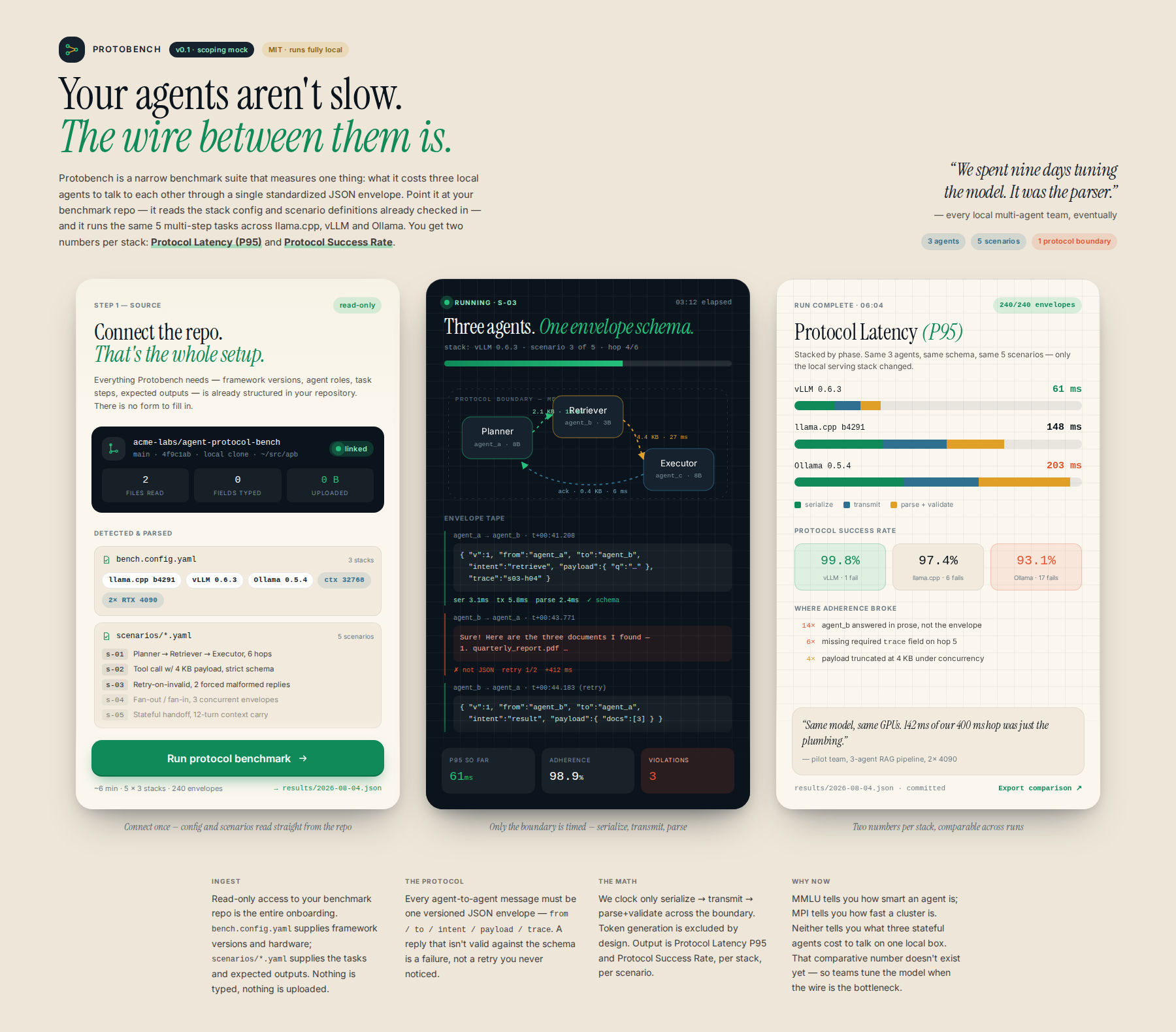
Process flow
Who it's for
AI/ML research teams and developers focused on local LLM orchestration, particularly those integrating agentic workflows.
Why they need it
The industry lacks a standardized, measurable way to compare the overhead and failure modes of different message-passing protocols (e.g., JSON vs. specific message formats) used in multi-agent systems operating on constrained, local hardware.
What it is
A narrow suite of structured, executable scenarios that force agents to communicate via a single, standardized communication protocol (e.g., a defined JSON schema for message passing). Benchmarks will measure latency and success rate based on protocol adherence, rather than holistic system resource usage initially.
How it works
- Select 2-3 established, open-source local LLM frameworks (e.g., llama.cpp bindings, vLLM for local setups).
- Define a limited set of complex, multi-step tasks involving 3 agents.
- Focus measurements solely on the time taken for message serialization, transmission, and parsing across the defined protocol boundary.
- Output standardized metrics: Protocol Latency and Protocol Success Rate.
Differentiation
Unlike general LLM benchmarks (e.g., MMLU, HumanEval) or distributed system benchmarks (e.g., MPI), this suite specifically targets the protocol translation and overhead layer unique to local, stateful, multi-agent LLM interactions. The gap is the lack of comparative metrics for protocol overhead when constrained by local GPU/RAM resources.
Implementation sketch
- Develop the core benchmark runner framework, initializing a controlled environment to simulate N agent processes.
- Build a standardized protocol validation layer that ingests raw message payloads, validates them against a defined schema (e.g., JSON Schema), and precisely measures serialization/deserialization time.
- Create a configuration layer to easily swap the target LLM framework and the specific communication protocol being tested, ensuring all tests run on a baseline hardware profile (e.g., 16GB RAM, specific GPU model).
First step: Select the top 2 competing local LLM frameworks (e.g., llama.cpp bindings and a Python wrapper for a local vLLM instance) and create a minimal, reproducible Docker container setup to establish the baseline environment for I/O timing measurements.
Remaining risks
- The 'protocol translation' layer overhead might be negligible compared to the LLM inference time, leading to benchmarks that measure noise rather than signal. — Focus initial benchmarks on synthetic, non-LLM-dependent message exchanges (e.g., simple state updates or data lookups) to isolate and quantify the protocol overhead itself, independent of the LLM call time.
- The defined 'standardized protocol' might become obsolete instantly due to the rapid evolution of underlying LLM tool-calling or function-calling standards, rendering the benchmark irrelevant before adoption. — Design the protocol layer to be an abstract interface (API gateway) rather than a rigid serialization format, allowing for pluggable protocol adapters that can quickly integrate new industry standards (e.g., OpenAI's evolving function calling specs).
- The 'local-first' constraint forces reliance on specific, non-standardized hardware configurations, making the benchmark results non-transferable or difficult to reproduce across different corporate/academic labs. — Develop a comprehensive 'Hardware Profile Definition' module that forces users to specify not just the GPU model, but also the OS kernel version, CUDA toolkit version, and specific driver versions, making the reproducibility requirement explicit and part of the output metadata.
Watch for: Any major, open-source LLM framework (e.g., Llama.cpp, vLLM) releasing a native, standardized, and measurable 'Inter-Agent Communication' module that bypasses the need for external protocol wrappers. Kill criterion: If the initial testing phase reveals that the measured protocol latency variation across different protocols is consistently less than the measurement noise floor (e.g., < 1ms difference in P95 latency on identical hardware), suggesting the problem is not a protocol bottleneck but rather a systemic limitation of the local compute environment itself.