
Contextual Spending Agent for Cross-Border Finance
An autonomous AI agent providing deep, predictive spending insights tailored for global earners by synthesizing jurisdictional context across multiple, semi-structured international data sources.
How can digital nomads avoid hidden fees and tax surprises from cross-border spending?
An AI agent designed for digital nomads, freelancers, and expatriates can flag hidden cross-border costs by ingesting transaction exports from sources like Stripe, Wise, and credit card statements, then enriching each purchase with jurisdictional context such as VAT applicability and expected FX spread. It predicts spending impact against a travel budget and surfaces mitigation steps, for example holding local cash to avoid high ATM fees. This addresses a gap in standard budgeting apps, which aggregate transactions but cannot interpret the tax and currency rules behind multi-country spending.
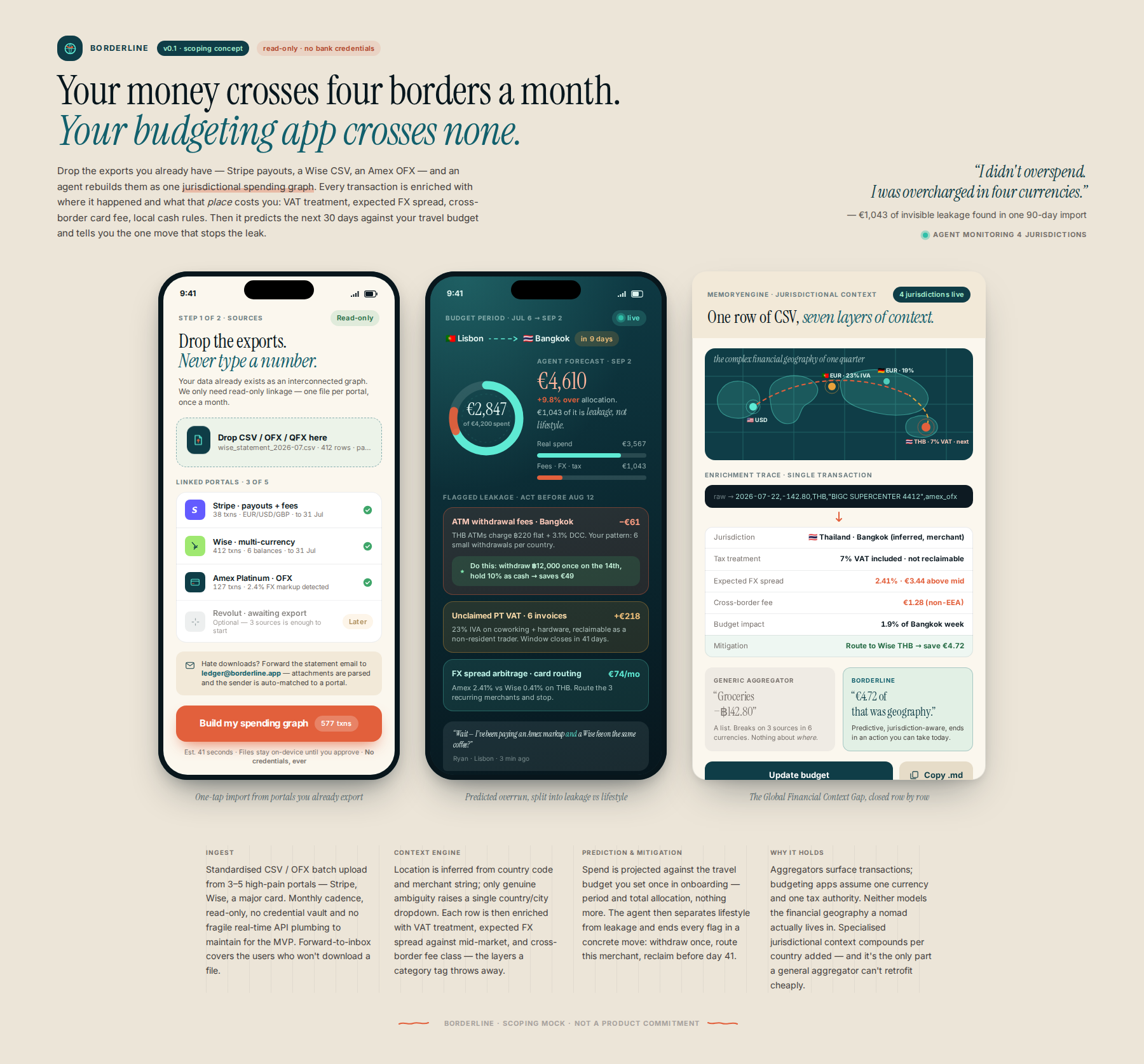
Process flow
Who it's for
Digital nomads, freelancers, and expatriates managing finances across multiple international jurisdictions.
Why they need it
Users struggle to track spending accurately when money flows across disparate, non-standardized international payment rails (e.g., local bank transfers, international CC, crypto). Existing tools fail because they cannot synthesize complex jurisdictional context (VAT, FX fees, local tax rules) into actionable spending predictions.
What it is
An agentic monitoring layer that ingests structured/semi-structured transaction data exports (e.g., Stripe, Wise, major CC statements) from 3-5 high-pain international sources. It uses an LLM context engine to build a comprehensive, real-time spending graph focused on jurisdictional spending patterns.
How it works
- Data Ingestion Focus: Ingest structured data exports from 3-5 defined international sources (e.g., Stripe, major CC). This bypasses unstable real-time API plumbing for the MVP.
- Context Engine: The 'memoryengine' enriches data not just with category, but with jurisdictional context (e.g., 'Is this purchase subject to VAT? What is the expected FX spread?').
- Prediction/Action: Predict spending impact relative to the user's current travel budget and flag potential tax/fee leakage or unexpected currency conversion costs, offering actionable mitigation steps (e.g., 'Hold 10% of local cash until next week to avoid high ATM fees').
Differentiation
Unlike general aggregators or budgeting apps that merely surface transaction lists and fail with complex multi-source data, this solution specializes in the complex financial geography of international travel. It moves beyond simple aggregation by applying specialized, domain-specific context (currency volatility, cross-border fees, local tax structures) to provide predictive intelligence essential for mobile, global earners. We solve the 'Global Financial Context Gap'.
Implementation sketch
- MVP Phase 1: Select and secure connectors/templates for 3 specific, high-pain international payment rails (e.g., Stripe/Wise exports, major CC statement format).
- Develop the 'Jurisdictional Context' vector within the memoryengine to flag cross-border issues.
- Build the agent logic to simulate spending impact across currency exchange rates and flag fee leakage.
First step: Identify the top 3 most common and painful cross-border payment rails used by digital nomads (e.g., Wise, Revolut, specific CC network). Download sample CSV exports for these 3 rails and structure a standardized schema definition for the memoryengine to process them against.
Remaining risks
- The 'Jurisdictional Context' becomes too complex or jurisdiction-specific to model reliably. — Limit the initial scope of context modeling to a single, highly defined geographic corridor (e.g., EU-to-US spending) and focus on the most variable element (e.g., VAT/GST compliance) rather than attempting global tax coverage.
- The user base (digital nomads) is highly transient and lacks consistent, longitudinal data streams. — Shift the product focus from 'real-time monitoring' to 'retrospective financial auditing' on bulk uploads. This lowers the expectation for constant connectivity and makes the value proposition more stable.
- Competitors (e.g., Wise, Revolut) rapidly integrate advanced AI features that match or exceed the 'Jurisdictional Context' layer. — Embed the agent's core value proposition into the workflow—making the prediction actionable within a unique, highly intuitive interface that forces users to confront the predicted risk before proceeding with a transaction or budget adjustment.
Watch for: A major FinTech competitor launching a similar 'contextual' warning feature directly within their primary user interface (e.g., Wise adding a 'Tax Leakage Alert' feature). Kill criterion: If the initial set of 3 sample data exports cannot be mapped to a single, consistent, and actionable 'Jurisdictional Context' vector within 2-3 weeks, indicating the underlying data structure variability is insurmountable for the MVP.
Sources the council used
Real-world evidence that grounded this idea — judge it for yourself.