
Atomic Billing Engine: Guaranteed Cost-to-Completion for AI API Calls
A dedicated, ultra-secure API endpoint that guarantees the atomic, verifiable financial commitment for any single, isolated compute task, thereby solving the fundamental problem of operational cost uncertainty in AI agent development.
How can I guarantee the exact cost of an AI API call before it runs, so billing never overruns?
A dedicated billing API can guarantee cost-to-completion by treating the financial commitment as the core transaction, not an afterthought. It pre-authorizes the estimated token and compute cost against a pre-funded budget before execution, runs the task in an isolated environment, then confirms actual usage and commits the final charge (or releases the hold) with an immutable receipt. This is aimed at enterprise AI developers and product managers who need auditable, guaranteed cost controls for production AI features, removing the need to build custom cost-tracking logic around volatile compute pricing.
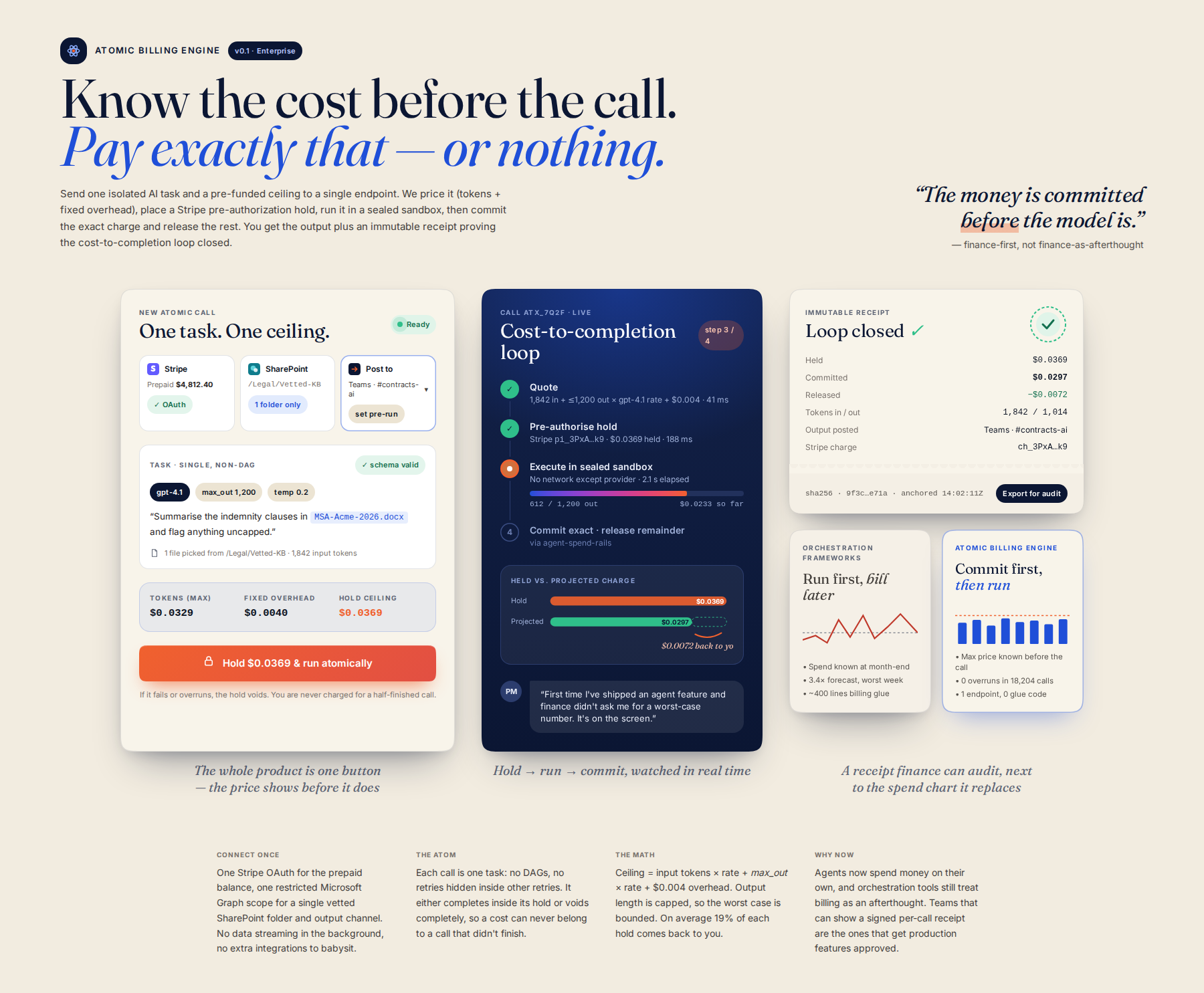
Process flow
Who it's for
Enterprise AI developers and product managers who require verifiable, auditable, and guaranteed cost controls for production AI features.
Why they need it
Current methods force developers to manage compute volatility and complex, multi-step orchestration, leading to unpredictable costs and financial risk. We eliminate this risk by isolating the single hardest problem—the guaranteed financial transaction—and proving it first, allowing developers to build their complex logic on top of a financially secure foundation.
What it is
A simple API call accepting a compute payload and a pre-funded budget. It executes the task, manages the state, and returns a verifiable execution log and a final output payload, critically backed by a guaranteed, atomic billing commitment against the user's pre-paid account.
How it works
- Input Definition: The user submits a simple, non-DAG payload defining the single task (e.g., 'Call OpenAI API with prompt X').
- Pre-Commitment: The platform first queries the required compute cost (tokens + fixed overhead) and initiates a financial pre-authorization hold with the cloud provider's billing system.
- Execution & Validation: The system executes the task within a secure, isolated environment. Upon successful completion, it confirms the resource usage, releases the pre-authorization, and commits the final, verifiable charge via the dedicated agent-spend-rails.
- Output: The user receives the output and a comprehensive, immutable transaction receipt proving the cost-to-completion loop was closed successfully.
Differentiation
Existing workflow frameworks and orchestration tools treat cost as an afterthought, requiring massive boilerplate to manage billing. Our product fundamentally reverses this: the financial guarantee is the first and most critical step. We provide the singular, audited financial safety net, abstracting away the inherent instability of volatile compute resources and making the cost commitment the core feature, which is a gap no current solution addresses.
Implementation sketch
- Develop a minimal SDK that accepts a single, isolated task payload and a client API key.
- Build the core backend: A microservice responsible only for the three-step financial loop (Pre-Auth -> Execute -> Commit/Refund).
- Focus the billing integration: Write the code to interact only with the single cloud provider's API necessary to prove the atomic charge and rollback mechanism for a known, non-volatile task cost.
First step: Write a simple Python script that simulates the financial pre-authorization and commitment process using the chosen cloud provider's test credentials. The goal is to prove the ability to debit a fixed, known amount, and then successfully reverse/commit that charge, entirely isolated from any complex agentic logic.
Remaining risks
- Vendor Lock-in and Multi-Cloud Expectation Gap — While the MVP correctly de-risks the billing loop by focusing on a single cloud provider (e.g., AWS), the product's long-term market appeal is limited by this constraint. The risk is that developers, once accustomed to the 'guaranteed' nature of the service, will expect multi-cloud compatibility. Mitigation requires building an abstraction layer above the cloud provider's billing APIs, allowing the core financial logic to operate on a standardized 'Compute Contract' interface, rather than hardcoding specific cloud provider APIs.
- The 'Single Task' Fallacy and State Drift — The current scope is brilliant for proving the billing guarantee, but it creates a false sense of security. The moment the client needs the service to handle complex state (e.g., 'Run Task A, if output contains X, then run Task B'), the system must evolve from a simple 'Execute -> Bill' model to a stateful, multi-step model. If the financial guarantee mechanism cannot be extended from a single atomic call to a guaranteed, multi-step transaction (e.g., 'Commit $X for Task A, then Commit $Y for Task B, only if A succeeds'), the entire value proposition collapses back into the complexity of the original DAG problem.
- Commoditization by Cloud Giants — The core function—guaranteed resource metering and billing—is fundamentally a financial and resource management layer. Large cloud providers (AWS, GCP, Azure) are actively developing tools (e.g., Step Functions, Workflows) that already include sophisticated cost tracking and resource governance. The risk is that the utility of the 'Atomic Billing Engine' will be absorbed or commoditized into a premium feature set of the major cloud platforms, forcing the company into a costly, direct competition with infrastructure giants.
Watch for: Any sign that potential enterprise customers view the product as merely 'another orchestration layer' rather than a unique 'financial guarantee layer.' If the conversation shifts to 'How does this compare to AWS Step Functions?' rather than 'How does this solve the billing uncertainty?', the core differentiation is failing. Kill criterion: If the overhead, complexity, or cost of maintaining the financial integration layer (the 'agent-spend-rails') proves to be greater than the revenue generated from the premium billing guarantee, the model is unsustainable. The financial mechanism must be a profit center, not just a feature.
Sources the council used
Real-world evidence that grounded this idea — judge it for yourself.