
Component-Level Cost-Optimized RAG Orchestrator (AgentCost v3)
A specialized, minimum viable orchestration layer that isolates the most expensive and critical component of RAG—the embedding generation—to guarantee the lowest cost path for knowledge indexing, providing measurable, upfront cost savings for enterprise applications.
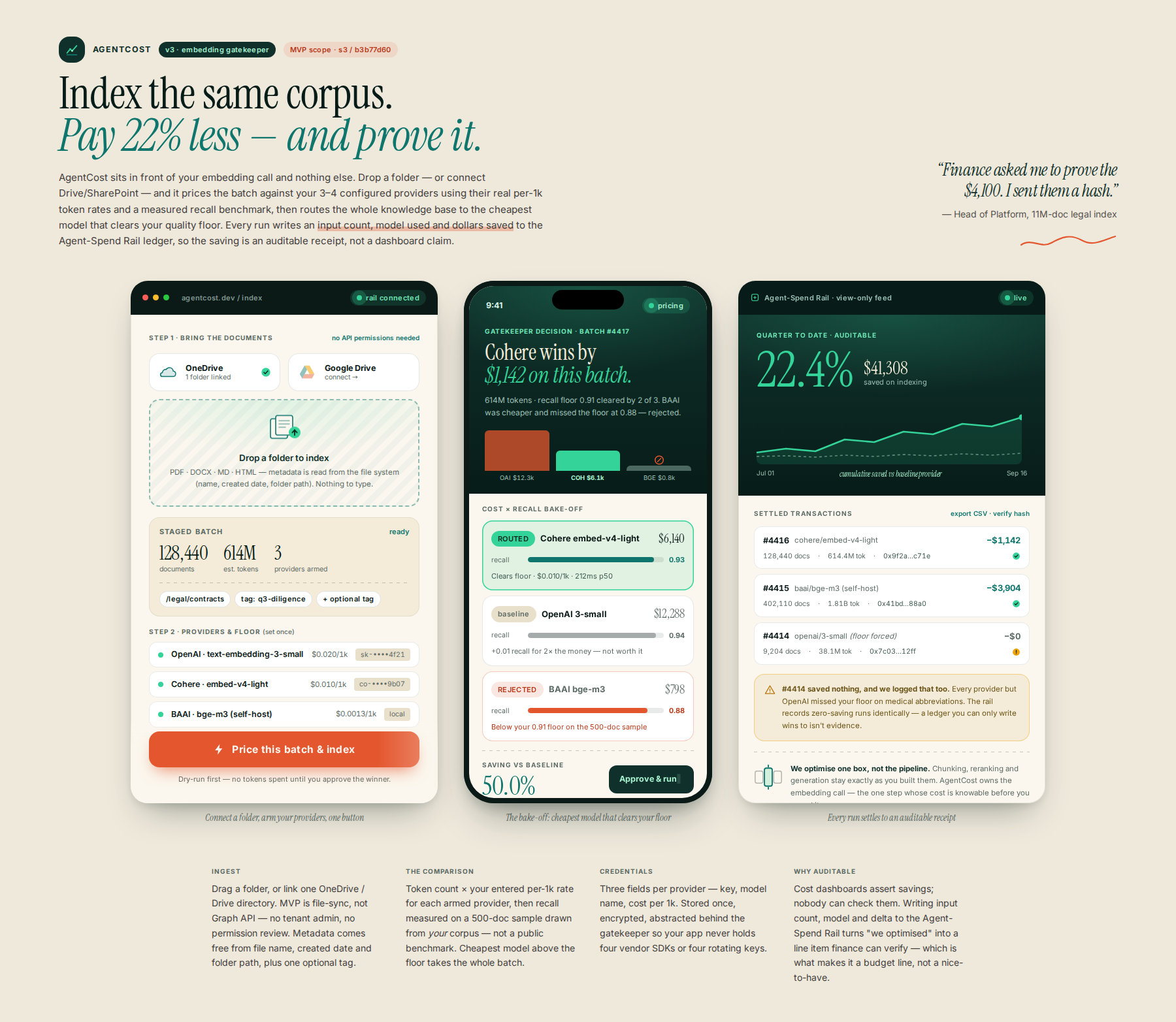
Process flow
Who it's for
Founders and engineering teams building high-volume, document-ingestion RAG applications with multiple embedding model options.
Why they need it
The operational challenge is that the foundational embedding step is a significant, measurable cost sink. High model volatility (OpenAI Ada vs. Cohere vs. Local) means that a failure to optimize this single step results in guaranteed, quantifiable overspending on every single document ingested.
What it is
A specialized Meta-Agent Orchestrator (AgentCost v3) that functions as an Embedding Gatekeeper. It intercepts document payloads and autonomously selects the cheapest, yet performance-vetted, embedding model for the entire knowledge base, drastically reducing the initial ingestion cost.
How it works
- The user/system sends a batch of documents for indexing.
- AgentCost v3 intercepts the batch and runs a simple, defined cost comparison against 3-4 specified embedding APIs (e.g., OpenAI, Cohere, BAAI). This comparison must be based on known token costs and measured performance benchmarks (e.g., recall on a sample set).
- It dynamically routes the embedding task to the optimal provider based on a defined cost/performance threshold.
- The resulting embeddings are stored, and the transaction (input count, model used, calculated cost savings) is logged to the 'Agent-Spend Rail' blockchain service, providing immediate, auditable proof of cost optimization.
Differentiation
AgentCost v3 does not attempt full RAG optimization; it focuses on a single, measurable component (embedding generation). Its core difference is the verifiable, financial-layer guarantee: it provides a measurable cost reduction percentage (e.g., '22% cost savings on indexing') by comparing real-world pricing for the foundational step. This turns a technical optimization problem into a demonstrable, financial ROI metric, which is superior to existing, non-auditable cost management tools (Solution IDs: s3, b3b77d60c30baca8).
Implementation sketch
- MVP Focus: Create a dedicated 'Embedding Cost Comparator' service (Python/FastAPI). This service accepts a document batch size and a list of API credentials.
- Cost Oracle Integration: Implement a module that calls the defined APIs to get real-time pricing for the specified embedding models (e.g., $X/1k tokens). This module must also track latency for performance vetting.
- The Financial Loop: Upon selecting the optimal model, the service generates a summary report showing 'Estimated Cost Before' vs. 'Estimated Cost After' and sends this summary payload to a simulated smart contract wrapper for immutable logging.
First step: Build a simple Python function that takes a document batch size (e.g., 1000 documents) and a dictionary of API price points (e.g., {'openai': 0.00015, 'cohere': 0.00018}). The function must calculate the total cost for each API and return the minimum cost and the corresponding API name, simulating the core decision logic.
Remaining risks
- API Price/Feature Drift: The core value proposition relies on real-time, accurate cost comparisons. If a major competitor (OpenAI, Cohere, etc.) drastically changes its pricing structure, introduces a new, superior model, or imposes unexpected rate limits, the entire Cost Comparator module becomes instantly inaccurate and unusable. — Implement a dedicated 'Pricing Health Monitor' that continuously tracks API pricing, latency, and rate limits against a predefined baseline. The system must be designed with a rapid, automated 'fallback' mechanism to maintain service continuity using a known, stable, albeit less optimal, configuration until the pricing discrepancy is resolved.
- The Cost-Quality Trade-off: By prioritizing minimum cost, the system risks selecting an embedding model that, while cheap, is suboptimal for complex, high-dimensional data. The resulting embeddings may lead to poor retrieval performance (low recall/precision), meaning the cost savings are meaningless because the application fails to deliver value. — Integrate a mandatory 'Performance Quality Gate' into the selection process. Before declaring the cheapest model optimal, the system must run a small, fixed benchmark set of complex queries against the top 2-3 cost candidates. The selection must then be based on a weighted score: (Cost Savings * Weight) + (Performance Score * Weight), ensuring quality is never sacrificed for marginal cost reduction.
- Vendor Lock-in on Data Schema: While the system optimizes the embedding step, the output embeddings must conform to a standard format. If the industry standard for optimal embedding representation evolves (e.g., moving from 1536 dimensions to 3072), the entire system must be rebuilt, creating a new, single point of technical failure. — Design the output layer to be highly abstract and decoupled. Treat the embedding output not as a proprietary artifact, but as a standardized vector payload (e.g., using a dedicated vector database interface) that can easily accept and manage different dimensionality standards without requiring core logic changes.
Watch for: Increased focus on 'Model Governance' or 'Data Provenance' over pure cost optimization. If the market begins prioritizing the trustworthiness or source of the data/model over the cost of the data/model, the entire financial layer's value proposition diminishes. Kill criterion: A major cloud provider (AWS, Azure, GCP) integrates a similar, highly effective, and auditable cost-comparison and routing feature directly into their core managed services, making the third-party orchestration layer a non-differentiated, redundant utility.