
Contextual Billing Gap Identification Engine
A specialized, asynchronous agent system that ingests draft invoices and client scope documents to proactively highlight potential ethical or regulatory billing ambiguities by pinpointing gaps in documentation rather than attempting to score compliance.
How can law firms catch billing items not covered by the client's scope agreement before invoicing?
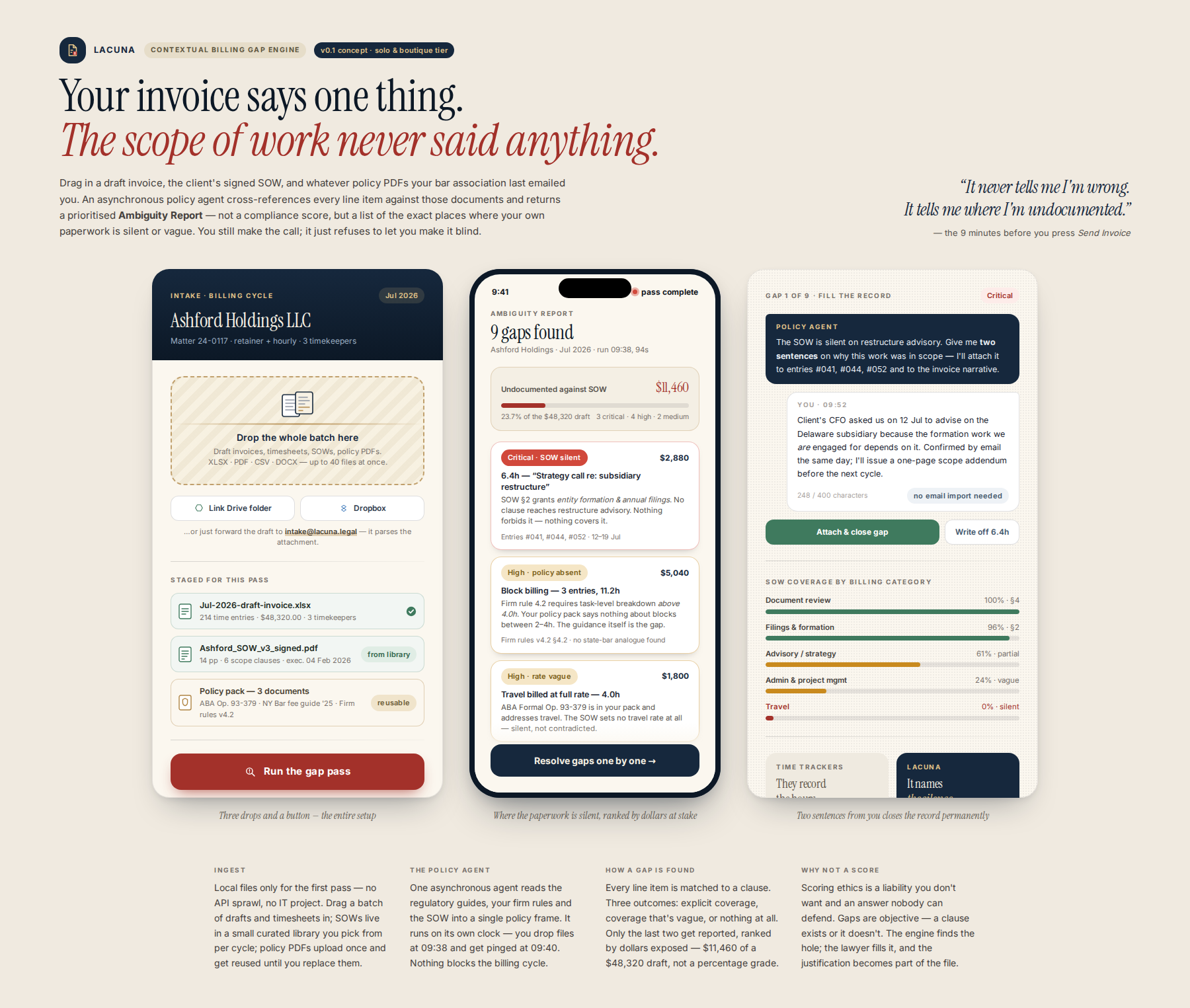
A documentation-gap engine cross-references draft invoices and time entries against the uploaded client scope of work and regulatory guides, flagging line items that lack explicit SOW coverage or policy support. Rather than scoring compliance, it produces a prioritized 'Ambiguity Report' showing where documentation is silent or vague, forcing the lawyer to review and fill each gap before billing. It's built for solo practitioners and specialized consultancies managing complex billing structures and liability exposure.
Process flow
Who it's for
Solo practitioner law firm owner or specialized consultancy dealing with complex billing structures.
Why they need it
These professionals face high-stakes liability risks when billing, needing proactive defense against ethical ambiguities and ensuring compliance with complex client scope agreements.
What it is
A policy-driven engine that cross-references proposed invoices/time entries against uploaded regulatory guides and client scope documents, generating a prioritized 'Ambiguity Report' detailing where the documentation is silent or vague relative to the proposed billing line item.
How it works
- The user uploads the draft invoice/time entries and the original Client Scope of Work (SOW).
- The 'Policy Agent' ingests the regulatory guides, firm rules, and the SOW.
- The system runs a structured comparison, generating a gap report: identifying line items that lack explicit SOW coverage, flagging billing categories that require further justification, or highlighting areas where policy guidance is absent.
- The output is a prioritized, actionable documentation gap report, forcing the human expert (lawyer) to review and fill the identified knowledge gap.
Differentiation
Unlike existing time tracking tools which only record time, or general guides which offer static advice, this engine acts as a dedicated 'Documentation Gap Identifier.' It moves beyond mere tracking or scoring to perform contextual validation by highlighting explicit informational gaps between proposed billing and client agreements, which existing CLM/billing tools cannot automate reliably.
Implementation sketch
- MVP: Build a document ingestion service using RAG over uploaded SOW/Policy documents to create a searchable knowledge base.
- Develop a structured prompt template for the LLM that forces it to output a JSON object listing 'Billing Item' -> 'Required Context' -> 'Gap Found/Not Found' instead of a score.
- Focus initial testing on a small, defined set of regulatory documents (e.g., bar association guidelines) to prove the gap identification mechanism.
First step: Set up a dedicated local environment (e.g., using LlamaIndex/LangChain) to ingest 3-5 sample SOWs and 3 sample regulatory documents, and write the initial structured prompt that forces the LLM to output a comparison JSON structure, ignoring scoring logic entirely.
Remaining risks
- Legal/Jurisdictional Ambiguity: The system's ability to identify gaps relies on the completeness and accuracy of the uploaded policy documents (SOWs, regulatory guides). If the user uploads documents from conflicting jurisdictions or if the underlying law is not codified in the documents, the 'Gap Report' will be inherently incomplete or misleading, creating a false sense of security. — Implement a mandatory 'Scope Disclaimer' at the point of use, explicitly stating that the output is only a documentation gap analysis based on provided inputs and does not constitute legal advice. Further, build a metadata layer that tracks the source/jurisdiction of every ingested policy document.
- Data Ingestion and Structure Variability: While the MVP focuses on RAG, the actual variability in how law firms structure their SOWs, internal policies, and client agreements (e.g., using different formatting, jargon, or embedding clauses within emails) will lead to inconsistent retrieval and interpretation, breaking the structured JSON output. — Develop a pre-processing 'Normalization Agent' layer whose sole job is to identify and tag document structure elements (e.g., 'Scope Definition Section,' 'Exclusions Clause,' 'Governing Law') before the RAG pipeline runs. This forces consistency before analysis.
- User Over-Reliance and Deskilling: Because the tool is designed to highlight gaps, users may begin to treat the absence of a gap report as confirmation of compliance, leading to over-reliance on the technology and potentially causing the human expert to neglect necessary critical thinking or manual cross-referencing. — Integrate 'Challenge Prompts' into the UI. After generating a gap report, the system should prompt the user with questions like, 'Based on your firm's established best practice for X, is there any unstated assumption here?' to force active engagement rather than passive acceptance of the output.
Watch for: If early pilot users begin asking the system to 'advise' on the solution to a gap (e.g., 'How should I word this clause to cover this billing item?'), it signals that the market is ready for a judgment/scoring feature, which is a massive, unmitigated technical leap. Kill criterion: If the system consistently fails to ingest or accurately parse the core structural elements (e.g., failing to distinguish between a 'Client Requirement' and a 'Firm Policy') across more than 3 different types of sample SOWs, the underlying document parsing/structuring layer is fundamentally flawed, and the project must pivot to a manual/semi-automated workflow.
Sources the council used
Real-world evidence that grounded this idea — judge it for yourself.