
Agent Spend Rail: Simulated Collateralized Transaction Proof-of-Concept
A highly de-risked, atomic financial layer that proves the core mechanism of collateralized compute payment by simulating the successful execution of a single, high-value API call within a closed, verifiable environment.
How can AI agents guarantee payment for API calls without risking fraud or non-payment?
A collateralized smart contract rail solves this by requiring the buyer to stake funds upfront, which are only released once a verifiable proof of successful execution is confirmed on-chain. The buyer locks collateral covering the API cost plus an insurance fee, a sandboxed process generates a deterministic success proof (such as a hash), and the contract then auto-releases payment to the provider while refunding unused collateral. This targets AI agent developers and API or MCP providers who need financial certainty for pay-per-call usage before building complex live integrations.
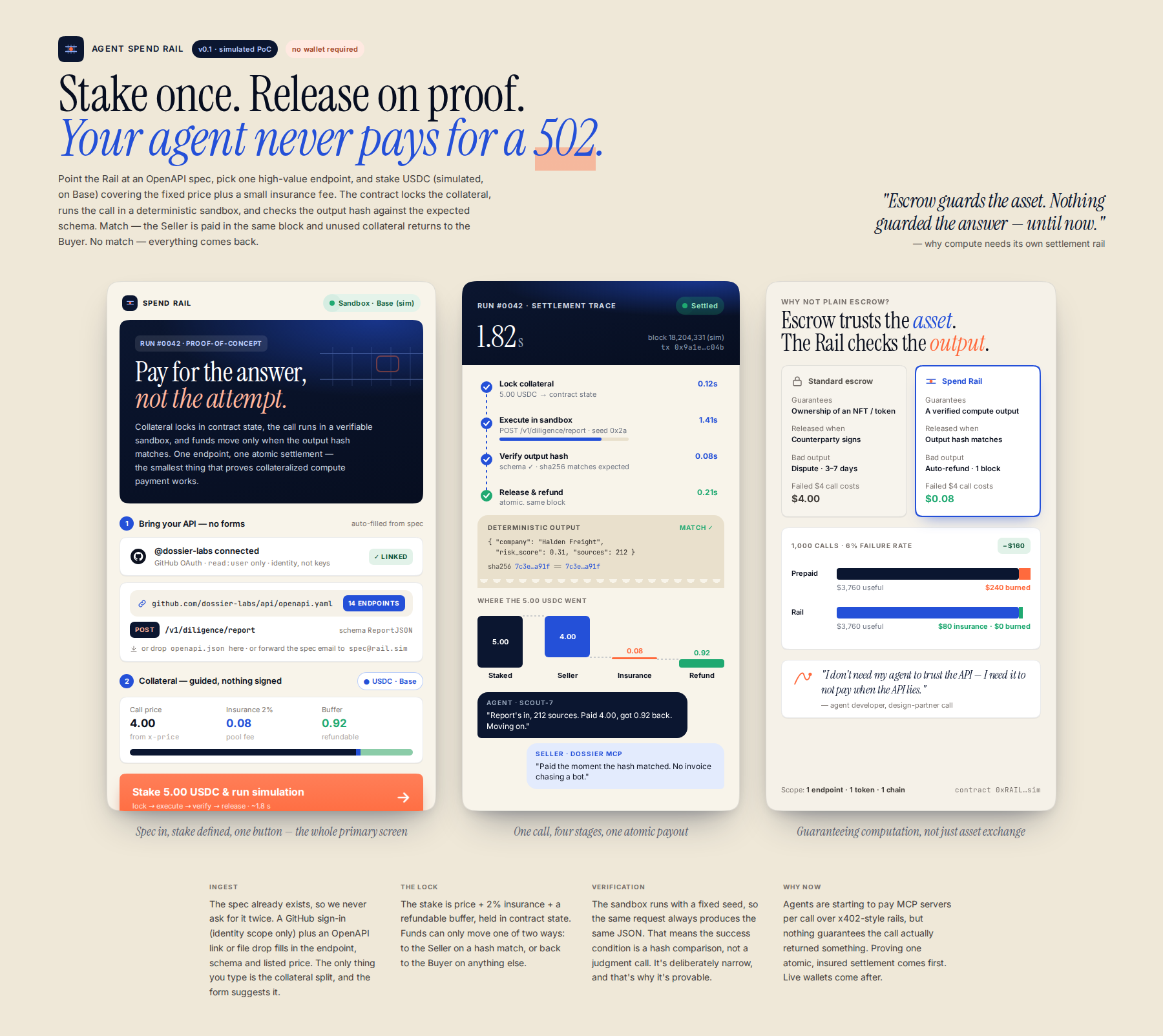
Process flow
Who it's for
Developers building and monetizing AI agents, and API providers/MCP servers offering high-value, single-endpoint services.
Why they need it
The market requires financial certainty for AI agent usage. By proving the atomic financial transaction (Stake -> Simulate Success -> Release Funds), we isolate the core risk—the payment guarantee—from the immense operational hurdle of live API integration. This makes the MVP immediately feasible, validating the financial rail before tackling complex external dependencies.
What it is
A decentralized smart contract wrapper that accepts staked collateral (e.g., USDC on Base) from the consumer (Buyer) and releases micro-payments to the service provider (Seller) only upon verifiable, simulated success of a single API call.
How it works
- The Buyer specifies the required single API call and stakes collateral covering the fixed cost + insurance fee.
- The Rail locks the collateral in the smart contract state.
- The Rail executes a simulated API call within the smart contract's verifiable sandbox, generating a deterministic, verifiable output (e.g., a fixed hash or structured JSON).
- The smart contract verifies the simulated success condition and automatically releases the accumulated micro-payments (minus the insurance fee) to the Seller via the blockchain rail, returning any unused collateral to the Buyer.
Differentiation
Unlike standard escrow systems (e.g., used in NFT marketplaces or DEXs like [Example_DEX_ID]), which manage verifiable digital assets, our system manages and guarantees the payment for non-fungible, time-sensitive computational output. The gap is the reliable, blockchain-guaranteed financial sink for complex, non-digital compute services. We are solving computational risk, not just asset exchange risk.
Implementation sketch
- Establish the smart contract wrapper on Base to handle collateral locking/release (USDC).
- Build a dedicated off-chain service (the 'Simulator') that accepts API parameters and deterministically generates a verifiable output (e.g., a fixed-length SHA-256 hash of the input + a simulation seed).
- Modify the smart contract logic to call the Simulator's output hash/proof before triggering the fund release, proving the financial mechanism in a controlled, zero-risk environment.
First step: Deploy a basic smart contract shell on Base that contains only the 'stake' and 'return collateral' functions. The immediate goal is to test the atomic state transition (stake -> success -> release) using a hardcoded, simulated success proof to validate the core financial logic without touching any external APIs.
Remaining risks
- The 'Simulation Gap': The success of the MVP proves the atomic financial transaction, but the transition from a deterministic, controlled simulation to handling real-world, variable, rate-limited, and failure-prone external API calls (the next stage) introduces immense, unquantified operational complexity. — Do not attempt to solve the entire workflow at once. Adopt a staged integration roadmap: Phase 1 (Simulation) -> Phase 2 (Single, Fixed-Cost Live API) -> Phase 3 (Multi-Step Orchestration). Treat the operational integration layer as a separate, highly specialized product with its own dedicated engineering and reliability metrics.
- Regulatory and Compliance Overhead: Since the product is fundamentally a financial sink handling collateral, it immediately draws the attention of financial regulators. The current focus ignores the complex, multi-jurisdictional requirements for KYC, AML, and automated cross-border payment guarantees, which could halt deployment entirely. — Integrate compliance requirements into the architecture from day one. Design the system to be modular, allowing specific regulatory modules (e.g., regional compliance checks, KYC verification hooks) to be plugged in as the service expands into new markets, rather than treating compliance as an afterthought.
- Developer Inertia and Adoption Friction: The concept is novel, but developers are accustomed to established, simple payment rails (e.g., Stripe, direct billing). The added complexity of staking collateral and interacting with a new smart contract layer may create enough friction to prevent mass adoption, even if the technology is superior. — Focus initial marketing and onboarding efforts on 'API providers' (Sellers) first, not 'consumers' (Buyers). By making the platform an indispensable risk management tool for the service providers, the demand for the Buyer side of the rail will follow naturally.
Watch for: Early signals of resistance or indifference from major API providers (Sellers). If leading AI model providers or high-value API owners view the collateralization mechanism as an unnecessary cost or regulatory burden rather than a necessary risk mitigation tool, the core value proposition collapses. Kill criterion: If the project cannot secure a Letter of Intent (LOI) from at least two major, independently operated, high-value API providers willing to integrate their services and commit to the collateralized payment model, the market dependency risk is too high, and the project must pivot to a purely theoretical or research-focused application.