
Atomic Billing Rail for Single-Unit Proprietary Simulation APIs
A specialized, mission-critical infrastructure layer that guarantees atomic, auditable payment and usage metering for the execution of a single, proprietary computational unit (e.g., one Monte Carlo simulation iteration). It solves the fundamental problem of achieving financial finality across heterogeneous, high-value, third-party compute APIs.
How can quant finance firms guarantee payment and compute execution happen atomically for a single API call?
A proxy gateway layer couples billing to execution so one cannot succeed without the other: it intercepts the request, escrows payment, calls the proprietary compute API, then finalizes the crypto settlement on success or automatically voids it on failure. This targets quant finance, drug discovery, and other high-stakes fields where value comes from a single expensive computation (e.g., one Monte Carlo iteration), turning the payment rail into an auditable trust primitive rather than a simple metering layer like AWS or Cloudflare gateways provide.
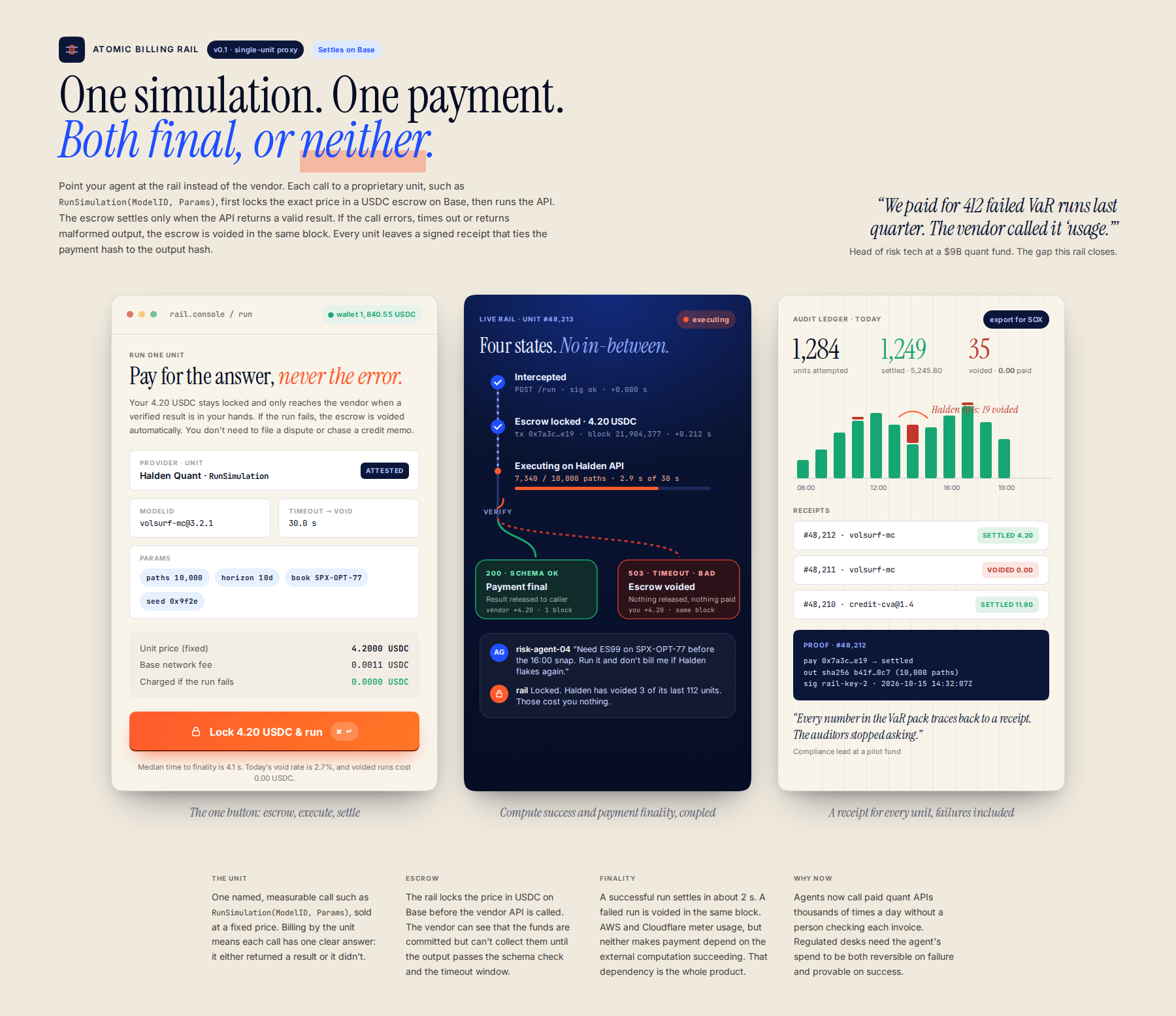
Process flow
Who it's for
Quantitative finance firms, specialized academic research groups, and regulated industries requiring auditable, high-stakes data access.
Why they need it
In fields like quant finance or drug discovery, the value resides in the output of a single, complex computation. The current bottleneck is not discovery, but the lack of a standardized, guaranteed mechanism to ensure that the payment (crypto settlement) and the computational execution are perfectly atomic—meaning one cannot succeed without the other. The payment rail becomes a critical trust primitive that guarantees the entire transaction's integrity.
What it is
A standardized, minimal-viability proxy gateway that receives a request for a specific computation unit, manages the state, and executes the transaction atomically: 1) Intercepts the request. 2) Initiates payment escrow/billing. 3) Executes the compute job via the proprietary API. 4) Confirms both successful payment and successful computation output before releasing the result.
How it works
- Define the Unit: Target one specific, measurable computational unit (e.g.,
RunSimulation(ModelID, Parameters)). - Proxy Implementation: The service acts as a proxy wrapper. Upon receiving the call, it first locks the required payment amount (escrow/billing).
- Atomic Execution: It executes the proprietary API call. If the API returns a successful result, the payment is finalized on the Base blockchain. If the API fails, the payment is automatically voided/refunded.
- Output: The result is returned to the agent/user, and the usage is recorded, providing auditable proof of payment and execution.
Differentiation
Existing API gateways (AWS, Cloudflare) handle metering, but they do not guarantee atomic, irreversible financial settlement tied directly to the success of a proprietary, external, high-value computation. The gap is the secure, decentralized coupling of computation success and payment finality. This solution is a specialized 'Compute-to-Coin' atomic transaction layer. (GAP: Standardized, payment-secured, atomic execution boundary for proprietary simulation APIs).
Implementation sketch
- Select a single, high-value partner (e.g., a quant firm) and agree on the precise API signature and billing unit (e.g., 1 unit = 1 Monte Carlo iteration).
- Build a minimal proxy service in a test environment that can successfully intercept, call, and measure the latency of this single API endpoint.
- Implement the payment logic: Use a testnet environment to prove that the payment initiation and the API execution can be successfully rolled back or finalized atomically within a defined time window.
First step: Identify one specific, high-value quantitative finance partner and draft a technical specification defining the exact API endpoint and the precise computational unit (e.g., '1 unit = 1 run of Model X with 100 paths') required for the initial proof-of-concept.
Remaining risks
- The 'Single-Partner Dependency Trap': The entire value proposition relies on the continued cooperation, stability, and willingness of the single, high-value partner (e.g., Quant Firm X). If they change their internal APIs, reduce access, or pivot their business model, the entire infrastructure becomes instantly obsolete, regardless of the technical perfection of the billing rail. — Design the proxy wrapper with extreme abstraction layers and clear versioning contracts. The focus must be on creating a standardized 'Adapter' layer that can be updated to accommodate changes in the underlying proprietary API without rewriting the core atomic billing logic.
- Regulatory Compliance Overload: Since the target niche is high-stakes (finance/biotech), the technical success of the atomic transaction is secondary to legal compliance (e.g., data residency, GDPR, HIPAA, financial reporting). Failure to integrate these complex, non-technical legal requirements into the workflow could halt deployment, even if the payment rail functions perfectly. — Engage specialized legal and compliance counsel (not just technical architects) during the design phase. The initial scope must include a compliance checklist and a 'compliance gate' within the proxy logic that must pass before payment escrow is initiated.
- Market Inertia and Internal Build-vs-Buy: The target clients (large financial institutions) are highly risk-averse and often prefer building critical infrastructure internally. Even if the rail is perfect, the perceived operational overhead, vendor lock-in, or loss of internal control might lead them to build a customized, non-standardized solution that bypasses the service entirely. — Shift the marketing focus from 'payment rail' to 'risk reduction and auditability.' Position the service not as a utility, but as an indispensable, pre-vetted compliance and audit layer that is significantly faster and cheaper to integrate than building it in-house.
Watch for: Any indication from the initial partner that the required computational unit is too variable or non-deterministic in its execution time or resource consumption. If the input API cannot provide reliable, measurable telemetry (latency, CPU cycles, memory usage) that can be correlated with the financial billing unit, the 'atomic' claim fails. Kill criterion: A major, established industry player (e.g., Bloomberg, Refinitiv, major cloud provider) releases a similar, integrated, and compliant feature that solves the 'Compute-to-Coin' problem natively, thereby eliminating the need for a specialized third-party billing layer.