
Verifiable Usage Logging and Dispute Resolution Layer for Agent Compute
A robust, automated microservice layer that ingests, standardizes, and verifies real-time usage telemetry from professional compute APIs, establishing a trustless, auditable record for billing and dispute resolution.
How can developers verify AI agent compute usage billing instead of trusting vendor dashboards?
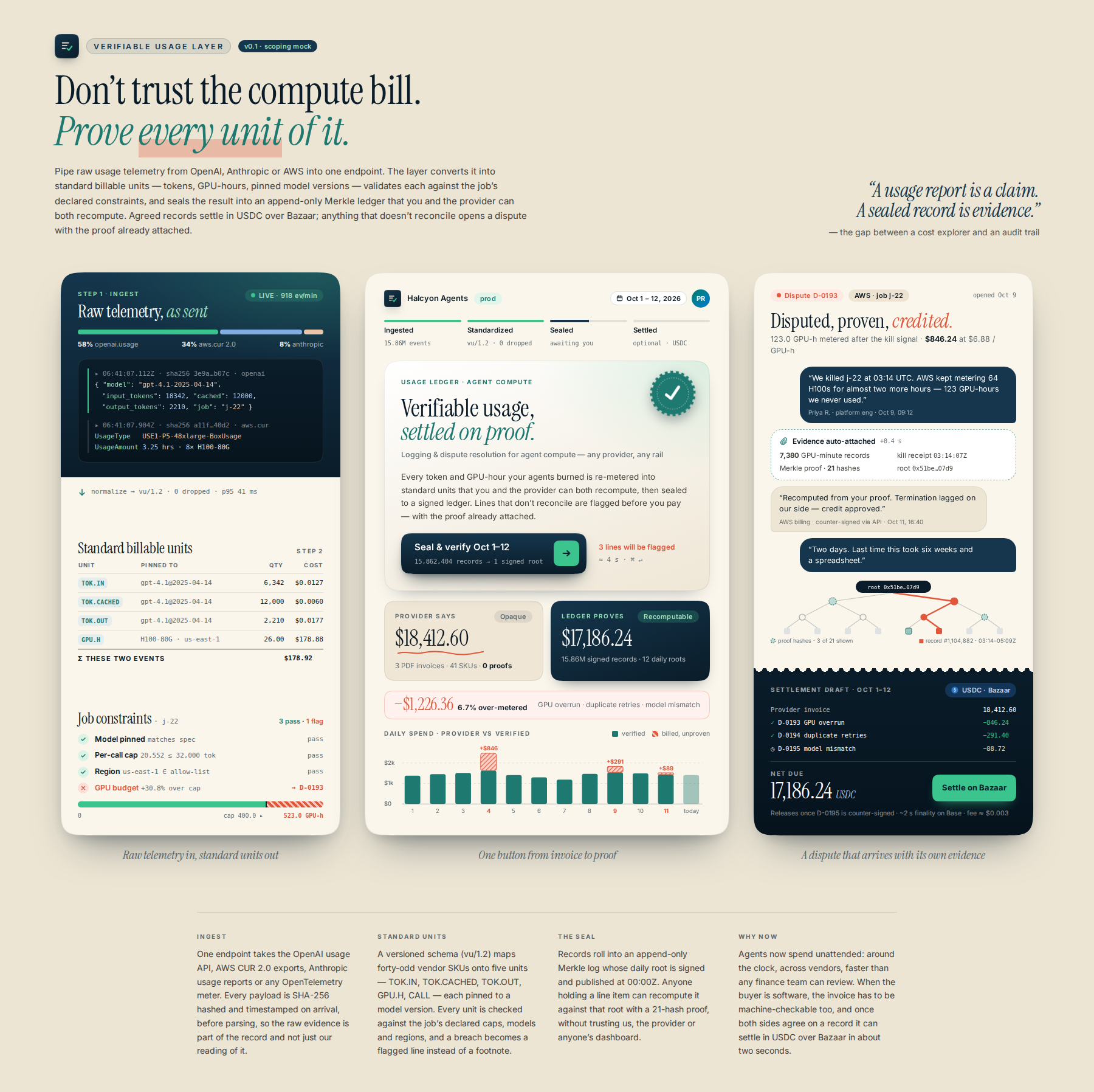
A standardization and logging microservice can make agent compute usage verifiable rather than relying on single-vendor billing reports. It ingests raw telemetry from compute providers (e.g., AWS, OpenAI), converts it into standardized billable units like GPU-hours or token counts, and writes an immutable, auditable record used for billing and dispute resolution. This is aimed at agent developers and enterprise AI builders who need a trustless source of truth before financial settlement occurs, with an optional dispute portal showing raw input versus standardized calculations.
Process flow
Who it's for
High-demand agent developers and enterprise AI application builders
Why they need it
Complex agent workflows require verifiable, standardized usage records that are immune to single-vendor billing opacity or dispute. The core need is for a reliable, trusted source of truth for physical compute consumption (GPU-Hours, tokens) before financial settlement occurs.
What it is
A dedicated logging and standardization microservice that ingests raw usage telemetry from a defined compute API (e.g., AWS/OpenAI), converts it into standardized, verifiable billable units, and provides a tamper-proof record for subsequent automated settlement.
How it works
- Telemetry Ingestion: The service receives raw usage logs (JSON/API calls) from the target compute provider.
- Standardization & Validation: A core engine processes the raw data, calculating standardized metrics (e.g., GPU-Hours, token counts, model versions) and validating them against defined job constraints.
- Logging & Dispute Layer: The standardized, verified usage record is immutably logged (e.g., to a private ledger or verifiable data store) and presented to the user/developer, forming the basis for billing.
- Settlement (Optional): Once the record is agreed upon, the standardized usage data can trigger the final financial settlement via the decentralized payment rails (Bazaar/USDC).
Differentiation
Existing cloud vendors (AWS Cost Explorer, Azure Billing) provide usage reports, but these are proprietary, opaque, and lack an easily auditable, trustless dispute resolution layer. Our service provides the verifiable, standardized, and immutable logging mechanism itself. We are building the 'Source of Truth' for compute usage, making the billing process verifiable regardless of the underlying provider's internal system.
Implementation sketch
- Build a Proof-of-Concept (POC) API endpoint that simulates receiving raw usage telemetry (e.g., a mock JSON stream representing OpenAI usage logs).
- Develop the Standardization Engine: Implement logic to parse raw data and calculate standardized units (e.g., converting token counts and model identifiers into billable 'Compute Units').
- Implement the Immutable Logging Service: Store the standardized, verified usage record in a secure, auditable log (e.g., a private ledger or database optimized for append-only record keeping).
- Develop the Dispute Portal: Create a simple UI that allows the developer to view the raw input, the standardized calculation, and the final logged usage record, demonstrating transparency and verifiability.
First step: Set up a local Python service that accepts a mock JSON payload (representing raw API usage logs) and write the initial parsing functions to extract the core metrics (e.g., 'token_count', 'model_id', 'timestamp').
Remaining risks
- Vendor Lock-in and API Dependency Risk: The entire system is predicated on the continued availability, stability, and API structure of major cloud providers (AWS, OpenAI). Any significant change, deprecation, or rate limiting imposed by these providers could instantly render the logging and standardization engine unusable or inaccurate. — Develop a highly abstracted interface layer that treats the compute provider as a pluggable module. Focus R&D on developing standardized data transformation schemas that can adapt to differing API structures (e.g., a 'Compute Unit' schema that maps inputs from multiple sources) rather than relying on direct API calls.
- Legal and Data Ownership Ambiguity: By claiming to be the 'Source of Truth,' the service enters a complex legal area regarding data custody. Ambiguity exists over whether the developer, the compute provider, or the logging service owns the definitive, verified record, creating potential liability and compliance nightmares (e.g., GDPR, CCPA). — Structure the service explicitly as a neutral, append-only protocol layer, not a data custodian. The service must only process and verify data provided by the user/API and must incorporate mandatory legal review and clear, non-negotiable data ownership clauses in the Terms of Service.
- Commoditization by Major Players: The core value proposition—providing an auditable, standardized log—is a critical infrastructure function. If a major cloud vendor (AWS/Google) decides to build this feature natively into their enterprise suite, they could offer it at a negligible cost, instantly making the specialized service redundant. — Shift the value proposition from 'logging' to 'dispute resolution and verification.' Focus marketing and development efforts on the unique ability to reconcile conflicting usage logs from multiple, disparate sources, a problem that monolithic providers cannot solve.
Watch for: A noticeable lack of interest from the target enterprise audience (legal/finance departments) in the 'dispute resolution' feature, suggesting they are satisfied with the status quo of vendor-provided billing dashboards, thus undermining the core value proposition. Kill criterion: If a major cloud provider (AWS/Azure) announces a new, native billing feature that includes verifiable, standardized usage logging and offers it at a cost point that negates the need for a third-party intermediary.
Sources the council used
Real-world evidence that grounded this idea — judge it for yourself.