
Boundary Cost Ledger (BCL) for High-Value External API Calls
A specialized, low-overhead middleware protocol that meters and bills autonomous agents solely for verifiable, high-cost external interactions (e.g., proprietary APIs, specialized database lookups) to provide auditable, outcome-based billing.
How can startups get auditable, real-time billing for expensive third-party API calls made by AI agents?
A boundary cost ledger meters and bills only for specific high-cost external interactions, like proprietary APIs or specialized database lookups, rather than trying to track all agent activity. Middleware intercepts pre-defined expensive function calls, converts each into a standardized Computational Cost Unit based on service-specific parameters, and streams that cost to an immutable smart contract ledger on Base/USDC that debits a staked payment rail. It's aimed at startups and platforms building multi-step, external-facing autonomous agents that depend on a small number of demonstrably expensive third-party services.
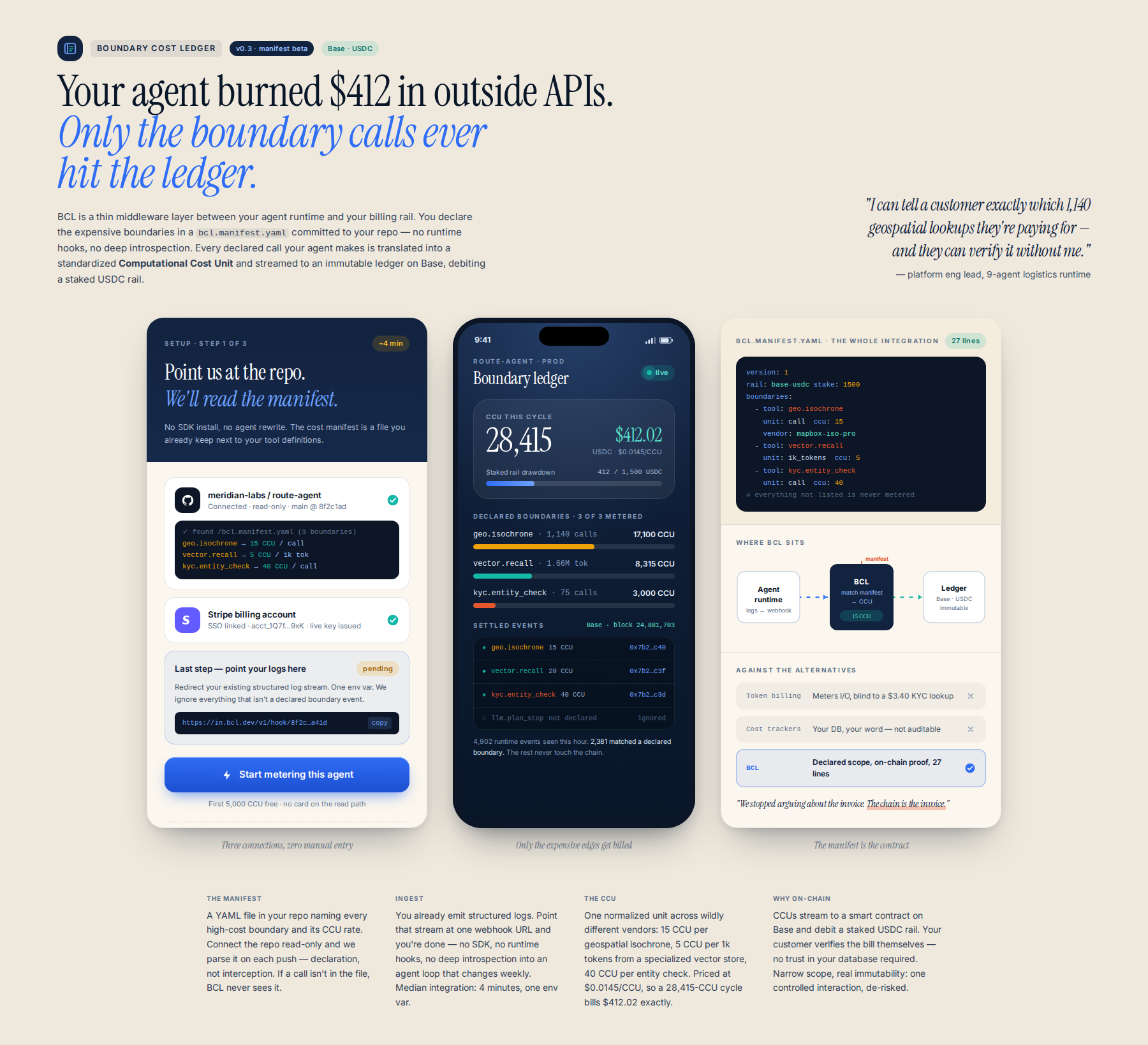
Process flow
Who it's for
Startups and platforms building multi-step, external-facing autonomous AI agents that rely on specific, high-cost third-party services.
Why they need it
The most volatile and often opaque cost component in modern agents is the usage of specialized external tools and APIs. Current billing solutions fail to provide real-time, auditable, and immutable metering for these critical, high-value boundary interactions, leading to major financial and auditing risks.
What it is
A streamlined 'Boundary Cost Ledger' (BCL) middleware layer that sits between the agent runtime and the billing rail. It focuses exclusively on intercepting and translating specific, high-cost boundary events (e.g., call_specialized_api(tool_name)) into a standardized Computational Cost Unit (CCU) and recording the total cost on an immutable ledger.
How it works
- Controlled Scope: The middleware is designed to intercept only explicitly defined, high-cost function calls (e.g., calling a specific external API endpoint). This eliminates the overhead of deep runtime introspection.
- CCU Calculation: For each intercepted event, the middleware calculates the CCU value based on pre-defined, service-specific parameters (e.g., 15 CCUs for a geospatial query, 5 CCUs per 1000 tokens retrieved from a specialized vector store).
- Ledger: These CCUs are streamed to a smart contract on Base/USDC, recording the total cost and debiting the user's staked payment rail. This proves the on-chain metering mechanism with minimal integration risk.
Differentiation
Unlike general billing systems optimized for simple I/O, or generalized cost trackers lacking immutability, we provide verifiable, auditable, and immutable metering for the single highest variable cost driver. By limiting the scope to a single, controlled API interaction (e.g., a specialized geospatial service), we drastically de-risk the technical overhead and standardization challenges, making the solution immediately practical for high-value enterprise use cases.
Implementation sketch
- Develop a lightweight middleware wrapper focused only on intercepting a single, pre-defined, high-cost function call signature (e.g.,
call_geospatial_api(coords)). - Implement a concrete CCU calculator in Python that weights this single boundary event based on defined parameters (e.g., distance calculation complexity, number of coordinates).
- Deploy a minimal smart contract on Base/USDC to accept and record these targeted CCU transactions, proving the boundary metering mechanism's viability with a controlled test environment.
First step: Identify a single, high-value, third-party API (e.g., a specific mapping service or specialized database) that is demonstrably expensive to run. Write a minimal Python proof-of-concept that intercepts calls to this specific API and calculates a weighted CCU value before simulating a transaction to a local smart contract emulator (e.g., Hardhat/Ganache).
Remaining risks
- Market Dependency and Adoption Friction — The success hinges on major, competing agent frameworks (LangChain, Agentcollective, etc.) choosing to integrate the BCL middleware rather than building their own proprietary billing hooks. If adoption remains niche, the solution becomes a non-critical dependency that is easily bypassed by larger, proprietary platforms.
- The 'Single API' Trap — While limiting scope solves technical overhead, it creates a single point of failure in the value proposition. If the market requires metering multiple, distinct high-cost APIs, the middleware must expand, reintroducing the complexity and standardization hurdles that were initially solved by locking the scope.
- Economic Standardization of CCU — Even if the middleware successfully meters usage, the underlying CCU definition (e.g., '15 CCUs for a geospatial query') remains proprietary. If the cost structure of the external API changes, or if multiple vendors use the same API but define costs differently, the BCL becomes a mandatory, but fragile, translation layer that requires constant, non-core maintenance.
Watch for: Any significant, well-funded competitor (especially a major LLM provider or cloud infrastructure player) releasing a native, simplified billing mechanism that is sufficiently good for the majority of enterprise use cases, even if it lacks the full immutability of the blockchain. Kill criterion: The failure to secure a binding commitment from a foundational layer (e.g., a major cloud provider or a consortium of top-tier agent framework creators) to adopt the BCL as a mandated, default billing standard, indicating the solution remains a non-essential, optional add-on.
Sources the council used
Real-world evidence that grounded this idea — judge it for yourself.