
Optimized Execution Rail for Re-Staking and Liquidity Provisioning
A non-governance, specialized on-chain execution layer that programmatically sequences and optimizes complex, repeatable DeFi operations, drastically reducing gas costs and eliminating manual failure points in high-frequency liquidity management.
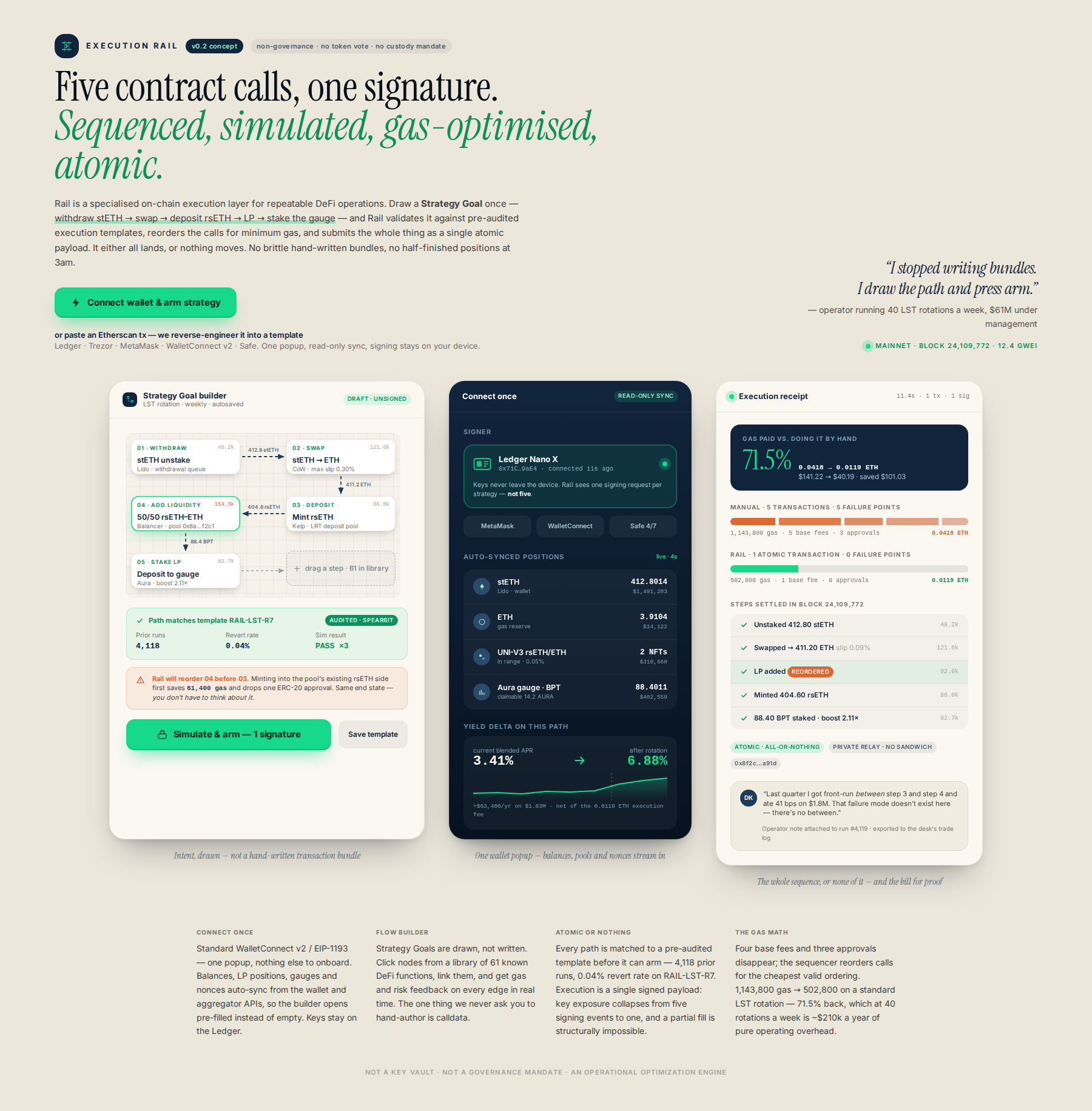
Process flow
Who it's for
Experienced DeFi operators, liquidators, and sophisticated capital managers who execute complex, multi-step, high-volume strategies (e.g., managing liquid staking derivatives or complex yield farming paths).
Why they need it
High-frequency, multi-step DeFi operations (like re-staking or complex yield harvesting) are currently executed via cumbersome, manual sequences of calls or basic multi-sigs. This leads to measurable gas inefficiency, potential execution sequencing errors, and high operational overhead. The market needs a dedicated, optimized path for known, repeating operational logic.
What it is
A decentralized, service-oriented execution rail that abstracts away the complexity of multi-step transaction ordering and resource management. It allows an operator to define a 'Strategy Goal' (e.g., 'Re-stake X amount from LST A into LST B, then LP into Pool C') and executes the entire sequence atomically and gas-optimized, requiring minimal external coordination beyond initial credential setup.
How it works
- The operator connects their agent's credentials to the Vault and defines a repeatable 'Strategy Goal' (e.g., a predefined sequence of 5 contract calls).
- The Vault validates the sequence against known, optimized execution paths (pre-audited/tested templates).
- The Vault initiates an atomic transaction, executing all necessary steps in the most gas-efficient order, signing and submitting the final, single optimized transaction payload.
- This minimizes key exposure to a single, controlled transaction and guarantees execution integrity for the entire sequence.
Differentiation
This is not a general key vault (like solutions citing s1 or s3) nor is it a governance mandate. We are a specialized Operational Optimization Engine. The gap is the automated, gas-optimized sequencing of known, repeatable, non-governance smart contract interactions. Existing solutions force operators to write complex, brittle transaction bundles; we provide a standardized, audited, and optimized execution path for the most common, high-volume operational workflows (e.g., LST rotation).
Implementation sketch
- Build an MVP Vault contract on Base/USDC, parameterized to accept 'Strategy Templates' (i.e., predefined, optimized execution sequences of contract calls).
- Develop a focused PoC demonstrating the full flow for a simulated Re-Staking/LP rotation: defining the goal, simulating the credential signing, and executing the optimized, single transaction.
- Build a simple CLI tool that ingests a known DeFi protocol's operational flow (e.g., Compound's LP addition) and generates the optimized, gas-efficient execution payload required by the Vault.
First step: Identify the top 3 most complex, repeatable, and gas-intensive operational workflows for a single, high-volume asset class (e.g., ETH liquid staking derivatives). Write the Solidity code for the MVP Vault contract to accept and store the function signatures and required input parameters for the first workflow (e.g., the 'LST Rotation' template).
Remaining risks
- Protocol Dependency and Obsolescence: The Vault's entire value proposition relies on knowing the current, optimal, and correct sequence of calls for external DeFi protocols. Any minor update, bug fix, or parameter change in a major protocol (e.g., Compound, Lido) could instantly invalidate the stored 'Strategy Templates,' requiring constant, manual, and expensive maintenance by the Vault operators. — Focus initial efforts on protocols with highly stable, battle-tested core logic, and build a transparent, decentralized mechanism for community-driven template auditing and submission (akin to a decentralized oracle network for execution paths).
- Internalization by Competitors: The core functionality—atomic, gas-optimized sequencing of known contract interactions—is a fundamental infrastructure pattern. Major DeFi protocols or specialized institutional custodians could integrate this optimization layer directly into their own smart contracts or SDKs, bypassing the need for a centralized, third-party Vault entirely. — Shift the focus from being the 'execution engine' to being the 'standardized template repository' and 'auditing layer.' Make the Vault the indispensable source of truth for optimized paths, forcing integration rather than competing with it.
- The Optimization Ceiling: The potential gas savings are finite. As the underlying DeFi protocols themselves become more gas-efficient (e.g., through L2 scaling or core contract upgrades), the marginal benefit of the Vault's optimization layer will diminish, eventually making the complexity of using the Vault outweigh the savings. — __
Watch for: Any early signal that the market values the 'guarantee of execution' (risk mitigation) over the 'optimization of gas costs' (efficiency). If operators are willing to use the Vault primarily to ensure the transaction will run, even if it costs 10% more gas than the best-case scenario, the product has stronger, more durable traction. Kill criterion: A Tier-1 DeFi protocol (e.g., Uniswap, Aave) announces a native, audited, and integrated feature that executes the core 'Strategy Goal' workflow (e.g., LST rotation) directly within its own smart contract, eliminating the need for an external, third-party execution rail.