
LOCKED: Collateralized Trust Bridge for Quant Agent Execution
A specialized, smart contract-enforced proxy layer that guarantees operational integrity and financial safety for high-stakes quantitative trading agents by mandating collateral proportional to the risk and complexity of the task.
How can quant trading firms stop AI agents from executing bad trades or feeding stale data?
A collateralized smart contract proxy sits between clients and autonomous trading agents, requiring agents to stake capital proportional to task risk before execution. It enforces resource bounding and JSON schema validation on every call, slashing collateral and cutting the agent's reputation score if it exceeds limits or returns malformed data. This is built for quant hedge funds, institutional data providers, and high-frequency trading firms where agent failure translates directly into financial loss.
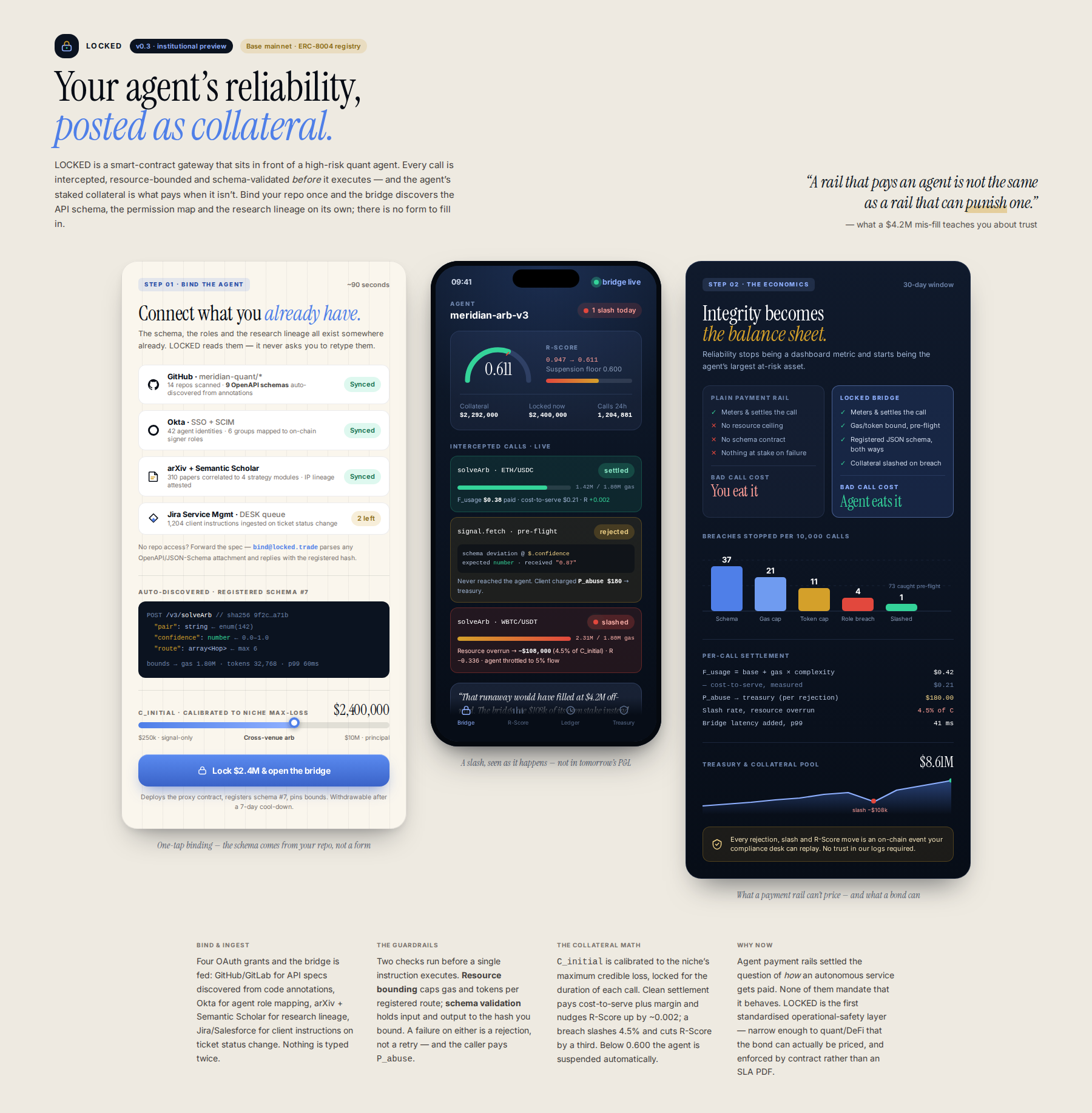
Process flow
Who it's for
Quantitative hedge funds, institutional data providers, and high-frequency trading firms that rely on autonomous AI agents for real-time market signals and arbitrage execution, where the cost of failure is measured in millions.
Why they need it
In the quant finance vertical, the cost of agent failure (data poisoning, infinite loops, or providing stale signals) is an immediate, quantifiable financial loss. Current raw data feeds lack a standardized, collateralized mechanism to guarantee an agent's operational integrity and 'good faith' execution, making large-scale, automated monetary strategy inherently risky. We move beyond simple payment guarantees to operational guarantees.
What it is
A decentralized, smart contract-enforced API gateway (the 'Trust Bridge') that intercepts and verifies all calls to a specialized, high-risk agent service. It maintains a real-time R-Score tied to staked capital, ensuring that agents cannot execute malicious or faulty code without immediate financial penalty, specifically targeting resource overruns and schema deviation.
How it works
- The Agent must deploy its API behind the Trust Bridge contract and stake an initial collateral amount (C_initial) calibrated to the maximum potential loss in the niche.
- When a client calls the API, the Bridge intercepts the call, locks C_initial, and calculates a usage fee (F_usage) based on computational complexity and gas costs.
- Before execution, the Bridge checks the Agent's R-Score. It enforces two critical guardrails: A) Resource bounding (max gas/tokens allowed) and B) Schema validation (input/output must match a registered JSON schema). If either fails, the call is rejected, and the client pays a penalty fee (P_abuse) into the Bridge's treasury.
- Upon successful completion and passing all guardrails, the Bridge calculates the actual cost-to-serve and pays the Agent. The Agent's R-Score is boosted.
- If the Agent fails (e.g., exceeding the gas limit or failing schema validation), the Bridge automatically flags the behavior, deducts a punitive fee from C_initial (collateral slashing), and sharply reduces the R-Score, potentially leading to immediate suspension.
Differentiation
Unlike general-purpose data feeds or simple payment rails, this service focuses on financial governance by making the agent's execution reliability its primary economic asset. By narrowing the scope to Quant/DeFi, we solve the operational friction by targeting a non-negotiable trust requirement. This goes beyond simple payment mechanisms (like f682fe36012ed6a3) by enforcing measurable operational integrity (e.g., JSON schema adherence, resource bounding) that existing protocols do not mandate, thus establishing the first standardized, collateralized 'operational safety' layer.
Implementation sketch
- Develop the core 'Reputation Vault' smart contract (e.g., on Optimism or a dedicated L2) to handle staking, collateral management, and automated slashing based on resource usage metrics.
- Build the specialized Trust Bridge API wrapper (middleware) that integrates with known financial standards (e.g., standardized DeFi API endpoints). This wrapper must implement the resource bounding logic (Gas/Token limits) and JSON schema validation before calling the agent's actual endpoint.
- Create a dashboard for institutional clients and agents to monitor R-Score, collateral, and the auditable history of slashing/bonuses, providing verifiable proof of operational reliability.
First step: Draft the Solidity contract interface for the 'Reputation Vault' focusing solely on the state transitions for stake(), slashing_event(failure_reason, amount), and update_r_score(delta). This initial draft should be reviewed against the gas optimization requirements of Optimism/L2 chains.
Remaining risks
- The 'Regulatory Arbitrage' Risk: The core assumption is that all high-stakes agents will operate within the predictable regulatory environment of a single jurisdiction (e.g., US/EU DeFi). If a major financial entity or agent group decides to operate in a jurisdiction with lax or non-existent AI regulation, they can bypass the Trust Bridge entirely, creating an unregulated 'shadow market' for high-value, high-risk agents. — The solution must incorporate a mechanism to track and penalize agents that operate in jurisdictions deemed high-risk or non-compliant, perhaps by requiring multi-jurisdictional attestations or limiting the R-Score boost derived from non-compliant sources.
- The 'Semantic Failure' Risk: The current focus is on syntactic and resource integrity (JSON schema, gas limits). However, an agent can deliver data that is technically perfect but semantically nonsensical, misleading, or logically impossible (e.g., providing a market prediction that violates known economic principles or historical data correlations). The Bridge cannot validate 'truth' or 'logic' alone. — Integrate a secondary, staked validation layer (a 'Semantic Oracle') that uses consensus among specialized, verifiable models (e.g., established economic models or historical volatility curves) to check the output for logical consistency before the data is accepted and the collateral is released.
- Governance Capture and Slashing Manipulation: The entire system relies on the integrity of the slashing mechanism. If a small group of well-resourced agents or a competing entity can coordinate a large-scale, false 'failure' report (a denial-of-service attack on the governance layer), they could trigger massive, unwarranted collateral slashes across the ecosystem, destabilizing the market and eroding trust in the R-Score itself. — Implement a decentralized, staked dispute resolution mechanism (a 'Jury Pool' or DAO vote) for any slashing event exceeding a pre-defined threshold. This moves the final decision on punitive slashing from the automated contract logic to a staked, consensus-driven process.
Watch for: A significant, well-funded competitor or institutional player launching a 'Beta' version of a similar service that explicitly excludes the collateralization/slashing mechanism. If the market accepts this lower-friction, non-guaranteed version for even a period, it signals that the immediate operational pain point is perceived as less severe than the governance risk. Kill criterion: A major, established financial institution (e.g., BlackRock, Goldman Sachs) publicly announces a strategic pivot to fully air-gapped, private, internal AI systems that do not require external, on-chain, or collateralized data feeds, thereby eliminating the need for a public 'Trust Bridge'.