
Agent Treasury Manager for LLM Costs
A decentralized, automated financial copilot that monitors, predicts, and advises on the operational spending of autonomous AI agents by quantifying cost vs. engineering efficiency trade-offs.
How can I stop AI agent LLM costs from spiraling out of control before the bill arrives?
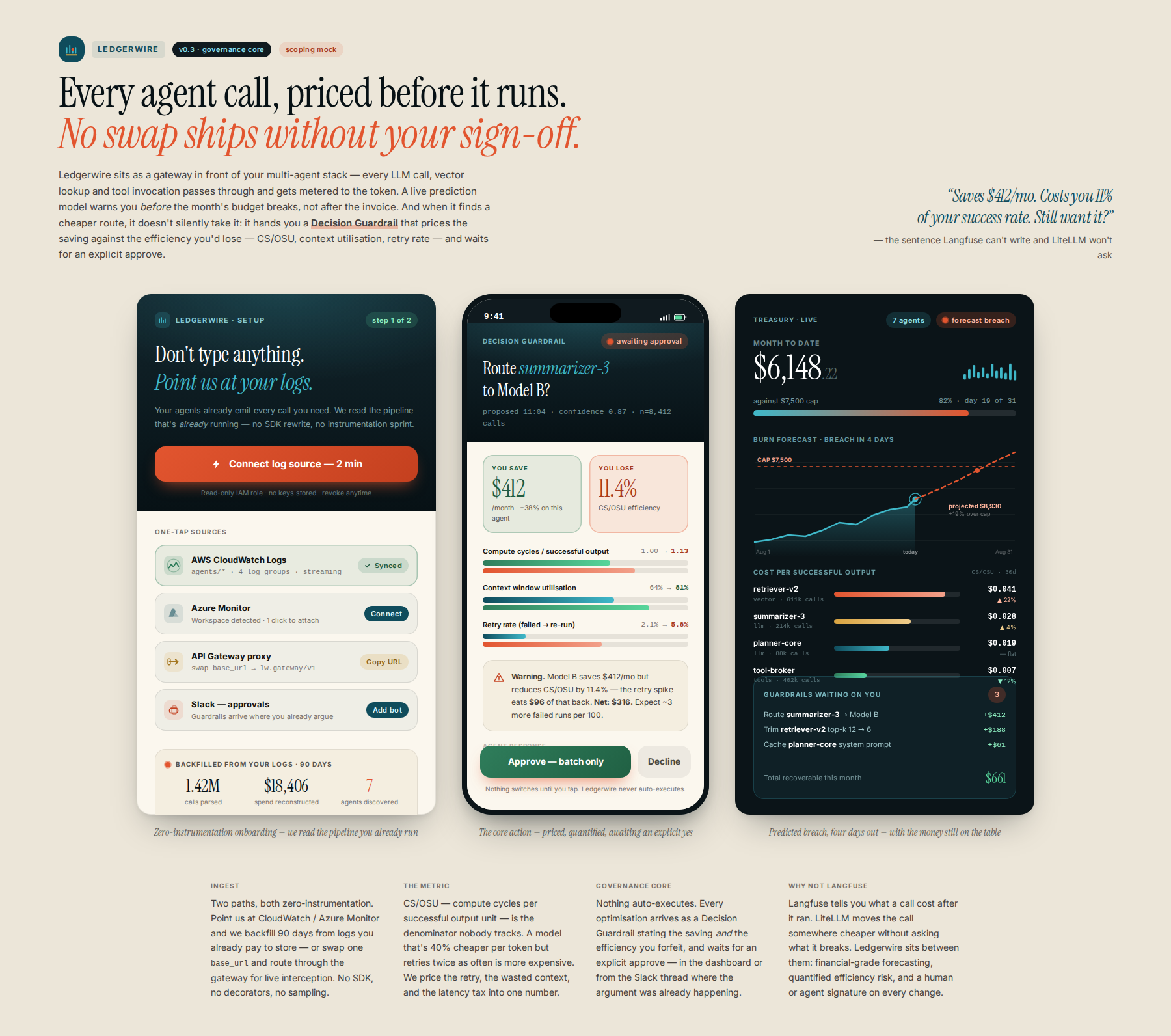
A middleware gateway that intercepts every agent LLM, vector DB, and compute call can predict spend in real time and warn developers before budgets are exceeded. Rather than auto-switching models, it presents a 'Decision Guardrail' comparing options on cost versus efficiency metrics like Compute Cycles per Successful Output Unit, requiring explicit developer approval before any cheaper-but-riskier model swap. It is built for developers running complex multi-agent systems who need proactive cost governance rather than after-the-fact observability tools like Langfuse or routing-only tools like LiteLLM.
Process flow
Who it's for
Developers building complex, multi-agent AI systems
Why they need it
Developers face escalating, unpredictable operational expenditures (OpEx) from LLM inference, vector DBs, and compute. The pain is twofold: runaway costs and the lack of systemic control over resource allocation, which impacts both cost and reliability.
What it is
A specialized SaaS middleware layer that intercepts all agent computation requests, providing real-time cost governance and actionable efficiency recommendations.
How it works
- Agent connects to the platform via a dedicated API gateway for all computation requests (LLM calls, vector lookups, tools).
- The platform intercepts every call, logging granular usage (tokens, dimensions, latency, compute time).
- It runs a real-time cost prediction model to alert developers before budget overruns.
- (Governance Core) Instead of automatic execution, the system calculates and presents a 'Decision Guardrail' dashboard. This dashboard quantifies the trade-off between cost savings and engineering efficiency, using metrics like 'Compute Cycles per Successful Output Unit (CS/OSU)' or 'Context Window Utilization Efficiency' (e.g., 'Warning: Model B saves $X but reduces CS/OSU by Y%, suggesting a potential performance hit'). The agent must explicitly approve the suggested action.
- The platform remains the central source of truth for cost, performance, and efficiency telemetry.
Differentiation
Unlike Langfuse, which focuses on observability and attribution after the fact, or LiteLLM, which only manages API routing, this system provides proactive, financial-grade governance. It unifies cost management with quantifiable engineering efficiency risk assessment, presenting actionable, cost-benefit trade-offs to the developer/agent, thus moving beyond passive monitoring to guided, optimized decision-making.
Implementation sketch
- Build a core webhook/API gateway service that intercepts all agent outgoing calls.
- Implement the cost tracking/prediction engine, simulating the multi-service billing model (LLM/Vector/Compute).
- Develop the 'Decision Guardrail' module: Prototype the calculation of a normalized efficiency metric (e.g., CS/OSU) by correlating cost data with observed latency/context usage patterns, and design the UI/API hook for required developer sign-off.
- Integrate basic historical performance data to back the efficiency quantification (e.g., 'Model B has a 2% higher P95 latency for this prompt structure').
First step: Build a minimal proof-of-concept Python service that accepts a mock API call payload (e.g., token count, model used) and outputs a structured JSON object containing: 1) Calculated cost estimate, 2) A simulated efficiency score (e.g., 100 - (tokens * cost_factor)), and 3) A required 'Approval Required: True/False' flag. This proves the core data transformation logic.
Remaining risks
- The 'Decision Guardrail' module's reliance on complex, proprietary, or non-standardized metrics (like CS/OSU) may fail to gain traction with developers accustomed to simpler, direct cost metrics ($/call). If the value proposition requires deep technical understanding to appreciate the efficiency gains, adoption stalls. — Initially anchor the marketing and onboarding around the most universally understood pain point: direct dollar cost reduction. Introduce the efficiency metrics (CS/OSU) as 'Advanced Optimization Tier' features, proving the core value first with cost, then layering complexity.
- The middleware layer becomes a single, critical point of failure (SPOF) for the entire agent ecosystem. Any downtime, bug, or performance degradation in the 'Gateway Service' immediately halts all agent operations, leading to catastrophic operational failure for the user. — Design the architecture with extreme redundancy and fail-open/fail-safe modes. Implement a fallback mechanism where, upon detection of Gateway failure, the agent can temporarily bypass the middleware for non-critical calls (logging the failure) while maintaining basic functionality, thus preserving developer trust.
- The scope creep from 'cost governance' into 'agent behavior modification' is inevitable. Users will inevitably ask the system to manage security, context filtering, or prompt engineering best practices, bloating the product and diluting the core financial focus. — Maintain strict adherence to the 'financial/efficiency' boundary. When faced with requests outside this scope, redirect by framing the limitation: 'That falls outside the scope of OpEx governance; we recommend integrating a dedicated security/prompt layer for that function.'
Watch for: If early pilot users begin treating the 'Decision Guardrail' output as a suggestion to ignore and manually override, rather than a necessary checkpoint, it signals that the perceived risk of the guardrail outweighs the perceived savings, indicating the core value proposition is not yet internalized. Kill criterion: If a major cloud provider (AWS, Azure, GCP) announces a native, integrated 'Agent Cost Governance' feature that incorporates multi-service billing and performance profiling, the technical moat of this middleware layer is immediately invalidated.
Sources the council used
Real-world evidence that grounded this idea — judge it for yourself.