
Constrained Oracle Call Layer for Agent DeFi Actions
A minimal, verifiable execution sandbox that restricts autonomous AI agents to calling only approved, whitelisted, and gas-budgeted external oracle functions, eliminating the risk of arbitrary, resource-draining, or unsafe external data calls.
How do you stop an AI trading agent from making unauthorized or overly expensive oracle calls?
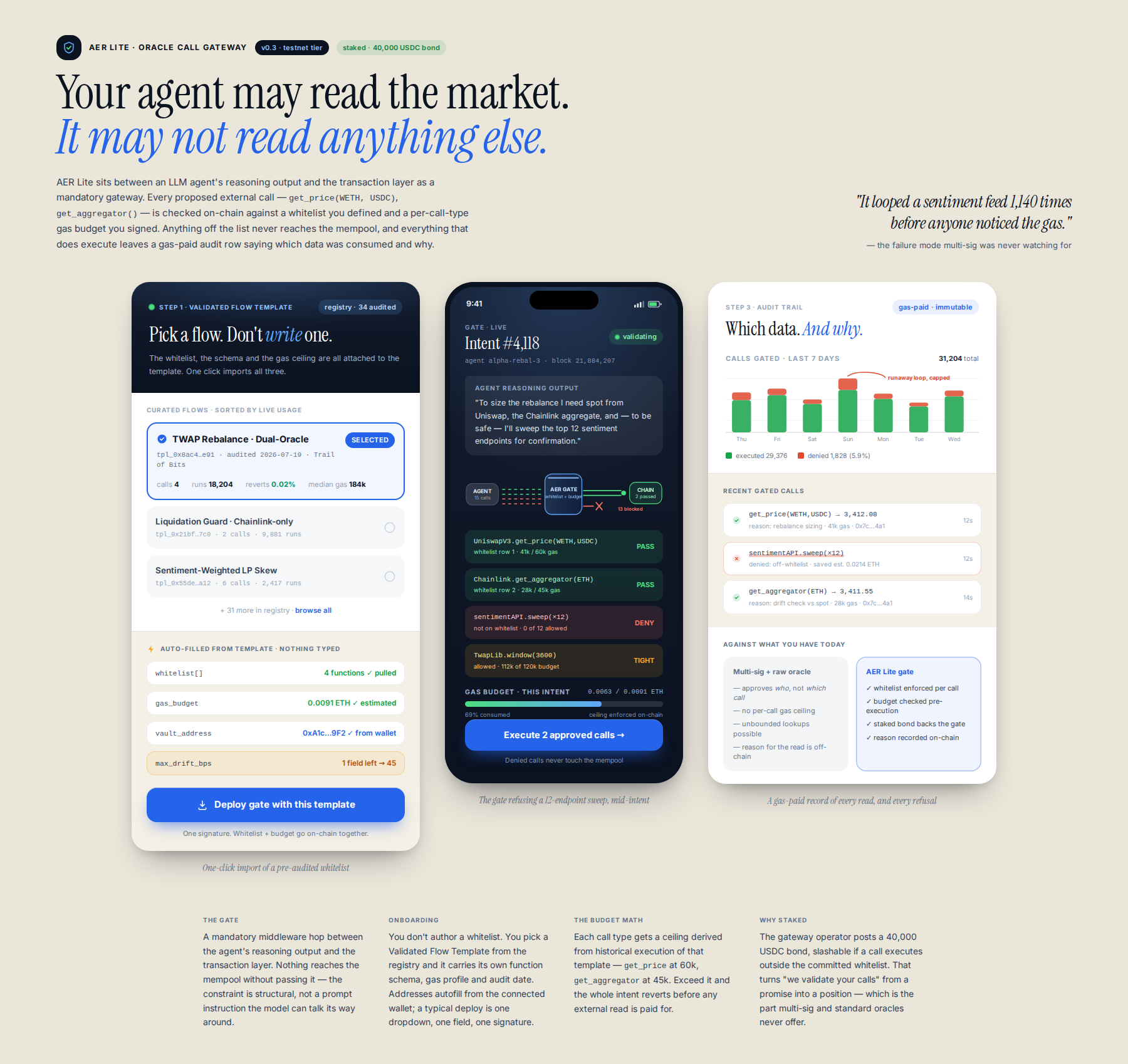
A constrained middleware gateway sits between the agent's reasoning output and the smart contract layer, validating every proposed external data call against a protocol-owner-defined whitelist and gas budget before execution. Calls like getprice(assetA, assetB) are checked against approved function signatures (e.g., only UniswapV3 or Chainlink endpoints) and per-call resource limits; transactions only execute if all calls pass. This gives DeFi teams and AMM builders an auditable record of which external data an agent consumed and why, turning open-ended oracle access into a fixed technical choke point.
Process flow
Who it's for
DeFi Protocol Teams, specialized AMMs, and crypto-native builders deploying agents that rely heavily on external market data (e.g., price oracles, sentiment feeds).
Why they need it
The most immediate and manageable risk is not general gas exhaustion, but the agent's ability to make unauthorized or excessively costly calls to external oracles or data feeds. By enforcing a verifiable, whitelisted function call constraint, we solve the critical problem of data-driven, unbudgeted external interactions, transforming theoretical systemic risk into a manageable, technical choke point.
What it is
A constrained middleware layer (AER Lite) that acts as a mandatory 'Oracle Call Gateway' between an LLM agent's reasoning output and the smart contract transaction layer. It verifies that every external data call (e.g., get_price(asset_A, asset_B)) is pre-approved, budgeted, and adheres to a defined whitelist.
How it works
The process is simplified to three stages:
- Intent & Whitelist Definition: The agent generates an intent, and the protocol owner defines a whitelist of allowed external functions (e.g., only
UniswapV3.get_priceandChainlink.get_aggregator). - Protocol Submission & Validation: The AER service intercepts the agent's proposed calls. The smart contract validates that every proposed function call and its parameters exist on the whitelist and adheres to a pre-defined resource/budget limit for that specific call type.
- Execution & Audit Trail: The transaction executes only if all calls pass the whitelisting and budget checks. This provides a highly auditable, gas-paid record of which external data was consumed and why.
Differentiation
Existing governance tools (e.g., multi-sig, standard oracles) manage approval or data acquisition, but they do not enforce a mandatory, verifiable, and constrained execution pathway for an LLM agent's multi-step data consumption. Our service differentiates by being a verifiable, staked, and call-constrained runtime environment. We solve the specific technical gap of preventing unbounded or unauthorized external data lookups, which is the most immediate, quantifiable failure point. The GAP is the verifiable, staked, and whitelisted execution gate for AI-driven external data consumption.
Implementation sketch
- Build a FastAPI endpoint that receives the agent's proposed function call list (e.g., JSON array of
{function_name: string, args: list}). - Deploy a minimal smart contract (e.g., on Base/Solana) that stores the whitelist (mapping function signatures to allowed calls) and enforces the call count/budget.
- Develop a simple dashboard for protocol owners to upload and manage the whitelist and view the accumulated call budget for the active agent session.
First step: Draft the Solidity interface for a minimal contract that accepts a whitelist mapping (e.g., mapping(bytes32 => bool) public isWhitelisted;) and write a basic Python function that parses a list of proposed function calls against this static whitelist before compiling the final transaction payload.
Remaining risks
- The Whitelist Bottleneck (Operational Risk) — The system's utility is entirely dependent on the completeness and accuracy of the whitelist. If a necessary, novel, or complex external data call is not pre-whitelisted, the agent is functionally blocked, creating a single point of failure for the entire DeFi ecosystem that relies on advanced data feeds. This creates a massive friction point for adoption.
- Data Poisoning/Oracle Compromise (External Trust Risk) — The constrained layer only verifies the call to the oracle, not the integrity of the data returned. If a whitelisted oracle feed is compromised (e.g., manipulated by a bad actor or experiencing a data feed failure), the agent will execute its logic perfectly based on false premises, leading to financial loss that the system cannot prevent.
- Suboptimal Economic Logic (Outcome Risk) — The system mitigates technical failure (gas, unauthorized calls) but not economic failure. An agent can make a sequence of perfectly whitelisted and budgeted calls that are technically sound but economically catastrophic (e.g., initiating a flash loan sequence that is legally valid but financially ruinous). The risk shifts from technical failure to strategic failure.
Watch for: A market signal that the necessary whitelisting process becomes too cumbersome or requires too much centralized governance overhead, suggesting the solution is merely a 'permission layer' rather than a true technical guardrail. Kill criterion: The mandatory gas cost of running the AER Lite validation layer on every single transaction exceeds the economic value of the risk it mitigates, making the service prohibitively expensive for the average DeFi user.