Orchestrated Financial State Rails for Enterprise AI Workflows
A robust, two-layer execution framework that guarantees auditable, verifiable cost accounting and financial reconciliation for complex, multi-step agentic workflows running within controlled enterprise environments.
How can enterprise AI agents guarantee accurate billing when a multi-step workflow fails mid-execution?
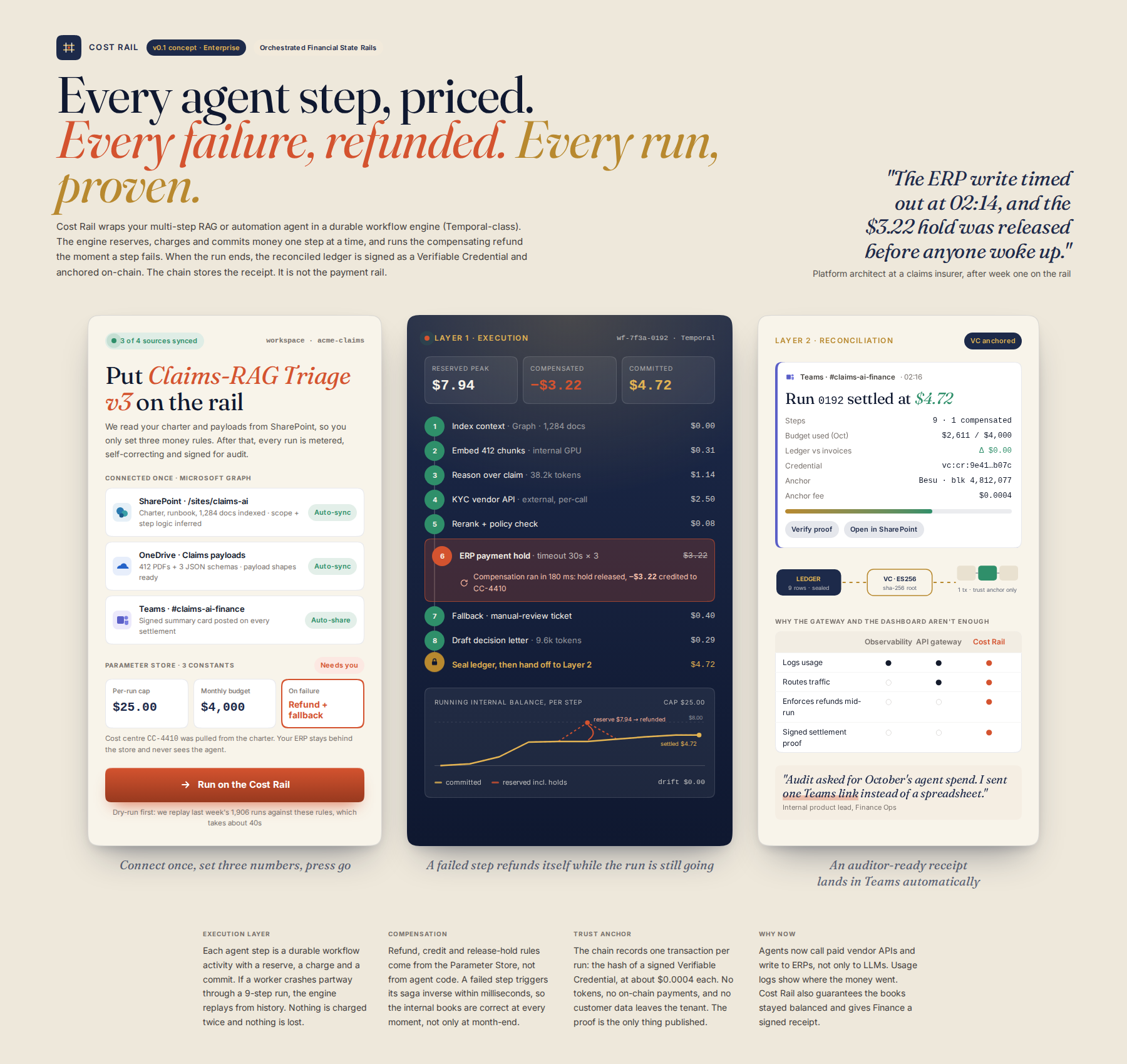
A two-layer financial state system can guarantee it by separating real-time cost handling from final audit. A workflow orchestration engine like Temporal tracks every step of the agent sequence and triggers compensating actions, such as automatic refunds or credits, the instant a step fails, keeping the internal ledger always correct. Once the workflow finishes, the reconciled ledger is committed as a verifiable credential on a blockchain layer, giving enterprise AI architects immutable audit proof without making the blockchain the primary transaction engine.
Process flow
Who it's for
Enterprise AI Architects and Internal Product Teams building mission-critical, multi-step RAG or automation agents.
Why they need it
As agentic workflows become mission-critical, the financial risk of state failure (unaccounted costs, incorrect refunds) is unacceptable. Current tooling provides passive observability (logging usage) but fails to provide active, guaranteed financial state management when complex, distributed processes fail mid-execution. We solve the need for guaranteed financial accountability by decoupling real-time state management from final immutable auditing.
What it is
A 'Cost Rail' service that utilizes a dedicated, reliable workflow orchestration engine (like Temporal) to manage the real-time, compensating logic of an agent sequence. It calculates costs, executes necessary steps across internal/external APIs, and then commits the final, reconciled ledger state to a blockchain layer for immutable audit and final settlement.
How it works
The system operates in two stages:
- Execution (Real-Time): The workflow is defined in a state machine (e.g., Temporal/Cadence). The engine monitors every step, executing micro-transactions and ensuring compensating logic (refund/credit) runs immediately upon failure, guaranteeing the internal financial state is always correct.
- Reconciliation (Audit): Once the workflow concludes (successfully or via forced compensation), the final, proven ledger of usage and financial disposition is committed as a Verifiable Credential (VC) to the blockchain. This provides the immutable, auditable proof of cost settlement, minimizing the blockchain's role to a trust anchor rather than the primary transactional mechanism.
Differentiation
Existing solutions like 's1' (Observability Platforms) and 's2' (API Gateways) are excellent at logging usage and routing traffic, but they cannot programmatically enforce complex, compensating financial rules across distributed systems. We fill the GAP of Active, Guaranteed Financial State Management. By using enterprise-grade workflow engines for real-time state handling and reserving the blockchain for final, immutable audit, we solve the distributed transaction problem in a scalable and enterprise-acceptable manner.
Implementation sketch
- Define a high-value PoC workflow (e.g., internal RAG agent requiring 3 specific API calls) and model its failure paths.
- Build the core service using a dedicated workflow orchestration engine (e.g., Temporal SDK). This service will manage the state transitions and execute the compensating logic (e.g., calling a refund adapter) when an internal step fails.
- Develop the final 'settlement' microservice that aggregates the execution trace from the workflow engine and commits the final, reconciled cost ledger as a signed transaction/VC to the payment rail (e.g., using x402 on Base/USDC).
First step: Prototype the target PoC workflow (e.g., RAG Agent) and define the full set of required state transitions and failure modes. Simultaneously, select and set up a sandbox environment for a workflow orchestration engine (e.g., Temporal) to model the basic 'Start -> Step 1 -> Step 2 -> Success/Failure' state machine.
Remaining risks
- The 'Cost Definition' Problem: The system assumes that all costs are quantifiable and can be mapped to a standardized ledger entry. In reality, complex enterprise workflows often involve non-linear, non-tokenizable costs (e.g., human review time, proprietary data access fees, internal compute quotas) which are difficult to integrate into a programmatic, auditable cost rail. — Limit the initial scope to workflows where the cost is dominated by easily quantifiable external API calls (e.g., token usage). Treat non-quantifiable costs as a separate, manual 'overhead' ledger that the system flags for review, rather than attempting to automate their financial settlement.
- The Operational Overhead Trap: By introducing two complex, highly reliable layers (Temporal/Workflow Engine + Blockchain Reconciliation), the system significantly increases its own operational complexity, maintenance burden, and latency. The cost and expertise required to maintain the state machine and the reconciliation service may outweigh the value of the financial guarantee itself. — Focus initial efforts on proving the concept using managed, low-overhead cloud services for the workflow engine, and only utilize the blockchain for the final, minimal settlement transaction, thus minimizing the architectural footprint and operational debt.
- Vendor Lock-in at the Orchestration Layer: By relying heavily on a specific, powerful workflow engine (like Temporal), the solution risks becoming tightly coupled to that vendor's specific development model and operational tooling. This creates a new, critical dependency that is difficult to swap out if the vendor changes pricing, features, or reliability. — __
Watch for: The team spends disproportionate time defining and testing the 'failure path cost calculation' (i.e., how much to refund when the failure is ambiguous) rather than building the core execution flow. This indicates the risk is conceptual complexity, not technical implementation. Kill criterion: If the team cannot demonstrate a clear, measurable financial ROI (Return on Investment) for the overhead of the two-layer system (Temporal + Blockchain) compared to the cost of the failure it prevents, the solution is over-engineered and should be simplified to a single, highly reliable, internal accounting ledger.
Sources the council used
Real-world evidence that grounded this idea — judge it for yourself.