
Verifiable Capital Flow Control: Financial & State Gateway for Autonomous Agents (LOCKED SPEC)
A mandatory, gas-optimized, on-chain middleware layer that provides verifiable, financial, and state containment for autonomous agents executing high-value transactions.
How can institutions let autonomous agents move large sums on-chain without risking unauthorized spending?
A mandatory on-chain gateway contract can audit every agent-proposed transaction before execution, checking the spend against pre-set, non-negotiable limits and simulating the resulting state change for validity before releasing funds. Transactions that fail either the financial or state check are rejected with an auditable report, converting the risk of catastrophic loss into a small, predictable governance fee. It targets institutional DeFi protocols, treasury management systems, and high-value asset custodians running autonomous agents.
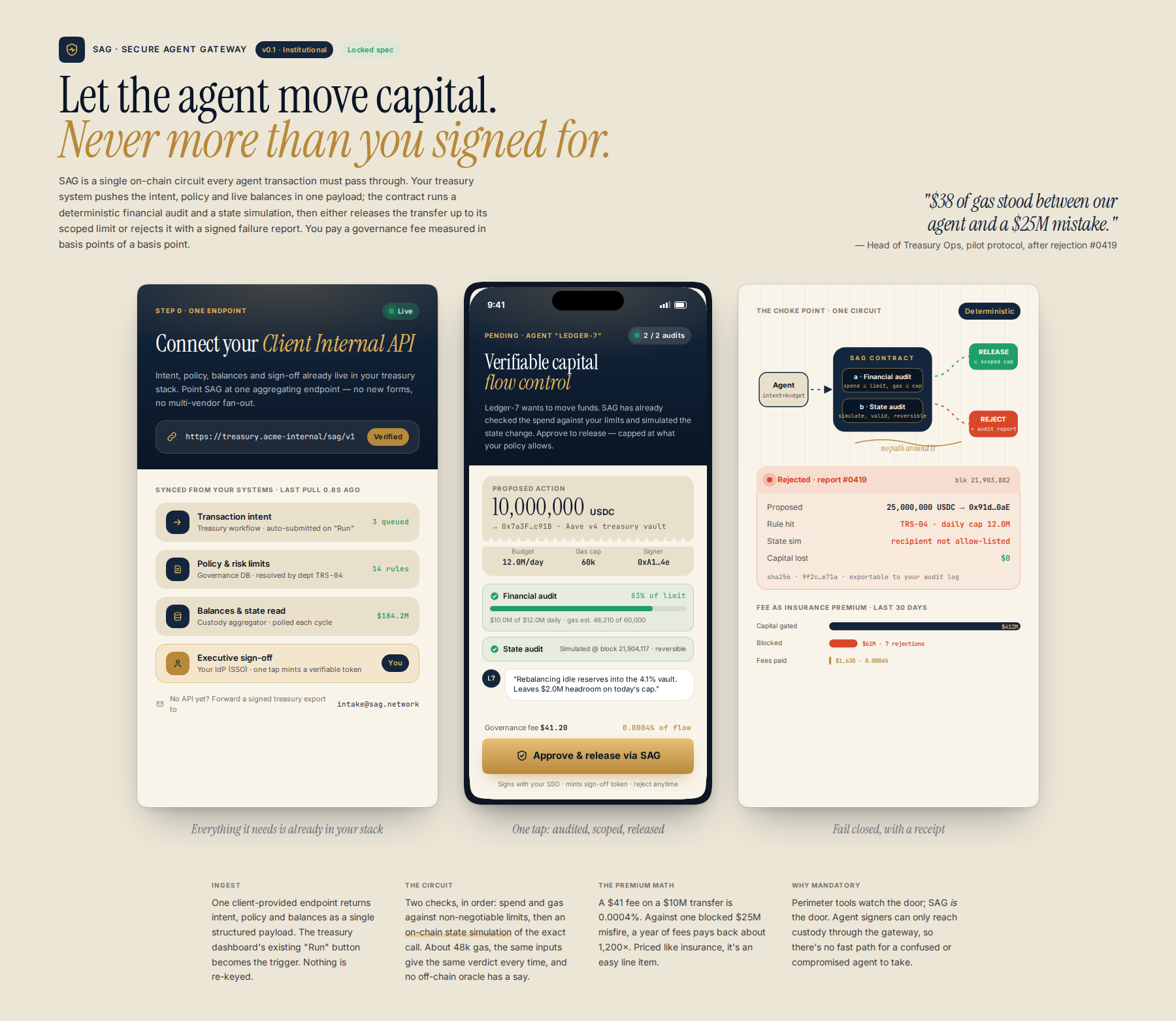
Process flow
Who it's for
Institutional DeFi protocols, Treasury Management systems, and high-value asset custodians deploying autonomous agents.
Why they need it
In high-value environments (e.g., multi-million dollar treasury transfers, institutional liquidity provision), the cost of an agent failure (state drift, unauthorized spending) far exceeds the cost of governance. Developers require a guaranteed, deterministic, on-chain mechanism to enforce spending limits and state integrity, making SAG a necessary insurance premium against catastrophic loss.
What it is
The Secure Agent Gateway (SAG) is a specialized, simple smart contract circuit that acts as the foundational choke point. It verifies the financial feasibility and state integrity of an agent's proposed action before allowing the transaction to proceed, thus converting potential catastrophic risk into a negligible, verifiable governance fee.
How it works
- Agent submits a proposed action (e.g., 'Transfer 10M USDC to Address B') along with a defined budget and required keys/signer address to the SAG contract.
- The SAG contract executes a deterministic, on-chain verification pipeline: (a) Financial Audit: Checks the proposed spend against the user's defined, non-negotiable spending limits and gas budget. (b) State Audit: Simulates the transaction using the blockchain's state reading capabilities to confirm the intended state change is valid and reversible.
- If both checks pass, the SAG executes the transaction flow, allowing the transfer up to the pre-approved, scoped limit.
- If either check fails, the transaction is rejected with a detailed, auditable failure report, preventing capital loss.
Differentiation
Current security solutions are either perimeter-focused or too complex/expensive to mandate. They fail to provide a simple, gas-optimized, mandatory smart contract circuit that enforces verifiable financial and state scoping. SAG provides the foundational 'Verifiable Capital Flow Control' layer—a mandatory, deterministic choke point that treats the governance fee as an insurance premium, making its cost negligible relative to the protected capital.
Implementation sketch
- Build the core, gas-optimized smart contract circuit (on Base/EVM) that accepts the agent's intent, budget, and required keys/signer address. Focus on minimizing gas cost for the audit logic.
- Develop the off-chain coordinator service (Python/Go) to read the transaction intent and submit it to the SAG contract for deterministic, on-chain verification.
- Integrate the coordinator service with a multi-sig wallet/escrow mechanism that only allows broadcast upon the SAG's successful on-chain confirmation of both financial and state passes. The governance fee is charged upfront to cover operational costs.
Remaining risks
- Regulatory Overreach and Jurisdictional Conflict. Because the SAG controls verifiable capital flow, it will attract intense scrutiny from global financial regulators (e.g., SEC, central banks). A single change in international financial law regarding agent accountability or on-chain custody could render the entire mechanism non-compliant or illegal in key jurisdictions. — Structure the governance layer to be jurisdiction-agnostic by prioritizing compliance with the most stringent financial regulations (e.g., MiCA). Instead of being a universal gateway, initially target specific, highly regulated institutional verticals (e.g., sovereign wealth funds, regulated prime brokers) and build compliance modules for those specific legal entities.
- Protocol Dependency and Upgrade Lock-in. As a foundational, mandatory layer, the SAG is deeply coupled to the specific gas model, state reading capabilities, and consensus mechanism of the underlying L1/L2. A major protocol upgrade or shift in the EVM architecture could break the deterministic audit logic, requiring a massive, risky, and potentially contentious migration. — Implement the smart contract using extreme abstraction layers, isolating the core audit logic from specific chain primitives (like
eth_callor state reads). Design the contract to be modular, allowing core audit components (Financial, State) to be individually upgraded and tested without forcing a full, monolithic contract overhaul. - The 'High-Value' Niche Shrinkage. While the current focus on institutional capital is strong, if the market rapidly shifts toward high-volume, low-value, or retail-scale agent interactions, the governance fee, no matter how small, will become a prohibitive overhead, causing the solution to lose its market breadth and limiting its total addressable market (TAM). — __
Watch for: A visible, sustained increase in the cost of gas or state reading operations on the target L1/L2. If the cost of running the deterministic audit logic approaches a percentage of the average transaction value, the core assumption that the fee is 'negligible' will fail, forcing a complete re-evaluation of the fee structure or the underlying chain. Kill criterion: The emergence of a competing, foundational Layer-0 or Layer-1 protocol that integrates state and financial control natively into the core consensus mechanism, thereby making the SAG a redundant, mandatory middleware choke point.
Sources the council used
Real-world evidence that grounded this idea — judge it for yourself.