
Data Transfer Cost Simulator: Cross-Region Network Billing Predictor
A specialized, agent-driven tool that accurately simulates the total, variable cost of large-scale data transfers between defined cloud regions, solving the opaque billing gap for data movement.
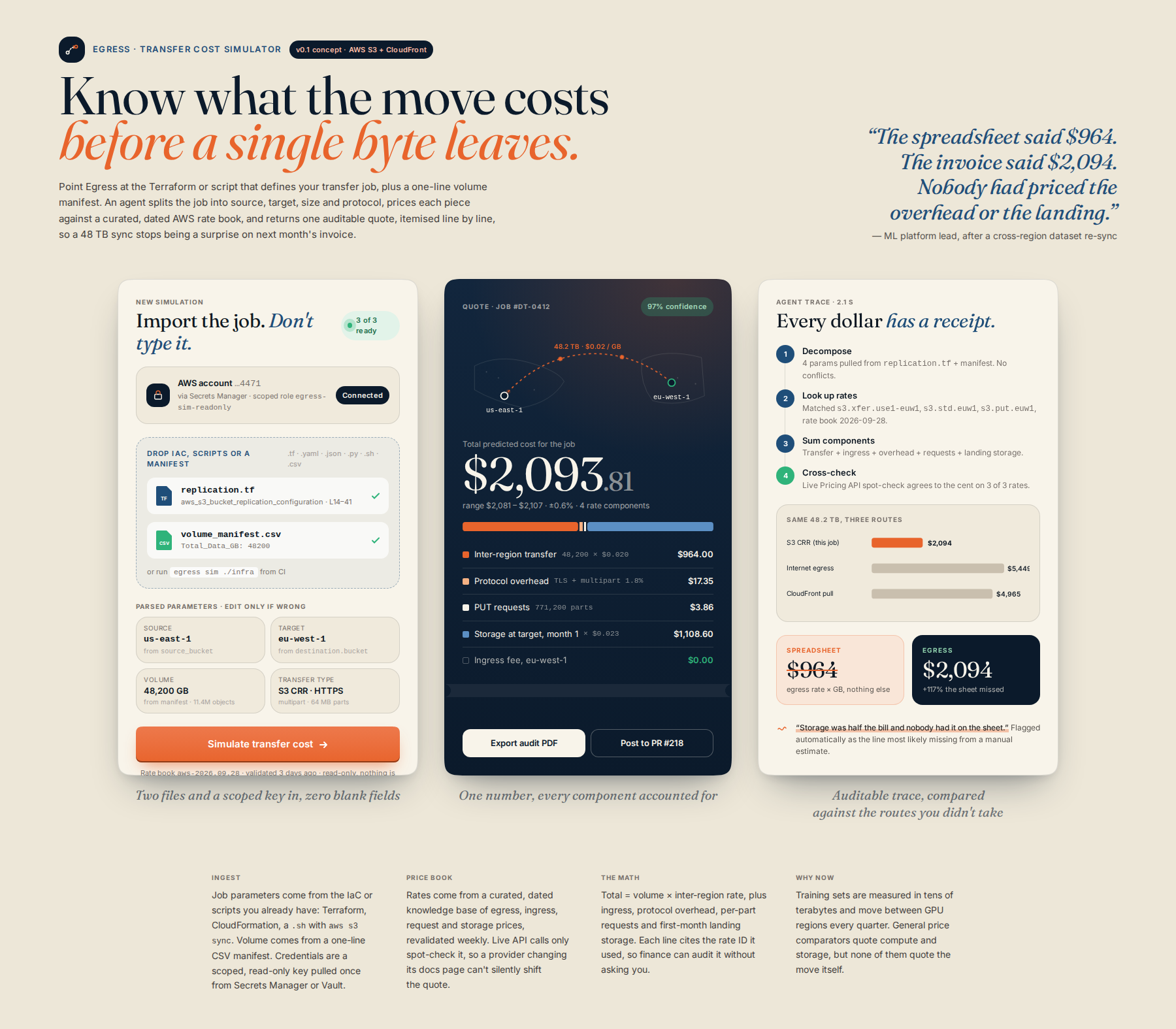
Process flow
Who it's for
ML/AI developers and data engineers migrating or synchronizing large datasets between distinct cloud regions or services.
Why they need it
While compute costs are debated, the hidden, variable costs of data egress and cross-region transfer are a major, predictable source of budget overruns. Current APIs provide complex documentation but no simple, automated simulation tool to calculate the total cost of a multi-gigabyte, multi-stage data movement job.
What it is
A dedicated agentic platform that ingests a defined data transfer job (Source Region A, Target Region B, Data Volume, Transfer Protocol), queries the public pricing API of a major cloud provider (e.g., AWS S3/CloudFront), and outputs a single, highly accurate, and auditable cost prediction for the entire job.
How it works
The user defines a simple data transfer job. The Cost Simulator Agent executes the following steps:
- Decomposes the job into quantifiable parameters (Source Region, Target Region, Data Size, Transfer Type).
- Queries the stable, public API documentation (or a dedicated wrapper for the provider's billing API) using the defined parameters.
- Calculates the total cost by summing the base data transfer rate, the destination region ingress fee, and any associated protocol overheads.
- Presents the user with a single, highly confident total cost estimate and a detailed breakdown (e.g., 'Data Transfer: $X, Storage: $Y').
Differentiation
Unlike manual spreadsheet calculations or simple API documentation lookups, the Data Transfer Cost Simulator automates the aggregation of variable, multi-component billing rates into one actionable quote. It specifically fills the gap of automated, state-aware prediction for data movement costs, a crucial operational concern often overlooked by general comparison tools like s1, s2, or s3.
Implementation sketch
- Scope Reduction: Focus exclusively on simulating the cost of cross-region data transfer (e.g., AWS S3 to AWS S3). This eliminates the need for complex compute reservation logic.
- API Wrapper: Build a single, robust wrapper that only interacts with the provider's public data transfer/egress pricing API endpoint.
- Core Agent Logic: Implement the agent to accept structured inputs (Source Region ID, Target Region ID, Volume in GB) and calculate the total cost by summing the variable rates retrieved from the wrapper.
- UI/UX Simplification: Create a minimal 'What-If' input form that allows the user to adjust the data volume and see the updated cost prediction instantly, proving the core calculation loop.
First step: Research and write a Python script that makes a single, authenticated GET request to the chosen cloud provider's public billing API endpoint, passing only the Source Region and Target Region parameters, and successfully printing the returned rate structure for a fixed 1GB data volume.
Remaining risks
- API Volatility and Maintenance Debt — Cloud providers frequently update their pricing models, API endpoints, and rate structures (e.g., adding new tiers, changing regional codes). The risk is that a single, non-trivial change by AWS/Azure could instantly render the entire simulator inaccurate or broken, requiring immediate, deep engineering intervention and constant 'Pricing Intelligence' monitoring.
- Protocol and Service Complexity Blind Spots — The current scope assumes a direct, simple data transfer. Real-world data movement often involves complex, multi-hop protocols (e.g., VPNs, specialized transfer appliances, or data passing through intermediate services like CDNs). The simulator risks being perceived as a 'best-case scenario' tool, failing to account for the cumulative, hidden costs of these necessary real-world complexities.
- Adoption as a 'One-Time' Tool — If the simulator is perceived solely as a 'pre-run cost check,' the user may use it once and then revert to manual processes or internal spreadsheets for subsequent, iterative data movements. The product must integrate into the development workflow (e.g., a CLI command or CI/CD step) to become a continuous utility, not just a report generator.
Watch for: If the market views the tool as merely a 'pre-purchase calculator' rather than an integrated, real-time component of the developer's operational workflow (e.g., a CLI command or IDE plugin). This indicates the value proposition is limited to planning, not execution. Kill criterion: The inability to reliably source the necessary rate structure data for a core, common use case (e.g., cross-region transfer) due to the provider making the pricing data inaccessible, requiring a shift to a fundamentally different data source or model.
Sources the council used
Real-world evidence that grounded this idea — judge it for yourself.