
Policy-Driven Cost Reconciliation Layer on Observability Data
A foundational software layer that ingests, standardizes, and applies governance policies to existing multi-agent execution logs, transforming raw usage data into auditable, policy-compliant ledger entries for enterprise billing systems.
How can finance teams track and control LLM/AI agent spending across departments?
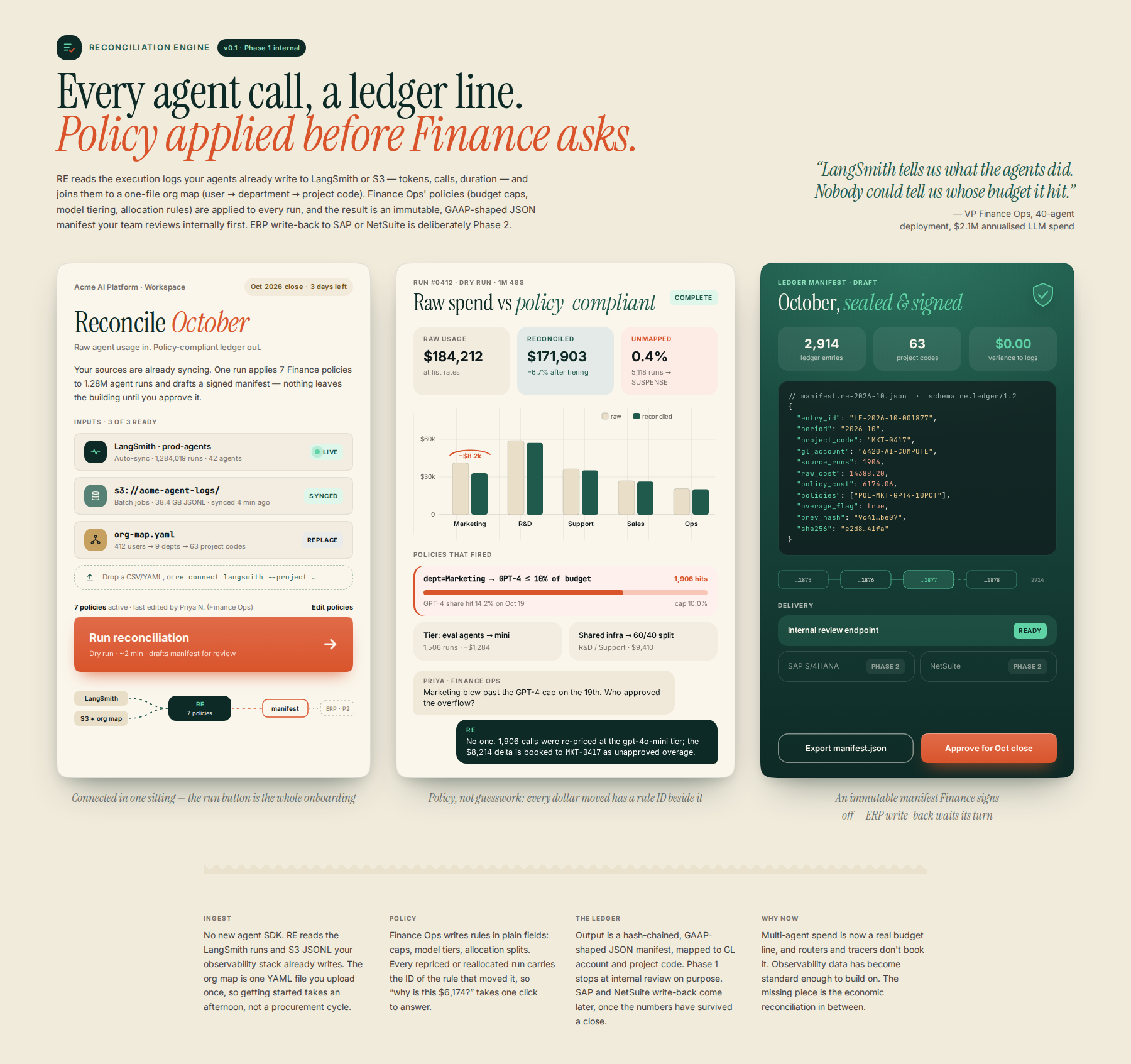
A policy-driven reconciliation layer built on existing observability logs (e.g., LangSmith) can solve this without intercepting every API call. It ingests standardized agent execution logs, applies cost governance rules like budget caps or model tiering per department, and maps usage to project codes, then outputs an immutable, GAAP-compliant ledger manifest for ingestion by ERP systems like SAP or NetSuite. It's built for AI engineering teams, CTOs, and Finance Ops managing multi-agent deployments with unpredictable LLM costs.
Process flow
Who it's for
AI engineering teams, CTOs, and Finance Ops teams managing multi-agent deployments and ballooning LLM API costs.
Why they need it
The rapidly escalating and unpredictable costs of LLM usage require sophisticated cost governance. By building on existing, standardized observability logs (e.g., LangSmith formats), we solve the critical 'economic reconciliation' gap without the prohibitive risk of requiring 100% middleware interception. We provide the necessary governance and structured output required for corporate finance.
What it is
A 'Reconciliation Engine' (RE) that consumes standardized agent execution logs (e.g., JSON output from LangSmith/s3). It applies granular, policy-driven cost controls (e.g., budget caps, model tiering, department allocation) and generates a standardized, immutable ledger manifest ready for API ingestion by corporate ERP/billing systems.
How it works
- The agent execution workflow is modified to ensure all relevant execution logs (tokens, calls, duration) are captured by existing observability tooling (e.g., LangSmith).
- The Reconciliation Engine (RE) ingests this standardized log stream.
- RE applies the defined policies (e.g., 'If department=Marketing, cap GPT-4 usage at 10% of budget for this month').
- RE calculates the final, policy-compliant cost and maps it to a specific project code or user ID.
- Instead of interception, RE generates a standardized, immutable ledger entry manifest (e.g., GAAP-compliant JSON schema) that is pushed to a dedicated API endpoint, ready for ingestion by established enterprise financial systems (SAP, NetSuite).
Differentiation
Existing solutions like 's2' (LLM Router) and 's3' (LangSmith) focus on simple routing or post-hoc observability. Our product is a policy-driven, real-time financial infrastructure layer that solves the 'economic reconciliation' gap. By building on established, standardized observability data streams, we drastically de-risk the initial build, making the governance solution immediately viable for enterprise adoption.
Implementation sketch
- Develop the core data ingestion module that accepts standardized log formats (e.g., LangSmith JSON) and normalizes critical fields (tokens, model name, API cost).
- Build the Policy Rule Engine (PRE) that allows non-technical users (Finance Ops) to define and modify cost governance policies using a structured DSL (Domain Specific Language).
- Develop the Ledger Manifest Generator, which outputs the reconciled, policy-compliant cost data into a standardized, auditable JSON schema designed for immediate API consumption by major ERP systems.
First step: Draft the initial schema definition and validation logic for the Reconciliation Engine (RE) to accept a sample LangSmith-formatted log payload, focusing solely on extracting and normalizing the required metrics (Model ID, Token Count, Timestamp, Associated Project ID).
Remaining risks
- Organizational Inertia and Political Friction — The biggest risk is not technical, but organizational. The reconciliation engine forces visibility into department-specific spending, which often triggers internal turf wars, pushback from department heads who resist having their budgets policed by a centralized system, or resistance from existing internal accounting teams who view the tool as a threat to their established workflow. This friction requires executive sponsorship that transcends technical merit.
- Policy Exhaustion and Ambiguity — The number of necessary governance policies (e.g., 'if task involves PII AND department is Marketing, use Model X AND cap tokens at Y, but only if the associated project code is Z') is functionally infinite and context-dependent. The team risks building a policy engine that is infinitely complex to maintain, leading to a 'policy paralysis' where the system is too difficult to configure for real-world use.
- Data Trust and Ownership Conflict — The system centralizes and interprets the most sensitive business data (how money is spent). If the reconciliation engine's output is perceived as merely suggestive rather than mandatory ledger truth, it fails. The risk is that the system becomes a 'source of truth' that is constantly disputed by different internal stakeholders (e.g., the AI team says the cost is X, the Finance team says the cost must be Y).
Watch for: Consistently receiving feedback that the system's output, while technically correct, is rejected by the end-user department because it conflicts with existing, undocumented internal 'tribal knowledge' or manual budget allocation methods. This signals that the problem is cultural/process, not technical. Kill criterion: The inability to secure a commitment from a major pilot customer's Finance/Accounting leadership that the reconciled ledger manifest will be treated as the final, non-negotiable source of truth for billing purposes, even if it requires significant internal process changes.
Sources the council used
Real-world evidence that grounded this idea — judge it for yourself.