AgentAudit: Compliance Metadata Proxy for Regulated AI Workflows
A lightweight, mandatory middleware proxy that provides auditable, non-invasive metadata logging for high-risk AI interactions, ensuring compliance accountability before full feature development.
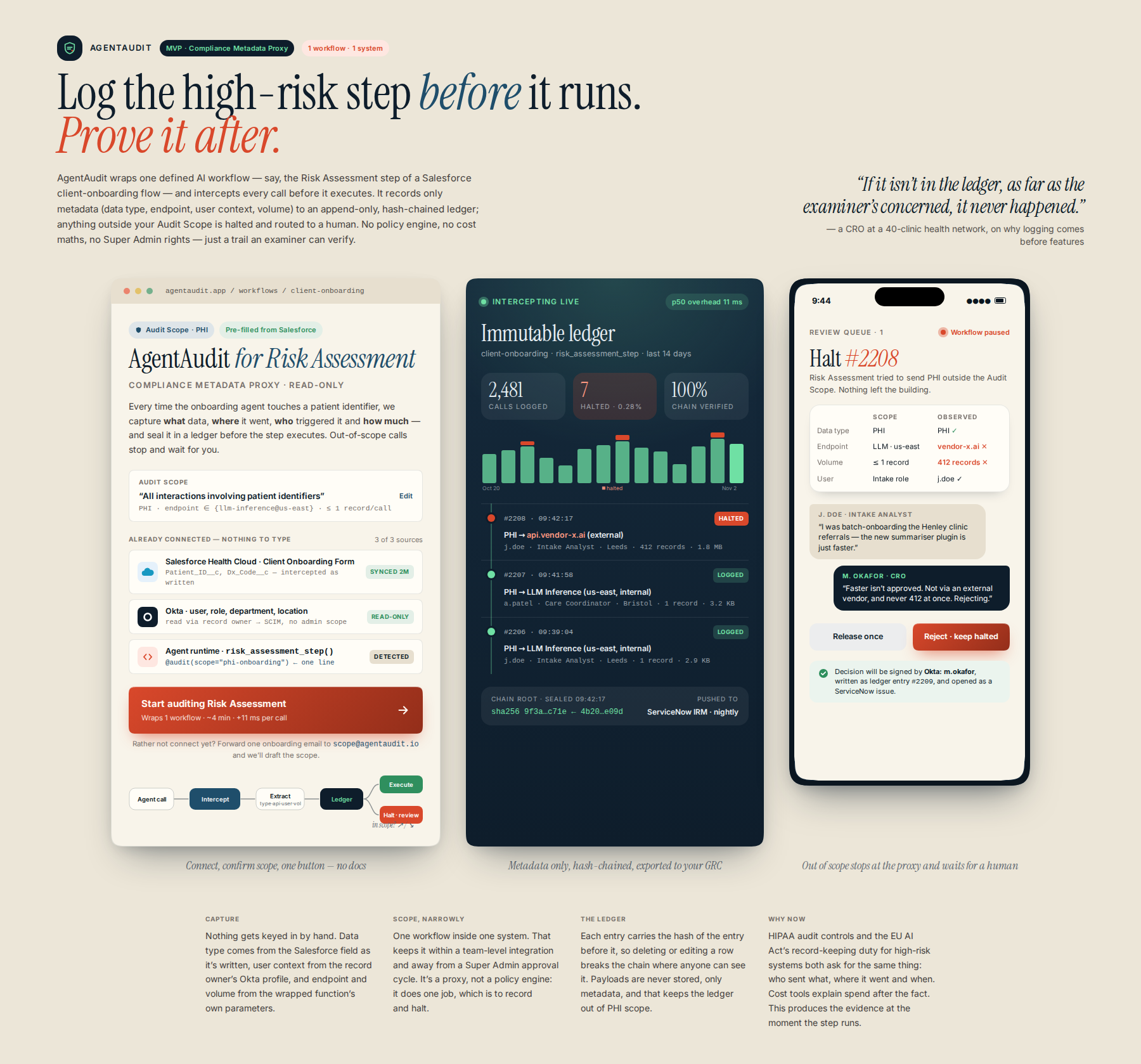
Process flow
Who it's for
Chief Risk Officers (CROs), Legal/Compliance departments, and Enterprise AI Architects in regulated industries (e.g., Healthcare, Finance).
Why they need it
In regulated sectors, the primary immediate risk is not just cost, but the inability to prove who accessed what data, when, and how it was processed by an autonomous agent. Current solutions fail because they are either internal platform features (non-auditable) or purely financial (ignoring compliance logs).
What it is
AgentAudit is an execution-time metadata proxy. It does not attempt to enforce policy or calculate costs yet; its sole function is to intercept the metadata (input data type, API endpoint, user context, and data volume) of a predefined high-risk workflow, log it immutably, and generate a verifiable audit trail.
How it works
The developer initializes the agent with a defined 'Audit Scope' (e.g., 'All interactions involving patient identifiers'). The AgentAudit proxy wraps the workflow execution. Before the agent executes the high-risk step, the proxy intercepts the request, extracts critical metadata (e.g., 'Data Type: PHI', 'Endpoint: LLM Inference', 'User Context: John Doe'), and writes this metadata to an immutable ledger. If the metadata fails to match the Audit Scope, the workflow is halted and flagged for manual review. This MVP limits the technical scope to provable, manageable logging.
Differentiation
We pivot from being a governance layer to a foundational 'Compliance Audit Proxy.' Existing solutions like s1 (Chargebee) or s4 (Specialized Cost Analysis Tools) are purely financial/reactive. AgentAudit provides proactive, immutable logging of high-risk metadata at the point of execution. Crucially, we differentiate by integrating this audit log directly with established enterprise Identity Providers (Okta/ServiceNow) and Governance, Risk, and Compliance (GRC) tools, solving the critical gap of proving regulatory adherence through verifiable, structured metadata.
Implementation sketch
- Define the Scope: Select a single, high-value, low-complexity workflow (e.g., 'Agent summarizing customer service tickets').
- Build the Proxy Wrapper: Create a minimal SDK wrapper that sits between the agent's orchestrator and the target API endpoint (e.g., OpenAI/Anthropic).
- Metadata Extraction: Implement the interception logic to extract key metadata:
user_id,data_type_classification(e.g., PII/PHI),endpoint_called, andinput_token_count.
- Metadata Extraction: Implement the interception logic to extract key metadata:
- Immutable Logging: Write the extracted metadata payload to a verifiable, append-only ledger (e.g., using a blockchain or specialized database like AWS QLDB) for auditable proof of access.
First step: Focus solely on developing a proof-of-concept Python wrapper that intercepts the input payload and response headers of a single, specific API call (e.g., OpenAI completion) and successfully logs the user_id and a simulated data_type classification into a local file or simple database, proving the interception mechanism works.
Remaining risks
- The 'data type classification' mechanism is the single point of failure. If the proxy relies on pattern matching or simple heuristics to classify data (e.g., identifying PHI), it is highly susceptible to evasion (e.g., obfuscated data, base64 encoding, or non-standard formats), leading to critical false negatives and rendering the audit trail legally invalid. — The MVP must immediately pair the metadata logging with a secondary, automated data validation service (e.g., a dedicated ML classification endpoint) that can be updated frequently and audited by the client, moving the liability for classification accuracy away from the proxy itself.
- The 'middleware proxy' model, while technically manageable for an MVP, will face insurmountable inertia in large enterprises. Compliance departments prefer solutions that are native to the core cloud infrastructure (AWS/GCP/Azure) because native integration guarantees platform-level security and maintenance, making the external SDK feel like a compliance loophole. — The product must shift its sales narrative from 'a tool you install' to 'a necessary data-sharing protocol' that connects existing GRC/IdP tools, positioning itself as a compliance data standard rather than a piece of software.
- The defined 'Audit Scope' is too narrow. While limiting scope reduces technical risk, it also limits the market. Regulators will eventually demand full visibility across the entire enterprise data lifecycle, not just the 'high-risk' workflow. The transition from logging metadata to logging full context (including internal state changes and complex data lineage) represents a massive, unforeseen scope creep. — Focus initial sales efforts on a vertical that has a single, highly defined, and legally mandatory data flow (e.g., financial transaction processing in banking) to build deep, defensible domain expertise before attempting horizontal expansion.
Watch for: Any early signal from potential enterprise partners that the compliance requirement is not merely 'logging' (audit) but 'automated remediation' (enforcement). This indicates the pain point is control, not visibility. Kill criterion: If the product cannot demonstrate a clear, repeatable, and low-friction integration pathway with at least two major, established enterprise GRC tools (e.g., ServiceNow GRC, Archer) that allows the audit log to trigger a workflow action (e.g., automatically opening a risk ticket or blocking a user account). If the log is isolated, it is useless.
Sources the council used
Real-world evidence that grounded this idea — judge it for yourself.