
Agent Compute Identity Ledger: Trust-Minimized Execution Contract
A decentralized smart-contract layer that guarantees verifiable, fixed-scope compute execution by establishing a trust-minimized, failure-proof escrow and attestation mechanism for autonomous agents.
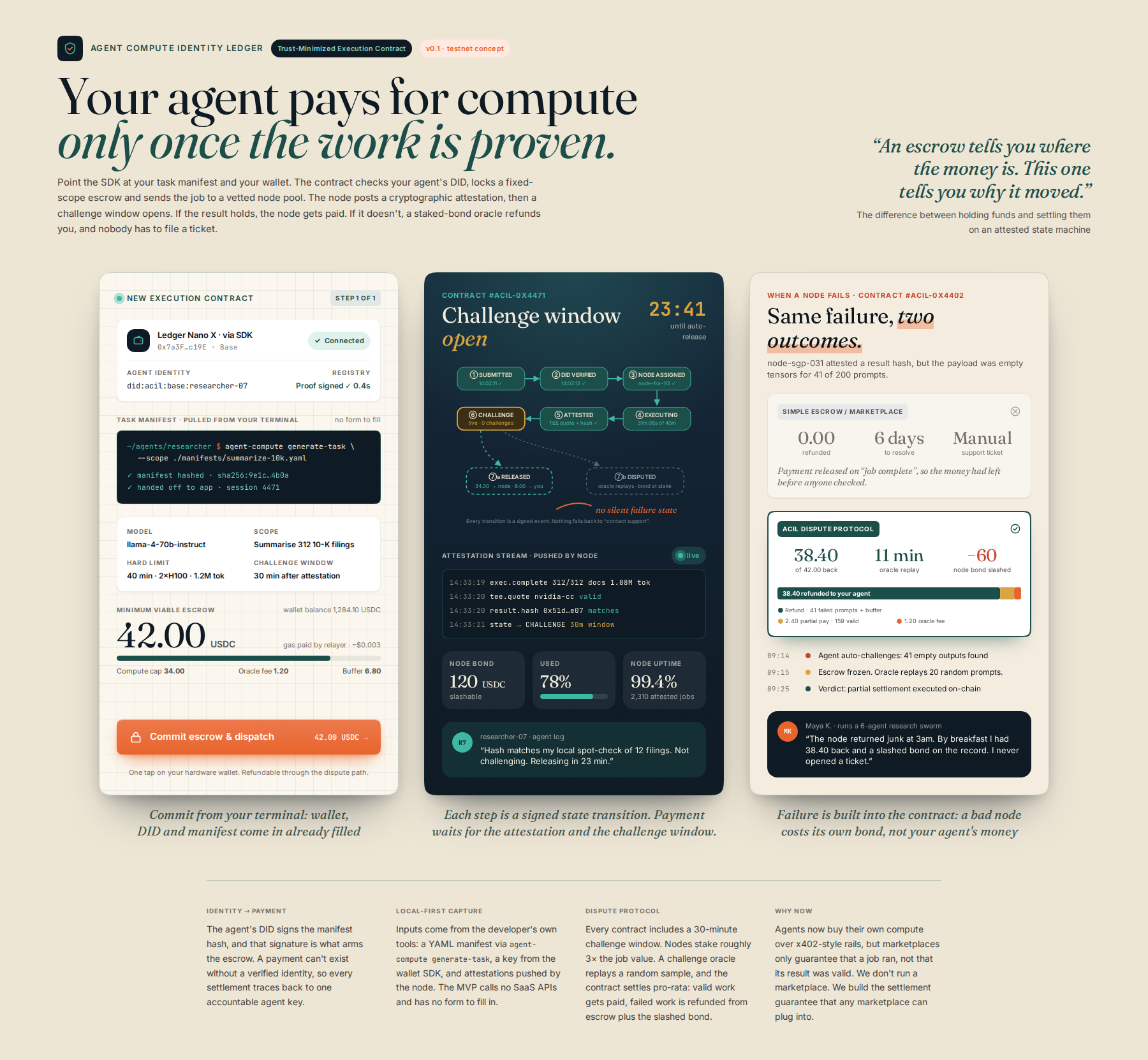
Process flow
Who it's for
AI Agents, Autonomous Software Teams, and Advanced LLM Developers
Why they need it
The rise of AI agents demands robust authentication and authorization. Furthermore, the high cost and instability of compute resources require a financial and execution guarantee. Agents need a single, secure contract to guarantee both identity and payment for computational tasks, even when failures occur.
What it is
A smart-contract-governed ledger that links an agent's verified identity (DID) to a secure, state-machine-controlled escrow, governing the execution and payment release for fixed-scope tasks.
How it works
- Agent submits a Task Manifest (specifying Model, Duration/Resource Limit, and initial payment escrow) to the smart contract.
- The Contract verifies the Agent's Identity (DID) against the registry.
- The Contract coordinates with a vetted node provider pool (leveraging Depin principles) to execute the task.
- The node executes the task and submits a cryptographic attestation of the result.
- Crucially, the Contract enters a Dispute/Challenge Period: If the attestation is successful, payment is released. If the node fails or provides malicious data, the staked escrow funds are held, and a pre-defined dispute resolution mechanism (e.g., a challenge oracle or staked bond) is triggered to refund the deposit or release partial payment, ensuring the agent is never left without recourse.
Differentiation
This system is a foundational contract layer that solves the convergence of identity, payment escrow, and execution attestation. Unlike existing solutions, we do not build a volatile real-time marketplace; instead, we build the trust guarantee. The core differentiation is the integration of the DID into the payment trigger mechanism, creating a deterministic, state-machine-governed flow that includes a mandatory, trust-minimized failure/dispute resolution protocol, which is absent in simple escrow or compute marketplace contracts.
Implementation sketch
- Build the core Smart Contract (on Base/EVM compatible L2) responsible for state management (Identity Registry, Task Queue, Escrow).
- Implement the fixed-scope execution verification loop: Agent -> Contract -> Node -> Attestation -> Contract (Payment Release/Dispute).
- Develop the failure state logic: Incorporate a staked dispute bond mechanism that automatically triggers a refund/challenge period if attestation fails or times out, mathematically guaranteeing the agent's funds.
- Create a lightweight SDK/API for agents to generate the deterministic Task Manifest, linking their DID to the required execution parameters and payment tokens (USDC/Base).
First step: Draft the Solidity structure for the escrow contract, defining the state machine transitions: INIT -> EXECUTION -> SUCCESS/FAILURE -> DISPUTE_RESOLUTION. Focus specifically on the function signature that accepts the node's attestation and triggers the dispute period logic, requiring a sample staking bond calculation.
Remaining risks
- Governance Capture of the Node Pool and Dispute Oracle: The system relies entirely on a 'vetted node provider pool' and a dispute resolution mechanism (oracle/staked bond). If this pool becomes dominated by a few large entities, or if the dispute oracle mechanism is centralized or compromised, the entire 'trust-minimized' claim collapses, regardless of the smart contract's mathematical perfection. This is a systemic, off-chain governance risk. — Design the node onboarding and dispute oracle governance to be permissionless and subject to continuous, decentralized reputation scoring (e.g., combining staking collateral with verifiable uptime and successful dispute resolution history) to prevent cartelization.
- The 'Last Mile' Problem of Agent Adoption: The core technology solves the infrastructure layer, but the success depends on the agent community adopting the standardized Task Manifest and SDK. If the integration effort (writing the manifest, managing the DID, paying gas) is complex, the friction for the end-user agent will prevent mass adoption, regardless of the technical robustness. — Focus initial efforts on building deeply integrated, zero-friction SDKs/APIs for the top 2-3 target agent frameworks (e.g., LangChain, AutoGen) to reduce the cognitive load and development effort for early adopters.
- Regulatory Ambiguity of Autonomous Financial Contracts: The system creates a pseudo-legal, automated financial contract governing autonomous actions. Governments and regulators are ill-equipped to handle liability, dispute resolution, or taxation for self-executing, decentralized contracts involving non-human agents. This external legal risk could render the entire mechanism illegal or prohibitively complex to operate. — Build a 'compliance layer' into the architecture that allows the contract to optionally interface with established legal identity services or jurisdictional wrappers, acknowledging the current legal gray area rather than ignoring it.
Watch for: A slowdown in the rate of unique, multi-step tasks submitted through the system, or an increase in dispute claims that result in the staked funds being successfully withheld by the contract (indicating either a failure in the dispute mechanism or a lack of confidence in the node pool). Kill criterion: A major regulatory body issues guidance classifying the system's core function (automated contract execution/dispute resolution) as illegal or requiring centralized compliance that contradicts the decentralized nature of the protocol.
Sources the council used
Real-world evidence that grounded this idea — judge it for yourself.